

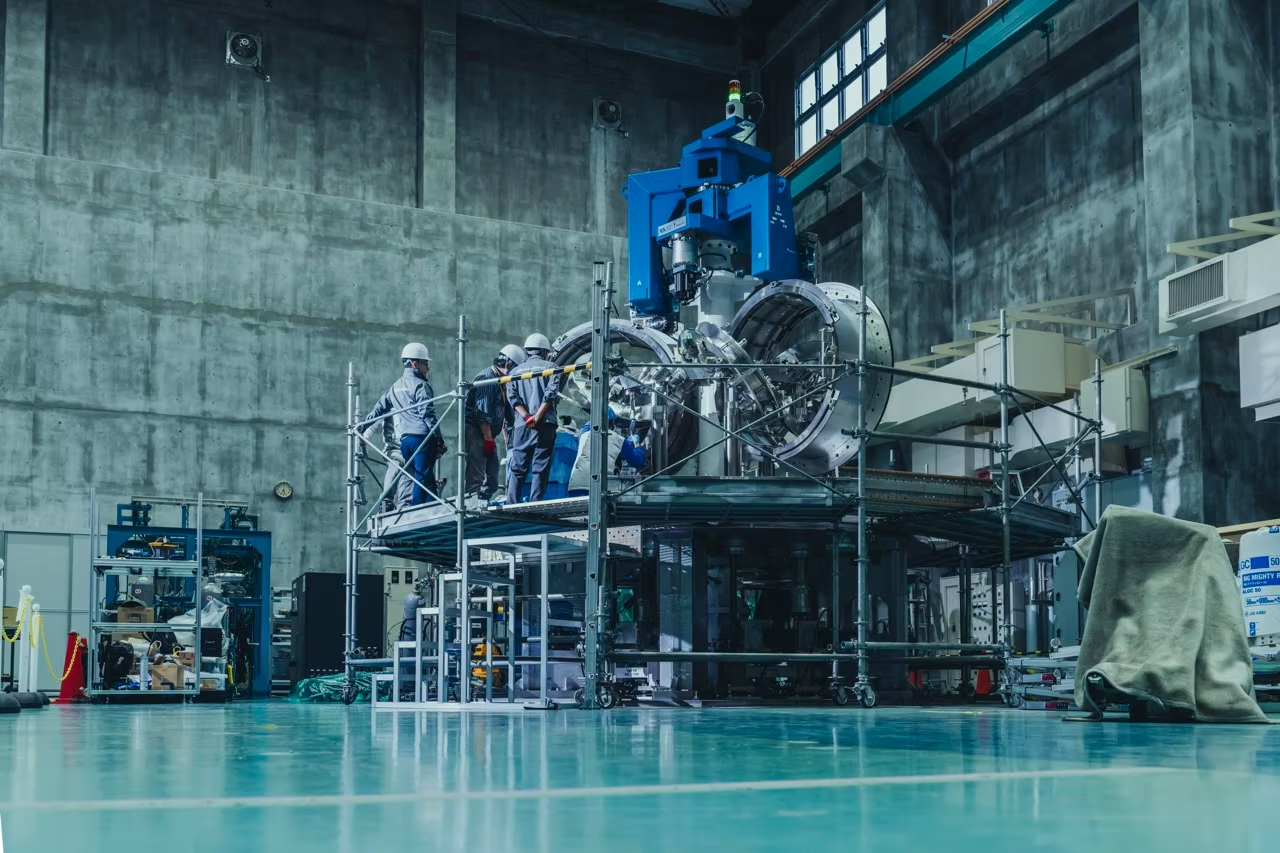
On September 1, 2026, Helical Fusion announced that it had received conditional selection under the Ministry of Economy, Trade and Industry's subsidy program for promoting fusion energy power generation demonstrations. The company uses the helical approach, which confines plasma with externally wound twisted coils, and aims for net power generation sometime in the 2030s.
This decision is neither a construction permit for a power plant nor a ¥60 billion (roughly $400 million) grant awarded to Helical Fusion. The four projects announced by the program's administrators were all given conditional selection, meaning each must first satisfy notified conditions before advancing to formal selection. The scope of each company's project and the amount of funding it receives will be determined later through coordination between the Ministry of Economy, Trade and Industry and the program office.
Still, it's worth noting that this program goes a step further than typical research grants. In addition to plasma performance, the government has made market viability of the power generation system, technical knowledge applicable to commercial reactors, and safety and community engagement all requirements for the demonstration. What's being tested for Helical Fusion is whether its track record with long-duration plasma can be turned into a power generation facility complete with magnets, fuel circulation, heat recovery, and maintenance systems.
Breaking down what the "¥60 billion" actually covers
Cross-referencing the Cabinet Office's program design documents with disclosures from the implementing body clarifies how the funding and selection status break down.
The roughly ¥60 billion figure represents the scale of the entire program covering all four candidates — it is not the amount awarded to Helical Fusion. All four projects remain in conditional selection status, with formal selection and individual funding amounts still to be determined once conditions are confirmed.
| Point | What is confirmed as of September 2, 2026 | What remains undecided or requires caution |
|---|---|---|
| Program scale | Approximately ¥60 billion, including budget authorization for future fiscal years | Not the amount granted to Helical Fusion alone |
| FY2025 supplementary budget | ¥20 billion | Initial budget for the entire program |
| Selection status | All four projects have conditional selection | Formal selection after condition confirmation is not guaranteed |
| Subsidy rate | Up to two-thirds of eligible costs | Companies must still cover the remaining costs themselves |
| Project period | From the grant decision date through February 28, 2029 at the latest | Not the same as the actual 2030s power demonstration period |
| Individual funding amounts | To be coordinated later by the Ministry of Economy, Trade and Industry and the program office | Allocation among the four projects has not been disclosed |
Converting the roughly ¥60 billion figure directly and presenting it as funding secured by Helical Fusion misrepresents how the program actually works. What has been disclosed is the scale of the entire program spanning multiple fiscal years, of which the FY2025 supplementary budget accounts for ¥20 billion. Since the subsidy rate caps out at two-thirds of eligible costs, selected companies will also need a business plan that includes fundraising and covering their own share of expenses.
What the government selected wasn't an approach — it was a narrowing competition
The four projects granted conditional selection differ in both their confinement principles and fuel concepts.
| Lead company | Approach listed in selection documents |
|---|---|
| EX-Fusion, Hamamatsu Photonics | Laser approach |
| Helical Fusion | Helical approach |
| LINEA Innovation | Field-reversed configuration approach combined with beams |
| Starlight Engine, Kyoto Fusioneering | High-temperature superconducting tokamak approach |
This parallel support is not accidental. The government's documents explicitly state that it is currently difficult to determine which fusion system represents the "winning approach." The program therefore backs multiple approaches led by startups and plans to evaluate technical progress, market viability, and implementation capacity after several years. Factoring in international trends, the design is meant to identify which approach the government will continue supporting toward an early power generation demonstration.
Accordingly, this conditional selection cannot be read as "Japan choosing the helical approach." What is clear, conversely, is that candidates for power reactors are not being decided on physics performance alone. The ability to raise funding, build a supply chain, and advance discussions on siting and safety are also factors in the selection.
The distance between 54 minutes of plasma and an actual power plant
In the helical approach, external coils generate a three-dimensional magnetic field that confines the plasma. Because it doesn't rely on driving a large plasma current to generate part of the magnetic field, as tokamaks do, there's no need to sustain continuous current drive, making it easier to avoid disruptions — sudden current collapses that exert large forces on the device. This is the reason the approach is considered well-suited to steady-state operation.
Japan has the Large Helical Device (LHD) at the National Institute for Fusion Science. LHD is an experimental device with a major radius of 3.9 meters, a maximum magnetic field of 3T, and total heating capacity of 36MW, and it has been running plasma experiments since 1998. Its research results include ion temperatures exceeding 100 million degrees and plasma sustainment for 3,268 seconds, or about 54 minutes. However, these are two separate achievements — not records set simultaneously in the same discharge.
Furthermore, LHD is not a power reactor. Between sustaining plasma for a long time and extracting heat from deuterium-tritium reactions, breeding the tritium consumed inside the reactor, and delivering net electricity to the grid after subtracting the power used for heating and cooling, multiple additional systems are required. The physical foundation of long-duration operation is a strength, but it cannot be translated directly into a demonstration of net power generation.
The magnet has progressed from a straight sample to a wound coil
What Helical Fusion has pursued first is a high-temperature superconducting (HTS) magnet. Because helical coils have a continuous, complex shape, it's difficult to remove and replace part of the structure once it's completed. This requires a manufacturing method that can produce a conductor capable of carrying high current, bend and wind it, and maintain superconductivity amid strong electromagnetic forces.
In a peer-reviewed 2025 paper, a 2-meter-long U-shaped conductor was raised to 40kA at 6K and 8T and sustained for 8 seconds. In a separate test, 22kA was run at 20K and 8T over 97 cycles, totaling 164 minutes, with no degradation or quench observed. Meanwhile, the conditions the paper set for the future FFHR-b3 reactor were 20K, 19T, and 52.1kA. Because the test facility's upper limit was 8T, there remains a gap between the test conditions and those expected in an actual reactor in terms of magnetic field and current.
In 2026, the work progressed to a coil wound from the conductor in a double-pancake shape. According to Helical Fusion's announcement, in a test with an initial temperature of 10K and an external magnetic field of 7T, the local magnetic field reached a maximum of 8.9T, and 40kA was sustained for 280 seconds. The electromagnetic force experienced by the conductor was 356kN per meter, and the company said it also confirmed the self-protection of the no-insulation coil against rapid magnetic field changes. The results were published in a peer-reviewed paper at an international conference.
The progression from a near-straight conductor to a wound coil, with current, magnetic field, and electromagnetic force applied simultaneously, is significant. However, the 280-second coil element test is not the same as running the full three-dimensional coil for over a year. In a power reactor, material degradation from neutron irradiation, cooling, and the reliability of connection points must also be evaluated at the same time.
The three walls that HARUKA must integrate
Helical Fusion aims to achieve net power generation with its 2030s power demonstration device, "Helix KANATA," following the integrated demonstration device "Helix HARUKA," targeted for around 2030. HARUKA's role is to measure the interference that occurs when components that worked in individual tests are placed together in the same device.
Magnets: from strength to lifespan
The company's power reactor concept targets continuous operation for over a year and an availability factor above 80%. Locally reaching 8.9T is progress, but the next challenge is maintaining the magnetic field under sustained thermal load and radiation exposure, and being able to safely discharge current in the event of a failure. Because the twisted coil surrounds the core of the device, the difficulty of replacing it is also directly tied to the facility's lifespan.
Liquid metal must carry both heat and fuel at once
The company plans to use liquid metal for both the blanket and divertor functions. The concept is to absorb heat and particles from the plasma, carry heat for power generation, and breed the tritium consumed in the process. While this could reduce the frequency of replacing solid components, it will require verifying the pump power needed to circulate liquid metal within a strong magnetic field, as well as corrosion and containment in the event of a leak.
The 2023 conceptual design paper also left the in-house electricity needed for liquid metal circulation as an undetermined item. Even if the generator's total output is large, if a large amount of power is consumed for magnet cooling, plasma heating, and liquid metal circulation, net power generation will be small. The success of KANATA will be judged not by fusion output itself, but by the electricity balance of the entire facility.
Moving the maintenance plan from paper to remote operations
The same conceptual design outlined a plan to remove 90 blanket modules from the top of the device, replacing 3 to 4 per day, completing scheduled maintenance in about a month. This is a concrete proposal linking maintenance time to availability, but it is not a track record of remote maintenance actually performed. Replacement procedures need to be reproduced in an integrated device equipped with piping, shielding, and working space, with radiation exposure management and waste disposal also timed and measured.
What the 2030s power demonstration will actually measure
The maximum duration of the power generation demonstration promotion program runs through February 2029, which does not align with when KANATA is expected to operate. This period should be understood not so much as a deadline for completing a 2030s demonstration reactor, but as a stage for gathering evidence that will help the government determine which approach to continue supporting. A mechanism is also in place to reconsider continued support based on progress toward milestones.
Helical Fusion says it is manufacturing and constructing a demonstration facility for HARUKA's HTS magnet at the National Institute for Fusion Science in Toki City, Gifu Prefecture, and is developing the project with more than 30 domestic companies. If the project advances to formal selection, the next things to watch will be not just the funding amount, but what magnetic field strength, operating duration, and scope of integration the company commits to achieving by February 2029. The scale at which it demonstrates heat recovery and tritium management for the liquid metal system, as well as remote maintenance, will also serve as key indicators.
With this decision, the helical approach has moved from being an extension of a research device to a candidate for a power demonstration with deadlines and program conditions attached. However, the superiority of this approach has not yet been settled, either politically or technically. The path forward involves first confirming whether the notified conditions can be met to advance to formal selection, then expanding the wound-coil tests to the integrated device, and finally measuring net power generation and availability factor in practice. Following each of these stages without skipping ahead is the shortest way to gauge just how realistic the vision of a "continuously operable fusion reactor" really is.