

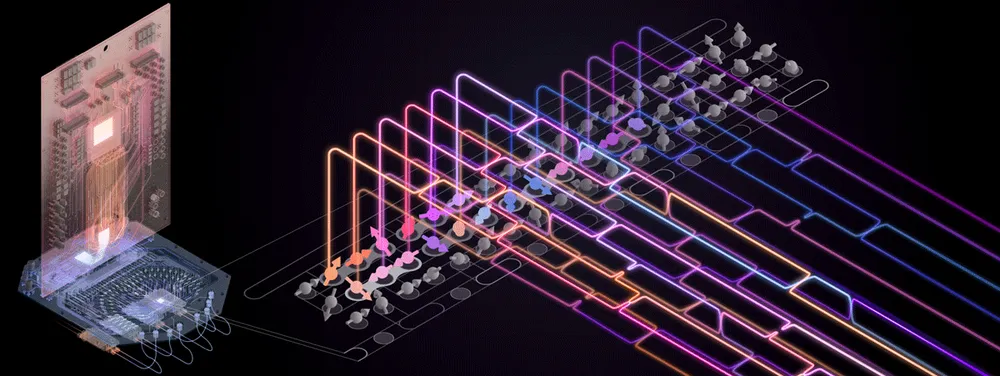
On July 29, 2026, HRL Laboratories published results in Nature showing that it integrated a cryogenic CMOS controller and silicon qubits within a single dilution refrigerator, executing a repetition code without receiving real-time commands from room-temperature equipment. The device can configure up to 18 qubits from 54 quantum dots, and for the distance-5 repetition code, the logical error rate was 4.7 times lower than that of a distance-3 subsystem extracted from the same data.
HRL describes this device as a "self-driving quantum processor." In reality, it is not a machine that autonomously devises quantum algorithms. What is novel is that a 4K control chip executes a previously written instruction sequence, eliminating the configuration in which a room-temperature waveform generator continuously sends pulses one at a time. Before increasing the number of qubits, this research addressed the growing problem of control wiring and heat generation using semiconductor manufacturing techniques.
A 4K Controller Removes the Room-Temperature Rack From the Real-Time Path
HRL's quantum processing unit (QPU) consists of a control board operating at 4K, a qubit substrate in the millikelvin range, and superconducting ribbons connecting the two. The qubits are "exchange-only" type, encoding information in the combined spin of three electrons confined in a Si/SiGe quantum well. Rather than inducing resonance with microwaves, the exchange interaction between quantum dots is switched using voltage pulses, making it well-suited for combination with baseband signals generated by cryogenic CMOS.
The control chip is fabricated using commercial 130nm RF CMOS and carries approximately 70 million transistors. Multiple sequencers operating at up to 250MHz read user programs from a 6,144-word instruction memory. After a program is initialized, it can process instructions without additional communication with room-temperature equipment. Power consumption during typical operation is below 3.5W.
The analog section features 156 outputs, 366 DACs, and 78 pulse generators. 150 time-varying control signals are generated on the 4K side and sent to the qubits along with 35 static bias signals. Pulse widths can be set from 400 picoseconds to 6 nanoseconds. The design shifted from routing precise analog waveforms from room temperature to each qubit, to instead passing digital instructions to the cryogenic side.
From the perspective of qubits with an average electron temperature of 150mK, the 4K chip represents a substantial heat source. To address this, HRL arranged 296 niobium wires on approximately 1cm-wide polyimide. This keeps adjacent crosstalk below −80dB up to 10GHz while limiting heat transfer from the 4K stage to the mixing chamber to under 10 microwatts. The round-trip signal delay is approximately 3 nanoseconds. Simply relocating the controller to low temperature would not have worked; the co-design of high-density wiring that resists heat transfer proved essential.
Running 200 Rounds at an Average CNOT Error Rate of 0.35%
The peer-reviewed published version shows an average gate error rate of 0.017% for single-qubit operations and 0.35% for CNOT. The lowest reproducible CNOT error rate was 0.09%. The CNOT operation arranges 37 exchange pulses across 45 time steps, with pulse intervals adjusted between 12 and 28 nanoseconds. Since HRL's 2023 two-qubit experiment achieved an encoded CNOT fidelity of 96.3%, this improved average is consistent with the paper's assessment of roughly an order-of-magnitude improvement in error rate.
Not all of this improvement can be attributed to the quantum dot material itself. Intrinsic charge noise was reduced to less than one-tenth that of previous HRL devices, and the combined contribution of charge and magnetic noise to CNOT errors was estimated at only 0.02 percentage points. What dominated the observed errors were static magnetic field gradients and context-dependent deviations in pulse waveforms. In spin-level simulations, calibration-drift terms set to match the measured CNOT errors accounted for approximately 80% of detection events. This is a model-based attribution of causes, not a directly measured proportion.
The distance-5 repetition code used 5 data qubits and 2 ancilla qubits. Syndrome extraction was varied from 1 to 200 rounds, with 50,000 shots repeated at each point. A single instance of 200 rounds alone involved 1,805 initializations, 805 measurements, and 335,422 exchange pulses. The logical error rate for distance-5 was 0.50%, while the average for the distance-3 subsystem within the same experimental data was 2.4%, yielding an improvement factor of 4.7 when increasing the code distance. However, the distance-5 data still exhibited unexplained variation in error rates.
In a separate 6-physical-qubit experiment, a [[4,2,2]] error-detecting code embedding 2 logical qubits into 4 data qubits was run for 3 rounds. When approximately 77% of the 10,000 shots per input state were discarded based on detection results, the fidelity of the 2-logical-qubit state reached 0.95. The average ignoring detection results was 0.59. The high value of 0.95 does not represent performance after correcting all shots, but rather the value after excluding trials where errors were detected.
What "Self-Driving" Refers To: Instruction Execution and Some Automated Tuning
What makes the cryogenic controller autonomous is that it interprets written instructions at each clock cycle and updates analog output settings. Qubit readout signals are still digitized at room temperature today, and room-temperature systems also supply static current and voltage biases. Both manual and automated methods were used to determine the biases applied to electrodes. Therefore, this is not a device from which electronics outside the refrigerator have been removed entirely.
The tuning software "Quiver" includes automated routines for loading electrons into each quantum dot and adjusting tunnel coupling. The convolutional neural network that reads charge stability diagrams was trained on thousands of human-labeled data points. The supplementary materials also show a tree-structure recording of the sequence of actions used to fully automatically tune a single qubit, providing a mechanism to later trace the success or failure of unattended operation lasting hours to days. Measuring multiple locations in parallel accelerated the electron-loading process by 4 to 5 times.
Even so, the device does not autonomously handle arbitrary failures on its own. Due to variability in materials and manufacturing, tuning is exploratory, and humans have built in processes to return from dead ends to known states. This "self-driving" combines a deterministic cryogenic sequencer with tuning software that includes conditional branching—it is not a result demonstrating that general-purpose AI can replace researchers.
Beyond 18 Qubits, Walls of Wiring Manufacturing and Power Remain
HRL demonstrated a universal 2-qubit gate using 6 quantum dots in 2023, and in 2025 reported single-qubit fidelity exceeding 99.9% using a scalable 2D array with 3-layer wiring. This chip arranges 54 quantum dots in three rows, configurable into a 3×6 grid supporting up to 18 qubits. The advance lies in integrating logic gates, 2D wiring, and cryogenic control into a single device capable of running error-correction protocols.
However, the distance-5 experiment used only 7 physical qubits, and the [[4,2,2]] experiment used 6 physical qubits—the full set of 18 qubits was not error-corrected as a whole. The types of errors protected against by the repetition code are also limited, and [[4,2,2]] is a scheme that detects errors and discards the corresponding trials. Interconnects and back-end qubit-side wiring suitable for scaling to mass production, control power per qubit, and device uniformity are all listed by the paper itself as unresolved issues. System-wide error-correction designs tailored to exchange-only qubits will also be needed.
Six days before this announcement, IBM finalized a definitive agreement to acquire HRL from Boeing and General Motors. Among the items IBM cited in its acquisition announcement were spin qubits along with cryogenic technology and control electronics. Interconnects and packaging were also included. This QPU serves as evidence that these surrounding technologies have reached the point of operating together as a single device. However, the acquisition is subject to regulatory approval and other conditions, with completion expected by the end of Q3 2026. How HRL's research results will be incorporated into IBM's product plans will need to be confirmed through the roadmap following deal completion.