

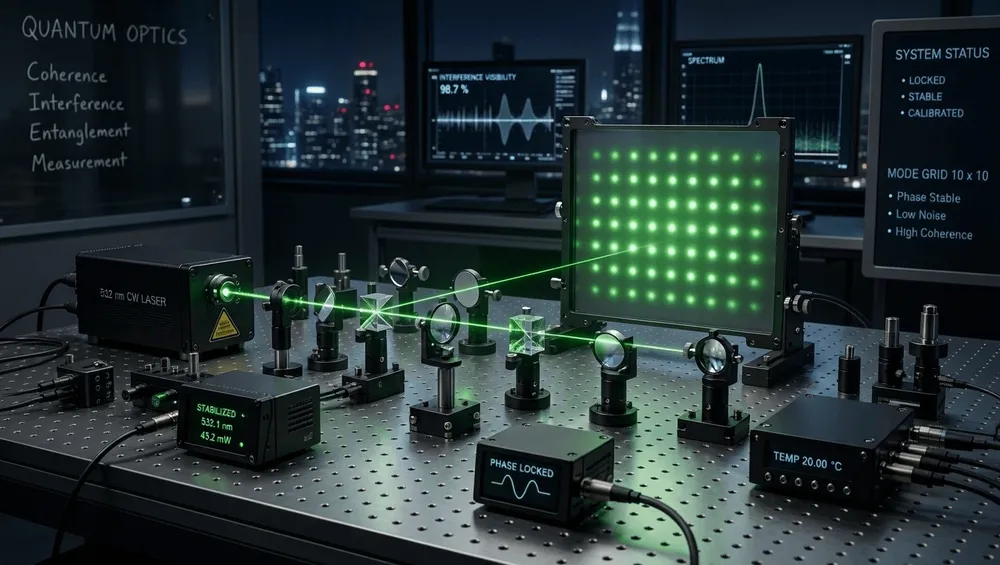
Among countless mirrors and lenses arranged on an optical bench, a laser beam is split into a microscopic 10-by-10 grid of light spots. Onto those 100 independent points of light, a bright-and-dark pattern spelling out the letter "Q" was superimposed. The instant the physical state of the light wave was measured on the sender's side, that quantum waveform information was reconstructed in the light grid of the receiver's optical system.
This is not the kind of "teleportation" that typically comes to mind—matter itself did not vanish from one place and reappear in another. What was transferred were the continuous quantum states—amplitude and phase—carried by each of the 100 independent spatial modes. A research group led by Professor Jietai Jing at the State Key Laboratory of Precision Spectroscopy at East China Normal University succeeded, at laboratory scale, in performing quantum teleportation while simultaneously controlling 100 spatially separated optical channels.
This work presents a new optical approach for scaling up the parallel-processing capacity of quantum networks. Previous quantum teleportation research had been limited to single channels or small-scale multiplexing, facing the engineering challenge that adding even one more channel required an entirely new detector and electronic control circuit. This study offers a solution through spatial light modulation combined with all-optical feedforward, enabling unified control of many channels at once.
The peer-reviewed physics paper behind the 100-channel quantum teleportation result
The achievement was accepted by Physical Review Letters, a flagship journal published by the American Physical Society, and appeared online on August 20, 2026 (Vol. 137, Iss. 8, article number 080801, DOI: 10.1103/rfz9-3prw). The paper is titled "Hundred-Channel Reconfigurable Quantum Teleportation." According to publicly available information on the review timeline, the manuscript was received on March 27, 2026, a revised version was submitted on June 10, and it was formally accepted on June 30.
- Measured Fidelity
- Classical Limit
データを表で見る
| Measured Fidelity (Fidelity (0-1)) | Classical Limit (Fidelity (0-1)) | |
|---|---|---|
| 100-Channel Average | 0.6 | 0.52 |
As the chart shows, the average fidelity of 0.60 achieved by the research team significantly exceeds the upper bound of 0.52 attainable through classical communication alone. This numerical gap serves as physical evidence that quantum entanglement genuinely contributed to the transfer process.
Yanbo Lou and Jiabin Wang served as co-first authors with equal contributions, with Yuyan Zou, Lingyue Hou, Shengshuai Liu, and Jietai Jing listed as co-authors. Liu and Jing serve as corresponding authors. The research was based primarily at the State Key Laboratory of Precision Spectroscopy at East China Normal University in Shanghai, with participation from researchers at the CAS Center for Excellence in Ultra-intense Laser Science, Shanxi University, and Zhejiang Normal University.
The American Physical Society selected this paper as an "Editors' Suggestion." In addition, Physics, the society's science-writing outlet, published a synopsis article titled "Teleporting More Quantum States at Once" on August 20, 2026, introducing the work as a new optical method supporting the scale-up of large quantum networks.
A note on access limitations is warranted here. What is freely available on the American Physical Society's public page is limited to the abstract, basic bibliographic details, and the synopsis article. Access to the full text of the paper, detailed measurement-distribution data in the supplementary materials, and the complete list of references requires a subscription. Technical details regarding the specific arrangement of optical components and the control system were cross-checked against the abstract registered on INSPIRE-HEP and author interviews reported by technology outlets such as IEEE Spectrum and ScienceAlert.
How spatial light modulation and all-optical feedforward enabled parallelization
The physical principle of quantum teleportation traces back to the theoretical framework proposed by Charles H. Bennett and colleagues in 1993. A sender and a receiver share a pair of particles that are quantum-mechanically entangled beforehand. The sender performs a joint measurement combining an unknown quantum state on hand with the entangled particle. The measurement result is sent to the receiver over a classical communication channel, and the receiver applies an appropriate unitary transformation to their particle based on that result, thereby reconstructing the original unknown state on the receiving end.
The greatest constraint facing previous experiments has been the scaling-up of equipment that accompanies channel multiplexing. Adding one more quantum channel has traditionally required an entire additional system of entangled-photon sources, photodetectors, high-speed electronic processing circuits, and optical modulators. In contrast, Professor Jing's team designed a structure that processes 100 channels together within a single optical system by incorporating spatial light-wavefront patterning technology.
The process of this parallel optical architecture can be organized into four major stages. First, light from an approximately 1-watt pump laser source is directed onto a spatial light modulator (SLM) displaying a phase hologram based on a weighted Gerchberg-Saxton algorithm. The SLM converts this single beam into 100 independent spatial modes arranged in a 10-by-10 grid. Next, this set of 100 spatial channels is loaded with an input signal—the amplitude and phase quadrature components corresponding to the shape of the letter "Q"—and combined with 100 pre-prepared pairs of entangled light fields.
The subsequent operation is all-optical feedforward performed without any electronic circuitry. Rather than detecting the light on the sender's side and converting it into an electrical signal, the feedforward operation for all 100 channels is executed at once through direct interference between light waves. Finally, on the receiving side, the quantum states of the optical fields corresponding to each of the 100 pixels are reconstructed while preserving fidelity.
Two elements underpin this system. The first is holographic technology based on the weighted Gerchberg-Saxton algorithm. A computed phase pattern is displayed on a liquid-crystal device called a spatial light modulator, and passing laser light through it generates 100 independent spatial modes arranged in a 10-by-10 grid. Unlike conventional multiplexing that superimposes frequencies or other properties within the same beam, these modes behave as 100 spatially separated, independent channels.
The second element is the implementation of "measurement-free all-optical feedforward." In ordinary continuous-variable teleportation, homodyne detection is performed on the sender's side, and the resulting current signal is amplified by an electronic amplifier to drive an electro-optic modulator on the receiver's side. However, once the channel count reaches 100, the wiring and synchronization needed to operate 100 sets of high-speed detectors and electronic circuits in parallel becomes an enormous burden. The research team instead built an optical system that directly interferes light waves to combine phase and amplitude, performing the feedforward operation for all 100 spatial modes at once without any electronic processing.
Speaking to IEEE Spectrum, Professor Jing noted that conventional teleportation could send only one quantum state at a time, and that realizing large-scale networks required technology to "simultaneously generate, align, and manipulate many quantum channels." What this experiment handled was not discrete-variable (DV) information encoded as the presence or absence of single photons, but continuous-variable (CV) physical quantities—the amplitude and phase quadrature components of light waves. The state of the minute fluctuations inherent to the optical field itself was transferred through 100 parallel optical channels.
Correcting the popular notion of "image transfer" and gauging the meaning of a 0.60 fidelity
When this research was covered in science media, headlines proclaiming that "an image was teleported" proliferated. Taking that phrasing at face value, however, misses the essence of the experiment. Nothing was transmitted as electronic image data the way a household scanner or fax machine works, nor did a picture drawn on paper vanish and reappear elsewhere.
What was used as the input signal in the experiment was a 100-dimensional optical field pattern, in which each spatial mode arranged in the 10-by-10 grid was treated as a single "pixel," collectively forming the shape of the letter "Q." As Professor Jing explained to ScienceAlert, what was actually transferred was "the continuous-variable quantum state of the optical field at each spatial mode, characterized by its amplitude and phase quadrature components." The distribution of quantum-mechanical fluctuations in the light wave corresponding to each pixel was transferred to the receiving side via the entangled optical fields.
The metric used to gauge the precision of quantum state transfer is called fidelity. Fidelity takes a continuous value from 0 to 1, with 1.00 corresponding to perfect state transfer. A crucial benchmark in quantum mechanics is the "classical limit." If entanglement is not used, and instead classical measurements are taken and their values communicated so the state can be reconstructed on the receiving end, measurement noise arising from the uncertainty principle is inevitably introduced. As a result, the transfer fidelity achievable through classical communication without entanglement cannot exceed a theoretical upper bound, no matter how sophisticated the equipment.
The classical limit for this experiment's optical system was calculated to be 0.52. As long as fidelity remains within the range of 0 to 0.52, it falls within territory achievable by classical communication alone. However, the average fidelity measured across all 100 pixels in this experiment reached 0.60. According to the research team's report, fidelity exceeded the classical limit of 0.52 in every one of the 10-by-10 spatial modes.
An average fidelity of 0.60 might seem coarse when judged by the standard of ordinary photographic transfer quality. But in quantum mechanics, the difference between 0.60 and 0.52 carries decisive significance. It demonstrates that all 100 channels simultaneously crossed into territory that classical measurement and communication cannot, in principle, reach. This gap of 0.08 stands as evidence that the nonlocal correlation of quantum entanglement was indeed at work in the propagation of the light waves.
It should be noted that the publicly available academic information and press materials do not specify error bars for individual channels or variance data including best and worst values. For now, one must treat the average value of 0.60 as the baseline while awaiting future replication studies and the release of more detailed data regarding channel-to-channel variability.
Reported figures versus the state of the art
To accurately grasp the contours of what the research team achieved, it is useful to objectively separate the demonstrated facts, the authors' claims, and their plans for future development.
| Evaluation criterion | This study's reported value/configuration | Comparison baseline / prior state of the art | Nature and limits of the evidence |
|---|---|---|---|
| Number of parallel channels | 100 spatial modes (10×10 grid) | 1 channel, or limited multiplexing | Confirmed by measurement on a laboratory optical bench |
| Average fidelity | 0.60 | Classical limit: 0.52 | An indicator of quantumness; exceeded across all 100 modes |
| Feedforward method | All-optical (no measurement, no electronic processing) | Modulation via detectors + electronic circuits | A mechanism for controlling 100 channels at once |
| Pump laser power | Approx. 1 W (primary limiting factor) | Typical lab-grade CW laser | A physical constraint cited by the authors |
| Future plans | Scaling to 1,000 channels | 100 channels (this study) | A goal set by the authors (not yet demonstrated) |
| Transmission path | Free-space arrangement on an optical table | Optical fiber or satellite links over tens to hundreds of km | No distance-based demonstration data |
Regarding the scale of the experiment, Professor Jing stated, "As far as we know, this is the largest number of independently controllable quantum teleportation channels ever demonstrated simultaneously." This statement should be read with due caution. It reflects the lead researcher's own assessment and has not been certified as an absolute world record by any independent third-party body.
Most prior research had been limited to either long-distance transmission over a single channel using a single photon pair, or multiplexing across a handful of channels using orthogonal polarizations or frequency modes within the same beam. In conventional approaches requiring separate electronic circuitry for each channel, increasing the channel count led to a rapid expansion in equipment scale. The value demonstrated by this study lies in its "architectural scalability." Through holographic wavefront control and all-optical operations, the team showed that parallelism can be pushed up to 100 without inflating the system scale by a factor of 100.
Behind the American Physical Society's Physics synopsis succinctly summarizing this work as demonstrating "a method that helps quantum networks scale up by teleporting a 100-pixel image" lies this kind of appreciation for engineering rationality. Professor Jing has expressed the outlook that "in principle, this architecture could provide a flexible, high-capacity interface for future quantum communication networks"—but this is merely a statement of design-level possibility, not a description of an already-completed network function.
What must not be conflated here are two distinct axes of development: communication capacity, or the expansion of parallelism, and the expansion of transmission distance. In the field of quantum communication, transmission over tens of kilometers or more via optical fiber networks, and long-distance teleportation exceeding a thousand kilometers via satellite relay, have been reported. Most prior research has focused on transferring a single channel or a limited number of degrees of freedom. This study is an experiment in spatial interfacing that processes 100 modes in parallel on the same optical bench; extending transmission distance itself was not its objective.
The one-watt wall blocking implementation, and the challenges still to be verified
Results obtained in the laboratory do not immediately translate into a practical quantum communication infrastructure. The authors themselves candidly acknowledge the physical limitations of the current system in their discussion.
The single greatest factor determining the upper limit of the 100-channel array scale was the laser power available to drive the optical system. The pump laser used in this experiment had an output of approximately 1 watt. Splitting the beam into 100 microscopic spots via the spatial light modulator, while generating sufficient quantum entanglement at each spot through nonlinear optical effects, becomes a major constraint as the light's intensity is distributed across each channel. Increasing the channel count further will require the development of more powerful laser sources and low-noise optical amplifiers capable of amplifying the divided, faint light with high fidelity.
Professor Jing revealed to IEEE Spectrum that the research team is currently working toward "building a 1,000-channel system" by introducing higher-power lasers and higher-performance optical amplifiers. However, this remains a goal on the team's roadmap; operation at 1,000 channels has not yet been confirmed. A tenfold increase in channel count would cause geometric- and wave-optical issues—such as optical component aberrations, thermal lensing effects, and crosstalk between spatial modes—to grow nonlinearly.
A sober assessment of the experimental environment is also necessary. All measurements in this study were conducted on a laboratory optical bench where vibration and temperature fluctuations were highly suppressed. The work did not include free-space links propagating over long distances through the atmosphere, or experiments transmitting 100 spatial modes without distortion through laid optical fiber cables. In multimode fiber communication that transmits multiple spatial modes within an optical fiber, dispersion and coupling between modes are unavoidable. Technology to compensate for these effects while preserving quantum states remains an area that has not yet been sufficiently established.
From the standpoint of academic verification, as noted earlier, there are access constraints requiring a subscription to view detailed raw data and supplementary materials. In addition, at this stage the achievement is a single experimental report from Professor Jing's group, and no independent replication or confirmation of reproducibility by other research groups has yet been conducted.
The establishment of a method capable of all-optically controlling 100 spatial channels in parallel for continuous-variable quantum teleportation represents a promising step toward realizing high-capacity quantum interfaces. However, several hurdles remain before it can function as a practical quantum repeater or terminal for inter-city quantum networks: overcoming the constraint of pump light intensity, addressing wavefront distortion over long-distance transmission paths, and achieving reproducibility of the measurement results through independent third-party verification.