


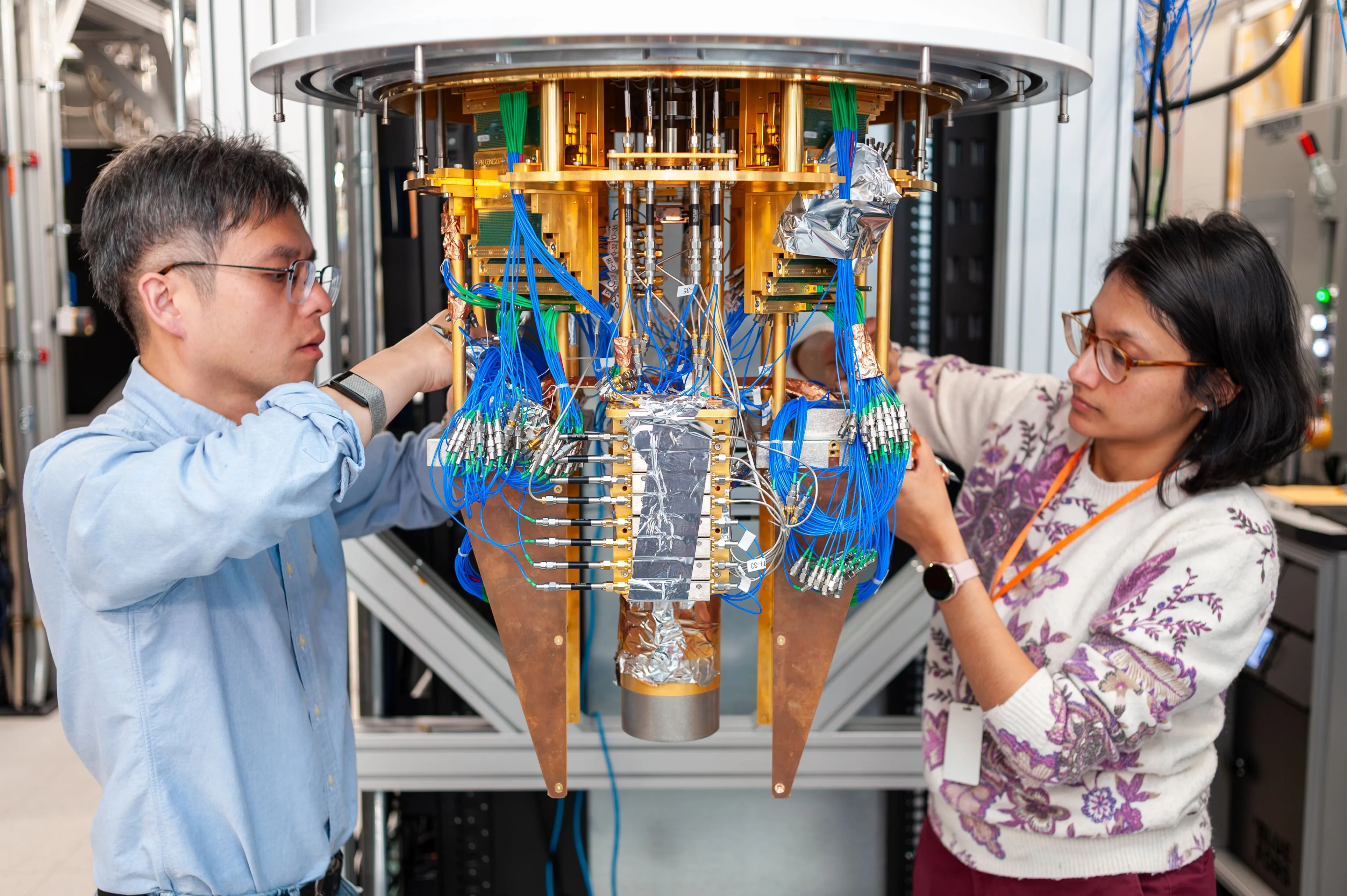
An IBM research team has connected two quantum processors, each carrying 120 qubits, with four superconducting cables and transferred quantum states between them with an average fidelity of 99.00%. According to the results IBM announced on October 27, 2026, each connection uses an 80 cm cable, and the two chips sit in the same dilution refrigerator. The team demonstrated not only quantum state transfer but also remote quantum gates, which perform operations between qubits on different chips, and the generation of entanglement across the chips.
The work was led by Neereja M. Sundaresan of IBM Research and a team of 42 researchers. The paper describing the results, "Meter-scale quantum interconnects between large quantum processors", was posted to arXiv on October 21 and is currently a non-peer-reviewed preprint. The experiment used two "IBM Quantum Nighthawk R1" processors, each with 120 qubits, but only a subset of qubits near the connections was wired for measurement. The team therefore has not demonstrated a quantum computation that coordinates all 240 qubits.
The reported 99.00% figure is the fidelity of the operation that transfers a quantum state from a qubit on one chip to a qubit on the other. It does not represent the fidelity of remote gates between qubits on different chips, nor the accuracy of an entire quantum computation. To judge how far multiple quantum processors can be used as one system, state transfer, remote operations, and entanglement generation each need to be evaluated separately.
What does 99% fidelity mean?
The new connection technology, the "L-coupler," is not just a cable. It refers to the whole interconnect system, including dedicated frequency-tunable "L qubits," tunable couplers, on-chip wiring, and the joints with the cables. State transfer uses a standing-wave mode of about 5 GHz formed inside a superconducting aluminum coaxial cable, which lets quantum information pass between L qubits on distant chips.
In quantum computing, "fidelity" measures how closely an actual quantum state or operation matches the target state or ideal operation. Besides state transfer between L qubits, the team evaluated CZ gates between computational qubits on each chip. A CZ gate is a two-qubit gate that changes phase depending on the states of the two qubits, and it is also used to generate entanglement. The team also worked on generating GHZ states, in which multiple qubits share entanglement.
The table below summarizes the main experimental results based on Table 1 and the Methods section of the paper.
| What was evaluated | Method and conditions | Measured value |
|---|---|---|
| Quantum state transfer | Each of the four connections evaluated bidirectionally, using a network benchmark that excludes errors from state preparation and measurement | Average 99.00% |
| Remote CZ gate | Sequence of operations between computational qubits on different chips, evaluated with randomized benchmarking; average of the four connections | 94.75% |
| 6-qubit GHZ state | Entangled state spanning three qubits on each chip; before readout-error correction | 67.67±0.66% |
The state-transfer figure of 99.00%, the remote CZ gate figure of 94.75%, and the 6-qubit GHZ figure of 67.67% each measure a different thing. The differences in size therefore cannot be read directly as performance gaps or improvement rates between operations.
State-transfer fidelity was at least 98.86% on all four connections, and reached 99.29±0.07% on the best-performing one. The highest remote CZ gate fidelity, by comparison, was 96.42±0.28%. The remote CZ gate is executed by combining three on-chip CZ gates, two inter-chip state transfers, and four single-qubit gates, plus virtual phase corrections. Errors from several operations, not just state transfer, therefore affect the overall performance of the remote gate. Separating the dedicated L qubits from the lattice of computational qubits makes the design easier to keep compatible with existing Nighthawk processors, but it also means inter-chip operations require additional steps.
The team also generated a 6-qubit GHZ state spanning the two chips. Its fidelity before correction was 67.67±0.66%, above the 50% threshold used to confirm genuine multipartite entanglement. After correcting for readout errors, the fidelity was 90.87±0.74%. However, this correction processes the data by statistically estimating the effect of measurement errors; it does not repair errors in the qubits themselves through quantum error correction.
The team also used two adjacent connections at the same time to generate two pairs of Bell states, a type of entangled state. After readout correction, the fidelity of the first pair fell from 93.94±0.27% when operated alone to 87.56±0.38% when operated simultaneously, while the second pair moved only from 86.98±0.41% to 86.14±0.58%. The results confirm that multiple connections can run at once, but interference and the effects of simultaneous operation have not been fully eliminated.
A design that can connect chips after large processors are installed
Beyond demonstrating state transfer and remote operations, modular quantum computers will also require that many connections can be assembled and operated reliably. Earlier studies have reported connections between small quantum processors and state transfers with fidelity around 99%. What sets this work apart is that it demonstrates a structure in which four connections can be attached after large 120-qubit processors have been installed in the refrigerator.
The new connection method forms electrical contacts by pressing indium against indium at room temperature, with cables mounted perpendicular to the chip surface. After both modules are installed in the refrigerator, they can be connected using only screws and visual alignment. A spring-loaded holder secures two cables at once, and the team envisions arranging connections at higher density in the future.
To evaluate losses at the joints, the team also built two independent test setups. The internal quality factor (), measured in the 3–8 GHz band, averaged 1.74 million, comparable to aluminum coaxial cable without a joint. The internal quality factor indicates how well a resonator or similar element retains energy; a higher value means lower loss. In the actual two-chip configuration, all four connections continued to work normally through three cooldown and warm-up cycles without any change to the contacts.
However, a connection surviving repeated temperature cycling is a separate matter from whether it keeps the same performance after being detached and reconnected. The paper states that initial tests of reconnecting indium joints have given promising results, but that this experiment never disconnected and reconnected the joints. The good performance of these four connections therefore does not confirm the manufacturing yield or maintainability needed for large-scale systems.
Magnetic fields during cooling affect superconducting cable loss
Keeping superconducting cable loss low is also important for increasing the number of connections. The study found that magnetic fields present while the cable is being cooled affect how well quantum information is transmitted. Separate from the four cables in the experimental setup, the team prepared a 1 m aluminum coaxial cable and wrapped it three times around a superconducting coil, creating a test environment in which the magnetic field was concentrated over a section of about 5 cm. With the field applied, they passed the cable through about 1.2 K, where aluminum transitions to a superconducting state, cooled it to 20 mK, and measured it.
The median internal quality factor in the 4.5–7.5 GHz band was 1.5 million when the cooling field was 0 gauss, 1.1 million at 1.4 gauss, 740,000 at 3.5 gauss, and 250,000 at 14 gauss. Comparing the 0-gauss and 14-gauss conditions, the internal quality factor fell to one-sixth. However, this is a change in the cable's ability to retain energy, not a sixfold drop in state-transfer fidelity.
What matters is that the magnetic field during the transition to the superconducting state determined the loss. According to the team, changing the field after the cable had become superconducting did not produce the same effect. This indicates that the increase in loss depends on the field conditions at the superconducting transition and cannot be recovered by adjusting the field after sufficient cooling. The microscopic mechanism behind the added loss has not yet been identified, and the paper names the motion of magnetic flux trapped inside the superconductor as a candidate cause.
The magnetic shielding structure also has room for improvement. In a test where a single cable was covered with a double magnetic-shielding braid, the median internal quality factor at about 5 GHz reached 2 million. In the actual device, where four cables were bundled under a common shielding braid, the average was 940,000. The team suggests that bundling multiple cables may have spread the braid and reduced its ability to block magnetic fields. However, the two measurements differ in target and configuration, so the performance gap cannot be attributed solely to how the cables were bundled.
Projected fidelity gains are a model-based upper limit
Separately from the experimental results, the team used a numerical model to examine how far state-transfer fidelity could be raised. The model focuses on how long quantum states are maintained in the L qubits and the cable, and calculates errors using , the energy relaxation time, and T_2^_, the time over which phase information is lost. It assumes both and T_2^_ of the L qubits are 100 microseconds, and uses measured values for the cables.
The calculation assumes that the quantum excitation spends half of the transfer time in the L qubit and the other half in the cable. Under these conditions, the upper limit on transfer fidelity for the four connections was 99.68–99.77%. The team believes that improving qubit coherence could raise fidelity beyond the current measured average of 99.00%.
However, 99.68–99.77% is not a value achieved in this experiment. The model considers only errors from relaxation and dephasing of the quantum state, and does not include all other error sources, such as imperfections in control pulses. It is therefore not a prediction that improving qubit coherence times will necessarily bring actual transfer fidelity into this range. It is a theoretical upper limit showing how high transfer fidelity could go if the ability to retain quantum states improves.
The study is at the pre-peer-review stage, and no replication by independent research teams has yet been confirmed. Evaluating four connections on the same experimental setup and running multiple cooldown cycles should also be distinguished from reproducibility across different devices or research environments.
Still, linking two large quantum processors with multiple superconducting connections, and demonstrating state transfer, remote operations, and entanglement generation, is an important step in developing modular quantum computers. The focus going forward will be yield and reproducibility as the number of connections grows, performance after connections are swapped or reconnected, and how far remote gate error rates can be reduced. If these challenges can be overcome, it would open a path to expanding computing power by combining multiple quantum processors, independent of the size of any single chip.