


On November 11, 2026, IBM announced design targets for its next-generation superconducting quantum processor, the IBM Quantum Nighthawk r3. Of its 2,034 physical qubits, 520 will be programmable, and IBM aims to run 10,000 quantum operations with high accuracy. In 2027, the company plans to connect two Nighthawk r3 chips with a chip-to-chip interconnect to build a system with 1,040 programmable qubits.
However, the Nighthawk r3 specifications announced this time are development targets, not measured performance of a finished processor. The processor currently available via the cloud, and the one for which measured data such as sampling speed has been reported, is its predecessor, the Nighthawk r2. IBM also announced demonstration results for chip-to-chip connections and a cryogenic cooling system, but these are achievements in individual component technologies. They do not mean that a full 1,040-qubit connected system has operated. Evaluating this announcement requires separating the track record of existing processors, the verification of component technologies, and future design targets.
Nighthawk r3 Targets 520 Qubits and 10,000 Operations
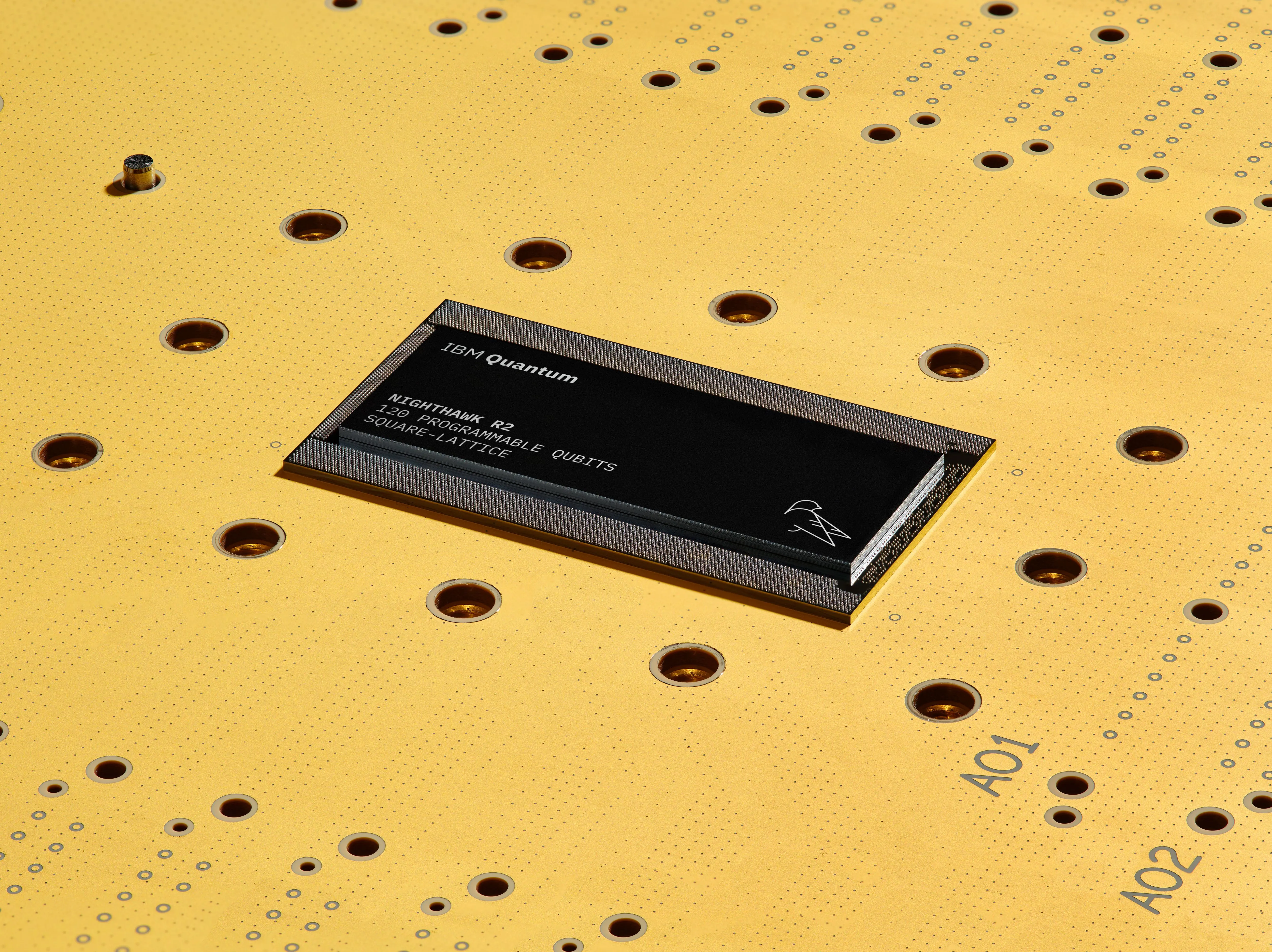
The specifications IBM presented for Nighthawk r3 are 520 programmable qubits, 2,034 physical qubits in total, and support for 10,000 quantum operations. All of these are design targets, not figures confirmed on actual hardware. As Baystreet's report also notes, IBM did not disclose a specific release timeline for Nighthawk r3 in this announcement.
By contrast, the Nighthawk r2, introduced in September 2026, already has operating experience. The r2 has 120 programmable qubits and 458 physical qubits in total. According to IBM, it can process more than 7,500 quantum operations with high accuracy and supports acquiring up to 100,000 samples per second.
When comparing quantum computer performance, the number of quantum operations must be distinguished from sampling speed. The number of operations executed within a circuit relates to the scale and complexity of the computation, while sampling speed expresses how well the machine can run the same quantum circuit repeatedly and collect measurement results. Normally, a single circuit execution yields a single measurement result, and estimating a probability distribution with sufficient precision can require millions to billions of measurements, depending on the problem. Being able to run a large circuit has limited practical value if measurement takes enormous amounts of time, but high sampling speed alone guarantees neither computational accuracy nor an advantage over classical computers.
| システム | 開発・提供状況 | プログラム可能量子ビット | 物理量子ビット総数 | 量子演算の規模 | 主な性能・機能 |
|---|---|---|---|---|---|
| Nighthawk r2 | 提供中・実測データあり | 120 | 458 | 7,500回以上に対応 | 毎秒最大10万サンプル、高速量子ビットリセット |
| Nighthawk r3 | 設計目標を公表 | 520 | 2,034 | 1万回を目標 | 正方格子結合、10系統のl-coupler |
| Nighthawk r3連結システム | 2027年の構築計画 | 1,040 | システム全体の仕様は未公表(2基の単純合計は4,068) | 未公表 | 2基をl-couplerで接続、モジュール型冷凍機を統合 |
Nighthawk r2 Reports Up to 25x Higher Throughput
The current Nighthawk r2 uses a fast qubit reset technique that shortens the interval between quantum circuit executions. According to IBM's technical explanation, this technique achieved up to 25 times the throughput of the earlier IBM Quantum Heron, making it possible to acquire up to 100,000 samples per second. However, the published materials we could verify do not give an absolute throughput figure for Heron, the comparison baseline.
IBM says customers and partners such as energy company E.ON and quantum software firms Algorithmiq and Q-CTRL have run more than 34 billion quantum circuit executions in total on Nighthawk r2. These efforts report performance improvements of up to 19 times compared with earlier IBM processors. However, this figure is the maximum obtained for a specific workload, and not every quantum algorithm will speed up by the same factor. Nor do the materials we could verify give absolute execution times or throughput for the older processors or the r2 in this comparison.
Among individual results, E.ON reported a 15x speedup over Heron on a quantum machine learning task aimed at power grid optimization. In a joint study by IBM and Oak Ridge National Laboratory (ORNL), a magnetic materials simulation produced results consistent with neutron scattering experiments, along with a 12x speedup compared with Heron.
データを表で見る
| Heron比の報告値 (倍) | |
|---|---|
| 電力網最適化(E.ON) | 15 |
| 磁性材料計算(IBM/ORNL) | 12 |
| 材料ダイナミクス(Algorithmiq) | 8 |
In joint research with Finland's Algorithmiq as well, a circuit simulating the dynamics of inhomogeneous quantum materials was reportedly processed 8 times faster than on Heron. These cases show that Nighthawk r2 is helping shorten processing times in real research applications. However, because the comparison conditions and absolute execution times for each case are not sufficiently disclosed, the speedup factors cannot simply be compared across different workloads.
IBM also assessed how difficult it is for classical computers to simulate the square-lattice qubit connectivity used in Nighthawk r2. By IBM's estimate, simulating an extended circuit with the leading tensor network methods while maintaining the same accuracy would require about 240 times more memory than an implementation using the conventional heavy-hex lattice. However, no absolute memory figure for the comparison baseline was given.
This 240x figure is an estimate based on a specific tensor network method, not a measured difference in processing speed. Classical computers also have other algorithms and approximation techniques, so this result alone does not mean classical reproduction has become impossible. The results suggest that the square-lattice structure may make quantum circuits harder to simulate, but quantum advantage over classical computers has not been established.
"l-coupler" Chip Interconnect to Scale to 1,040 Qubits
A key element of the Nighthawk r3 design is the chip-to-chip interconnect known as the "l-coupler," which links multiple quantum processors. IBM will equip Nighthawk r3 with 10 l-coupler channels, adopting a design that links multiple chips while preserving the square-lattice qubit connectivity. In 2027, the plan is to connect two chips and build a system with a total of 1,040 programmable qubits.
One way to scale up a quantum processor is to put more qubits on a single chip. But enlarging the chip area brings challenges such as lower manufacturing yield and more complex wiring. A modular approach that connects multiple relatively small chips eases these constraints while increasing the qubit count of the whole system. IBM has now announced demonstration results for both the chip-to-chip connection and the cooling system needed to make this approach work.
For the chip-to-chip connection, IBM ran an experiment connecting two early-generation Nighthawk r1 processors with four l-couplers. According to IBM, the fidelity of quantum state transfer between the chips reached an average of 99%, with a maximum of 99.3%. The company aims for 99.9% fidelity in the future, so while the experiment achieved some results, it has not yet reached the target.
However, the 99.3% figure indicates the fidelity of a specific connection when transferring quantum states between chips, not the accuracy of running complex algorithms across an entire 1,040-qubit system. In large quantum circuits, operations that cross between chips are repeated in addition to gate operations within each chip. Errors from each operation accumulate, so achieving high fidelity at individual connections does not guarantee that a whole circuit can be run with sufficient accuracy. Going forward, the fidelity of quantum operations spanning multiple chips will need to be evaluated in actual circuits.
Another result is the modularization of the cryogenic cooling system. Operating superconducting qubits requires an extremely low-temperature environment close to absolute zero. IBM announced that it had, for the first time, physically connected two cryogenic refrigeration modules and operated them as a single cooling system. The system reportedly reached operating temperature in under five days and maintained a temperature below 15 millikelvin (about minus 273.135 degrees Celsius).
These experiments show progress on both the connection technology and the cooling infrastructure needed to modularize quantum processors. However, what has been demonstrated are individual component technologies, not the operation of a completed system connecting two Nighthawk r3 chips. To realize the 2027 plan, IBM must further raise the fidelity of the connections and confirm that large quantum circuits using multiple chips can run stably.
Hybrid Computing With Fugaku Advances Through Demonstration Research
Alongside developing quantum processors, IBM is working on hybrid computing that combines classical and quantum computers. Using quantum computers in real scientific calculations requires large amounts of classical computing resources, not only to run quantum circuits but also to analyze noise, mitigate errors, and post-process measurement results. In joint research using the IBM Quantum Platform, attempts are being made to apply the technology to larger problems than before by linking supercomputers with quantum processors.
One example is Sample-based Quantum Diagonalization (SQD), developed in joint research with RIKEN. In a paper published in 2025 in the peer-reviewed journal Science Advances (Science Advances 11, eadu9991, DOI: 10.1126/sciadv.adu9991), IBM's Heron quantum processor was combined with RIKEN's supercomputer Fugaku to calculate the ground-state energies of the nitrogen molecule () and iron-sulfur clusters. The study used quantum circuits of up to 77 qubits and 10,570 gates to obtain upper bounds on the ground-state energy.
This research tackled problems of a scale that is difficult to handle directly with exact diagonalization. However, the claim of "going beyond the limits of exact diagonalization" means that the study targeted an active space whose dimensionality is hard to handle with conventional exact diagonalization, not that it surpassed all classical computational methods. What was actually obtained were upper bounds on the ground-state energy and a sparse approximation of the wave function, and comparison with approximate calculations on classical computers remains necessary.
Research is also progressing on closed-loop electronic structure calculations that build on SQD. In a paper posted to the arXiv preprint server (arXiv:2511.00224), a Heron processor without error tolerance was combined with up to 152,064 nodes of Fugaku to perform a calculation using 77 qubits. After correction by energy-variance extrapolation, the calculation error was about 0.1 hartree relative to results from the density matrix renormalization group (DMRG) method, a representative high-accuracy classical technique.
Compared with about 0.0016 hartree, a commonly cited benchmark for chemical accuracy, the error reported here still leaves a large gap. Even when combined with post-processing on a large supercomputer, securing sufficient computational accuracy is not easy. While quantum processors now make it possible to take on larger problems, further verification is needed of their advantages in accuracy and computational efficiency over classical computation.
Applications in medicine and drug discovery are also being studied. For protein-ligand binding modeling, in joint research with the Cleveland Clinic and RIKEN, a preprint (arXiv:2605.01138) was released in May 2026. This study used two 156-qubit Heron r2 processors to run 21,006 different circuits using up to 94 qubits. Acquiring 3 billion measurement results reportedly took more than 239 hours.
In addition, an automated computational pipeline reportedly processed 608 million samples in 62.4 hours. This result shows that the automation of large-scale computational chemistry workflows incorporating quantum computation is advancing. On the other hand, measurement and post-processing still take a long time, and improving processing efficiency remains an important challenge. The study is also a demonstration of a technique for calculating molecular binding, and does not confirm the clinical efficacy or actual therapeutic effect of any new drug.
What these studies have in common is that they do not complete the computation on the quantum processor alone but actively use the computing power of supercomputers. Processing the measurement data obtained from quantum circuits with classical computation to find solutions while suppressing the effects of errors has become an important option for using today's quantum computers in scientific calculations. However, given the heavy reliance on classical computing resources, it is essential to evaluate not only speedups of the quantum processor portion but also the computation time, accuracy, and resources required by the entire system.
Challenges on the Road to a Fault-Tolerant Quantum Computer in 2029
In IBM's announcement, demonstrated results and future development targets need to be evaluated separately. For Nighthawk r2, the ability to acquire up to 100,000 samples per second and shorter processing times for specific workloads have been reported. In chip-to-chip connections, an experimental quantum state transfer fidelity of 99.3% was obtained, and the cryogenic cooling system was successfully modularized. On the other hand, Nighthawk r3's 520 qubits and 10,000 quantum operations, and the 1,040-qubit system planned for 2027, are all future development targets.
The published materials we can verify at present do not include a common dataset that would let third parties verify Nighthawk r3's design targets, nor details of quantum gate error rates or the statistical uncertainty of measured values. Results from connecting two Nighthawk r3 chips and running quantum circuits across the whole system have not yet been shown either. The cumulative 34 billion or more circuit executions reported for Nighthawk r2, the performance improvement of up to 19x, and the estimate that classical simulation would require 240 times more memory are all based on disclosures by IBM and its collaborating companies. They are not standard performance values verified by independent third-party reproduction or benchmarks run under uniform conditions.
Also, achieving a speedup on a specific quantum circuit does not necessarily mean a problem can be solved faster and at lower cost than on a classical computer. Evaluating practical computational performance requires including not only quantum circuit execution time but also the number of measurements, error mitigation processing, classical post-processing, and the computing resources and power consumption required. On the classical side, improvements in algorithms and GPU-cluster simulation techniques continue, and the baselines for assessing quantum computers' advantage are changing as well.
IBM's published roadmap sets a goal of realizing the fault-tolerant quantum computer "Starling" in 2029. Starling is envisioned to use quantum error correction to execute on the order of 100 million quantum operations. By contrast, the Nighthawk r3 and the 2027 connected system announced this time sit at a stage before full-fledged fault tolerance through quantum error correction. Increasing the number of qubits and executable operations alone therefore cannot achieve the fault tolerance that Starling aims for.
The significance of Nighthawk r3 lies not only in improving single-chip performance but in making concrete a design that scales computational capacity by connecting multiple quantum processors. The demonstrations of the chip-to-chip connection and cooling system are progress toward that goal. However, whether the design target of running 10,000 quantum operations on 520 qubits can be achieved on real hardware, and whether sufficient computational accuracy can be maintained when two chips are connected, are questions yet to be tested. Going forward, in addition to when Nighthawk r3 will be released, the error rates of quantum gates that span chips, the execution fidelity of whole large circuits, and the real performance gains from hybrid computing with classical supercomputers will be key indicators for evaluating IBM's scaling strategy.