


There is a law reported by Guillaume Amontons to the Royal Academy of Sciences in Paris in 1699 and established experimentally by Charles-Augustin de Coulomb in 1785. It is a fundamental principle of physics stating that the frictional force between dry objects does not depend on sliding velocity and remains constant at all times—a principle still taught in physics textbooks around the world today. However, for over three hundred years, physicists have grappled with a strange dilemma: the more precisely real materials are examined using sophisticated measurement instruments, the more the frictional force turns out to vary slightly with sliding velocity, meaning the idealized velocity-independence described in textbooks had never actually been experimentally verified. A joint research team consisting of the National Institute for Materials Science (NIMS), the United States Geological Survey (USGS), and the University of Tokyo announced on July 20, 2026, that by heating single crystals of mica—a layered oxide also used as a lubricant—to 200°C, they had for the first time experimentally realized this three-century-old ideal of frictional behavior.
The Velocity-Dependence Dilemma That Physics Has Carried for Three Centuries
The Amontons-Coulomb law of friction, as taught in classical physics, is an empirical rule that has underpinned mechanical design and structural engineering calculations. Its defining feature is its simplicity: frictional force is unaffected by contact area or sliding speed and depends only on—being proportional to—the normal force pressing the surfaces together. Amontons first presented experimental results in 1699, and Coulomb systematized the law in 1785 through experiments using shipyard pulleys and sleds. This law provided sufficient accuracy for designing and explaining the mechanics of steam engines and simple gear mechanisms during the Industrial Revolution.
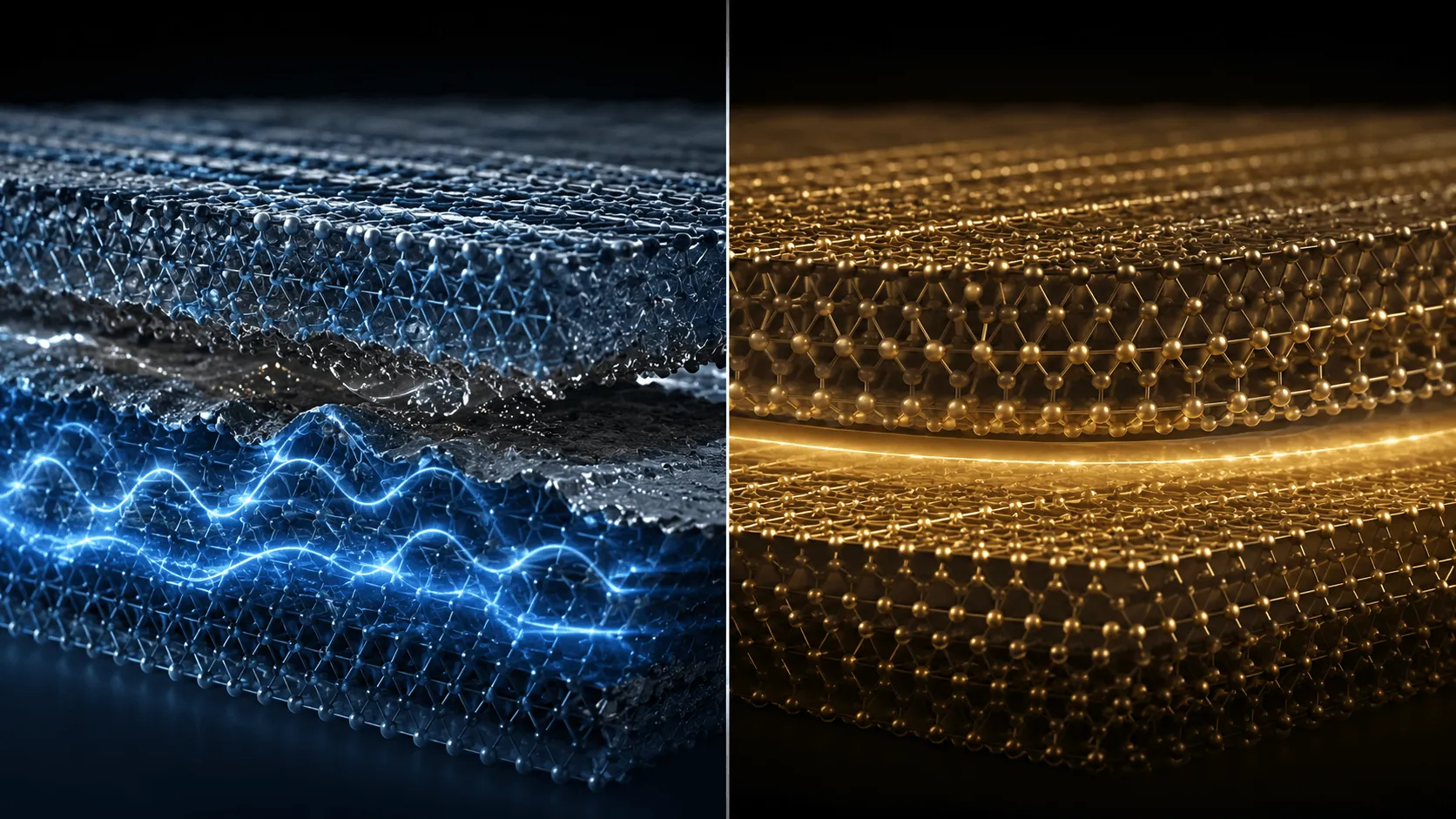
However, as modern surface physics and tribology (the science of friction, wear, and lubrication) have advanced through microscopic measurements using atomic force microscopes and high-precision load cells, it has become clear that the classical law does not actually hold for real solid surfaces. At real contact interfaces, a "rate-and-state friction law," in which frictional force varies logarithmically with sliding velocity, is dominant. This means that the coefficient of kinetic friction increases or decreases slightly whenever the sliding speed changes, and this small response is a major factor generating mechanical instability.
In conventional experiments conducted under room-temperature conditions of 22°C to 25°C, whenever the sliding velocity was varied under a high normal stress of 100 MPa, fluctuations in frictional force were invariably observed. This velocity dependence is known to be involved in phenomena such as the squealing noise generated by automobile brakes and unpleasant vibrations in precision machinery, and it is also known to influence unstable slip behavior in earthquake faults. Given that it had become something of a scientific consensus that no material or condition exists in which velocity dependence is physically reduced to exactly zero, demonstrating a state of perfectly constant friction unaffected by speed had remained a long-standing unsolved problem in both basic science and surface engineering.
The Ideal Sliding That Emerges When Mica Is Heated to 200°C
The research team focused on single crystals of the layered oxide mica (chemical formula: ), which exhibits excellent cleavage properties as a solid lubricant, and tracked in detail how the kinetic frictional force between contact surfaces depends on temperature. Using a high-pressure rock mechanics testing apparatus installed at the United States Geological Survey, the team performed precision measurements across a wide temperature range from room temperature up to 200°C, applying a normal stress of 100 MPa while incrementally varying the sliding velocity. The results of this experiment were published online on July 20, 2026, in Physical Review Letters, a journal of the American Physical Society.
The data obtained captured an intriguing physical phenomenon that runs counter to conventional thermodynamic intuition. Generally, when a material is placed in a high-temperature environment, thermal vibrations intensify and the formation and breaking of atomic bonds at the interface accelerate, so one would expect frictional behavior to become more irregular and unstable. Yet between single crystals of mica, as the temperature rose from room temperature (22°C to 25°C), the magnitude of the kinetic frictional force's response to changes in sliding velocity steadily diminished, and upon reaching a heating temperature of 200°C, a mechanical transition was observed in which velocity dependence vanished entirely.
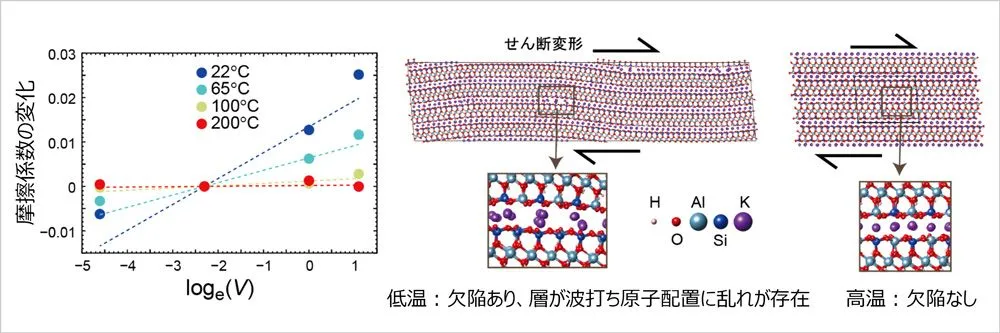
In the classical law of friction, the relationship between the kinetic frictional force $F$ and the normal stress $N$ is expressed using the coefficient of kinetic friction as follows:
Based on the conventional rate-and-state model, when the actual sliding velocity $V$ changes relative to a reference sliding velocity , the friction coefficient is expected to fluctuate according to a logarithmic function. However, under the 200°C condition confirmed in this experiment, the change in friction coefficient associated with velocity changes was found to be exactly zero, exhibiting behavior in which frictional resistance did not change at all no matter how the sliding speed was varied. This state—difficult to explain using existing friction theory—represents the true realization of Amontons-Coulomb friction, verified more than 300 years after it was first proposed.
The Disappearance of Wave-Like Internal Defects Captured by Electron Microscopy
Why does simply heating layered mica to 200°C cause the velocity dependence of friction to vanish so clearly? To investigate the mechanism underlying this phenomenon, the research team used transmission electron microscopy (TEM) to precisely observe the post-experiment single-crystal samples, analyzing the microscopic deformation state of the crystal structure immediately beneath the contact surface. The results revealed that the properties of friction are determined not solely by the topmost atomic layer where the two solids meet, but by the behavior of defects located somewhat deeper within the crystal, just below the contact surface.
When cross-sectional observations were made of samples that had undergone friction experiments in a low-temperature, room-temperature environment, numerous wave-like nanoscale defects known as "ripplocations" were found to have formed within the crystal. To explain this phenomenon using a familiar analogy: it closely resembles what happens when a heavy piece of furniture is dragged across a carpet—wrinkles and undulations do not form at the boundary between the floor and the carpet itself, but rather develop as wave-like folds within the carpet's own structure, propagating forward as the furniture is pushed. At room temperature, these wave-like defects migrate and propagate through the interior of the crystal in tandem with sliding motion, and because the drag resistance of the defects themselves is highly sensitive to speed, the macroscopically observed frictional force also exhibited velocity dependence.
On the other hand, in the heated samples at 200°C that demonstrated ideal friction, it was confirmed that the ripplocation defects within the crystal had disappeared entirely. Under the high-temperature environment, the thermal energy supplied relaxed the distortions in the crystal lattice, causing the wave-like wrinkle structures that had formed internally to heal and vanish, with the result that sliding deformation proceeded purely through the smooth interface alone. This transition in mechanical mechanism—from defect-driven, complex energy-dissipating resistance at room temperature to defect-free interfacial sliding at 200°C—is what enabled the realization of ideal friction entirely unaffected by speed.
Comparing Old and New Friction Models and the Ripple Effect on Solid Lubricant Materials
The significance of this research lies in having clearly linked the velocity dependence of macroscopic friction—previously treated merely as a phenomenological parameter—to a concrete physical phenomenon: the presence or absence of fine structural defects within the crystal. The differences between the characteristics of kinetic friction observed conventionally at room temperature and the ideal friction experimentally demonstrated here at high temperature can be organized into the following comparison table.
| Comparison Item | Kinetic Friction at Room Temperature (22°C–25°C) | Ideal Friction at High Temperature (200°C) |
|---|---|---|
| Sliding velocity dependence | Friction coefficient changes logarithmically with velocity | Friction coefficient remains unchanged regardless of velocity changes (completely independent) |
| Dominant microscopic mechanism | Propagation of wave-like "ripplocation" defects within the crystal | Pure interfacial sliding alone, due to disappearance of internal defects |
| Mechanical stability | Vibration and stick-slip wear occur due to velocity fluctuations | Stable against velocity fluctuations, minimizing energy loss |
This discovery in basic science carries important application value for improving future mechanical engineering and energy efficiency. In modern automotive and aerospace engineering, reducing energy loss toward the realization of a decarbonized society is in high demand, and designing materials that can reduce frictional loss even slightly has become an urgent priority across the industrial world. In particular, in extreme environments such as deployable antennas on space probes, high-vacuum semiconductor manufacturing equipment, and high-temperature turbines for power generation—where ordinary liquid lubricants fail to function due to evaporation or freezing—the performance of solid lubricant materials such as mica and graphite determines the lifespan of machinery. If a lubricant's frictional force increases or decreases with changes in operating speed, an unpleasant self-excited vibration known as stick-slip occurs within the machinery, causing rapid wear of components and loss of driving energy.
If an ideal solid lubricant could be developed whose frictional resistance remains unchanged regardless of operating speed, the controllability of mechanical systems would be stabilized, and energy loss associated with power transmission could be minimized. The research team has presented a new guideline for materials development: if nanoscale defects within a crystal can be eliminated through thermal or structural control, the macroscopic physical laws governing friction can be deliberately designed according to human intent.
Extension to Other Layered Materials and Unverified Challenges Posed by Extreme Environments
The experimental demonstration of ideal Amontons-Coulomb friction in mica—a mystery that had persisted for three hundred years—represents a major breakthrough. However, whether this mechanism of ideal sliding through defect elimination holds universally across other material systems remains to be verified in future research. Whether heating to around 200°C causes ripplocation defects within the crystal to disappear and gives rise to velocity-independent ideal friction in other layered compounds widely used as solid lubricants in industry—such as graphite, molybdenum disulfide, and titanium dioxide—is an open question that has not yet been examined.
Furthermore, when considering the complex physical environments encountered in actual industrial machinery or in geological processes such as crustal deformation within the Earth, technical challenges remain to be resolved. This study confirmed the disappearance of defects under the specific conditions of 100 MPa normal stress and 200°C, but how mica's dehydration bonding and chemical reactions would proceed—and how they would alter frictional properties—under harsher high-temperature conditions exceeding 300°C remains unconfirmed. Additionally, the question of how stably the defect-free state can be maintained over the hundreds of millions to billions of continuous sliding cycles required in industrial machinery—an issue of durability and service life—remains a task for future research.
As for future prospects, the research team has indicated its intention to use in-situ observation techniques that allow friction experiments to be conducted directly inside an electron microscope, tracking in real time how crystal defects form and disappear during sliding motion. With the classical law of friction—born three centuries ago at the Royal Academy and existing until now only within the pages of textbooks—now connected to cutting-edge nanoscale defect analysis, the challenges of surface physics and tribology are opening a new door.