

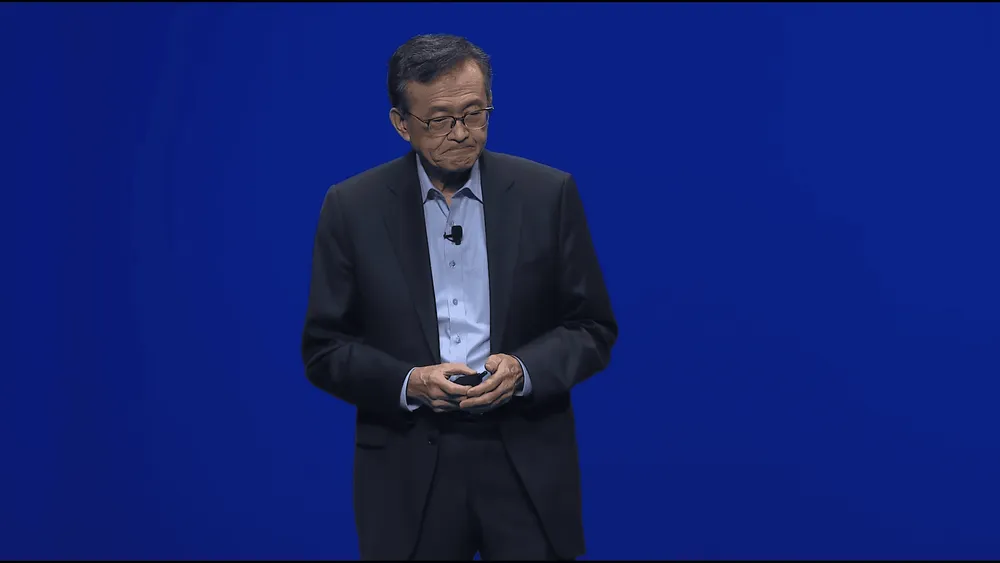
Intel CEO Lip-Bu Tan put an unusually specific number on the company's CPU supply capacity. Speaking during the official livestream of Splunk's annual event, ".conf26," he said Intel is meeting only about 50% of the CPU demand customers are asking for. He also revealed that he has personally heard from multiple company CEOs directly, and that he has apologized for not being able to manufacture enough.
However, this 50% figure cannot be read as an overall shortage rate or market share for all Intel CPUs. The remarks did not specify the product lineup, customer segment, time period, or the denominator used in the calculation. What can be confirmed is only that Tan described current supply against current customer requests as roughly half.
Tan did not frame the CPU shortage as simply a rebound in PC demand. When people talk about AI computing demand, attention tends to gravitate toward GPUs, but according to Tan's explanation, the spread of inference and AI agents is also increasing CPU workloads. Cross-referencing Intel's own regulatory filings shows that the obstacles to meeting that demand are not limited to CPU manufacturing capacity. The supply chain for the entire system—including memory and semiconductor packaging substrates—is setting the ceiling.
CPU Workloads Rising in the Shadow of GPU Training
In the livestream, Tan explained that while GPUs are well-suited to training AI models, CPUs are useful for inference, reinforcement learning, allocating and controlling AI agent workloads, and control systems generally. He also mentioned single-threaded processing, saying that multiple frontier model companies he personally invests in have told him they need more CPUs.
This is not a general performance comparison claiming CPUs are superior to GPUs. In large-scale AI infrastructure, even when GPUs handle matrix operations, tasks like receiving requests and sequencing processing remain. Data preparation, coordination with storage and networking, and failure-handling controls are also necessary. As AI agents multiply and more short-lived tasks run in parallel, the load on the control layer that orchestrates computing resources also grows. Tan's comments reflect Intel's own view that the wave of AI investment is spilling over from GPU demand into CPU demand.
Intel's Form 10-Q for the second quarter of 2026 also states explicitly that market demand has exceeded available supply. However, this qualitative disclosure in a regulatory filing cannot itself verify the 50% supply ratio. The measurement periods and populations behind the two statements do not align; they are separate pieces of evidence that happen to point in the same direction.
Intel's Filings Point to a Triple Supply Constraint
Intel's Form 10-Q, filed with regulators, divides the causes of its inability to keep up with demand into two layers. One is capacity constraints at Intel's own fabs. The other is supply constraints on key components affecting the industry as a whole. For the latter, the company specifically named semiconductor packaging substrates, memory, and other components. The filing also indicates that these shortages could persist into the following year, potentially limiting Intel's ability to meet demand.
What this reveals is that simply increasing front-end CPU production does not by itself increase the supply of finished products. Even if silicon dies can be manufactured, they cannot ship without the semiconductor packaging substrates that connect the die to the circuit board. Operating as a server also requires DRAM and storage. If any single one of these is missing, the computing capacity customers can actually deploy does not increase.
As countermeasures, Intel cited expanding fab capacity and securing components through long-term contracts. In the first half of 2026, the company prepaid suppliers a total of $934 million, with the funds going mainly toward components such as semiconductor packaging substrates. While a prepayment is not the same thing as supply capacity itself, it represents a concrete financial burden that signals a situation in which ordinary purchase orders alone are insufficient to secure the necessary volume.
Tan's 50% remark and the statements in the Form 10-Q are not figures measured over the same period or against the same population. Even so, the structure is one in which the CEO's verbal explanation is backed by an official disclosure indicating that demand is exceeding supply on both the fab and component fronts.
How Much Can You Trust the "5 to 7 Times" Memory Claim?
This story has also been reported alongside a claim that "memory prices have risen 5 to 7 times." This figure did not come from the Splunk livestream; it was reported locally by Seoul Economic Daily from remarks made at the Intel AI Infra Summit, held on September 15 in Santa Clara, California. According to that outlet, Tan also said that memory shortages will worsen the following year and that price increases are delaying projects.
This figure requires significant caveats. The reporting does not make clear whether it refers to DRAM, NAND, or high-bandwidth memory (HBM), nor does it specify the baseline comparison point, the region, or whether contract prices or spot prices are being referenced. The outlet's English-language version is an AI translation of the original Korean article, and it explicitly notes that foreign-language remarks may not exactly match the original wording. Therefore, this 5-to-7-times figure cannot be treated as an overall memory market price index, nor can it be reproduced as a precise, word-for-word quote.
| Claim | Where Stated/Disclosed | Subject and Unit | Directly Verified | What Can Be Confirmed |
|---|---|---|---|---|
| ~50% | Official Splunk .conf26 livestream | Intel's CPU supply relative to customer requests | Confirmed via official captions | Product line, time period, and denominator not disclosed |
| 5–7x | Intel AI Infra Summit | Verbal estimate on memory prices | Reported locally only | Memory type, baseline, region, and price channel not disclosed |
| Demand exceeds supply | Intel Form 10-Q | Qualitative regulatory disclosure regarding Intel products | Confirmed in original filing text | States fab capacity and industry-wide component constraints |
The "50%," the "5 to 7 times," and the "supply constraints" each come from different subjects, different venues, and different forms of evidence, and cannot be treated as a single, unified supply-demand indicator. It is not valid to calculate a shortage volume from the 50% figure, nor to translate the 5-to-7-times figure directly into a rate of increase in Intel's own procurement costs. Rather than focusing on how dramatic the numbers sound, it is more useful for procurement and investment decisions to understand the differing boundaries of what each figure actually measures.
Why Increased Supply Won't Catch Up Quickly
Official statements from the memory side of the industry also point to a structural situation that is unlikely to ease in the short term. In its earnings materials for the third quarter of fiscal year 2026, Micron stated that industry demand for DRAM and NAND is substantially outpacing supply, and that due to both AI demand and structural supply constraints, tight conditions are expected to persist through at least calendar year 2027. This is Micron's own company forecast, not a confirmed outcome for the market as a whole, but it does indicate that at least one supplier does not view the tightness as a temporary inventory adjustment.
SK hynix has explained that producing the same amount of memory capacity in high-bandwidth memory requires more wafers than it does with conventional DRAM. This is because of the added die area from stacking, through-silicon vias, and more complex packaging processes. If production resources are redirected toward high-bandwidth memory for AI accelerators, the total memory capacity that can reach the market may decrease even if wafer input volumes stay the same.
Furthermore, new semiconductor fabs cannot begin production immediately after an investment decision is made. SK hynix has also explained that construction and ramp-up take on the order of years. This is because the process requires building out equipment and cleanrooms, securing manufacturing tools, materials, and personnel, and then raising yields over time. Understanding this time lag also makes it easier to see why Intel is turning to long-term contracts and prepayments.
Buyers Need to Look at the System, Not Just the CPU
For companies procuring AI infrastructure, Tan's 50% remark is not a forecast that every Intel CPU shipment will be cut in half. Because the affected products and time period remain unspecified, buyers need to check lead times and allocations for their individual orders directly. Nor is this a statement about the magnitude of price increases, so price pass-through cannot be estimated from the 50% figure either.
At the same time, it is also insufficient to treat the supply constraint purely as a CPU-specific problem. In deployment planning, it is necessary to treat the CPU model and quantity needed, along with the capacity and type of memory installed, server supply including semiconductor packaging substrates, and even power and cooling, as part of a single, integrated process. Even if substituting components shortens lead times, changes to memory capacity, power consumption, or software validation requirements can increase the burden on operations.
What to watch next is whether Intel can demonstrate supply improvements by specific product line, whether prepayments made to secure components begin to shrink, and how memory manufacturers update their contract terms and timelines for increasing output. The AI infrastructure market, which had been tracking GPU supply almost exclusively, is entering a phase in which whichever element—CPUs, memory, substrates, power, or cooling—is scarcest at any given moment will determine the overall pace of deployment.