

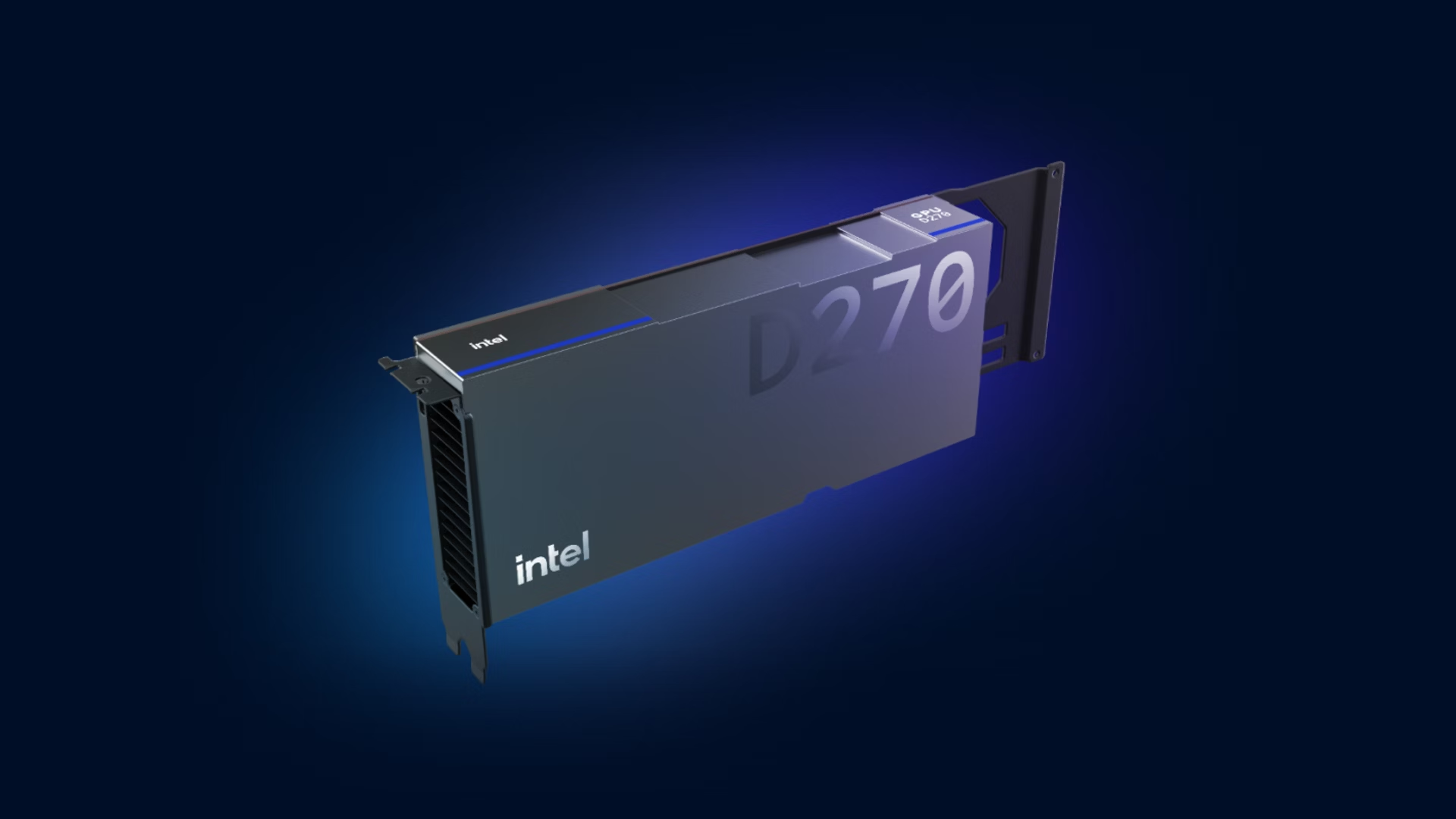
- What happened: Intel has announced details of the Intel GPU D-series, an AI inference GPU, disclosing specs that include 1.3 PFLOPS of FP8 compute and 1.5TB/s of memory bandwidth. Customer sampling has also begun.
- Why it matters: With up to 480GB of memory in a 350W air-cooled PCIe card, the design aims to run large AI models and many concurrent inference requests efficiently in existing server environments.
- What to watch next: Beyond the official launch date and pricing, the key will be comparisons of inference speed, throughput, and power consumption under matched conditions: the same AI model, the same precision, and the same number of concurrent requests.
On October 12, 2026 (US time), Intel announced details of the Intel GPU D-series, an AI inference GPU, revealing key specs including 1.3 PFLOPS of FP8 compute and 1.5TB/s of memory bandwidth. Previously known by the code name "Crescent Island," the GPU can be configured with up to 480GB of LPDDR5X memory, yet it is offered as an air-cooled PCIe card with a 350W power envelope. Sample shipments to customers have also begun.
In addition to the large memory capacity emphasized so far, the announcement put concrete numbers on compute performance and memory bandwidth, clarifying where Intel is positioning the GPU in the AI inference market.
However, being able to fit a large AI model in GPU memory is a separate question from running that model quickly. Judging the D-series requires evaluating not just memory capacity but also response speed during inference, concurrent processing capability, and power consumption together.
The "Intel GPU D270" name is revealed, and customer sampling begins
At this year's OCP Global Summit, Intel announced "Intel GPU D-series" as the official product family name for the AI inference GPU it had been developing under the code name Crescent Island.
The product page published at the same time also lists a model called the "Intel GPU D270."
The D-series uses Intel's Xe3P architecture and is designed to prioritize the memory capacity, compute performance, and power efficiency needed for large language model (LLM) inference.
According to Intel's official announcement, the main specs are 1.3 PFLOPS of FP8 compute, 1.5TB/s of memory bandwidth, and a 350W power envelope.
FP8 is an 8-bit floating-point format, one of the data formats used for AI model computation. 1.3 PFLOPS corresponds to floating-point performance of 1,300 trillion operations per second.
That said, this figure describes the GPU's raw compute capability, not how much text an AI model can actually generate per second. Intel did not publish token-generation speed comparisons using specific AI models this time.
Memory capacity also varies by product configuration, which calls for some care.
According to Intel, the Intel-branded PCIe card has 160GB of memory, and the 480GB maximum is the upper limit achievable with ODM-branded cards designed by partner companies.
In other words, not every card built on the D270 will carry 480GB. The capacity you can actually choose depends on the manufacturer supplying the product and the card's configuration.
The approach of using the Xe3P architecture and large memory is not new to this announcement.
In its announcement on October 14, 2025, Intel said Crescent Island would carry 160GB of LPDDR5X memory and outlined plans to begin customer sampling in the second half of 2026.
This announcement confirms that the planned sampling has actually started. General availability timing and pricing, however, remain undisclosed.
Compared with AMD and NVIDIA GPUs, large memory is the strength
The D-series is easiest to understand when compared with other data center GPUs in the PCIe card format.
Large-scale AI systems also use dense, liquid-cooled rack configurations. But what the D-series emphasizes is an air-cooled PCIe card form factor that is easy to deploy in existing server environments.
We therefore use AMD's Instinct MI350P and NVIDIA's RTX PRO 6000 Blackwell Server Edition as points of comparison.
| Published spec | Intel GPU D-series | AMD Instinct MI350P | NVIDIA RTX PRO 6000 Blackwell Server Edition |
|---|---|---|---|
| Memory capacity | 160GB for Intel-branded card; up to 480GB in ODM designs | 144GB | 96GB |
| Memory type | LPDDR5X | HBM3E | GDDR7 |
| Memory bandwidth | 1.5TB/s | 4TB/s | 1.597TB/s |
| Rated card power | 350W | Up to 600W, configurable to 450W | Up to 600W, configurable |
| Form factor | Air-cooled PCIe card | Passively cooled PCIe card | Air-cooled PCIe card |
Note: Based on specs published by each company as of October 13, 2026. For AMD, see the MI350P product specs; for NVIDIA, see the RTX PRO 6000 Blackwell Server Edition product specs. NVIDIA's memory bandwidth of 1597GB/s is expressed as 1.597TB/s in decimal units. The Intel GPU D-series is at the customer sampling stage, and the 480GB maximum is the upper limit achievable with partner-designed cards.
Compared with the AMD Instinct MI350P, the Intel-branded D-series card offers about 1.11 times the memory capacity, and the maximum partner-designed configuration about 3.33 times.
On the other hand, its memory bandwidth of 1.5TB/s is only 37.5% of the MI350P's 4TB/s.
In other words, the D-series lets you choose configurations that hold more data in the GPU than the MI350P, but it falls behind in the amount of data that can be read from and written to memory per unit of time.
The picture differs when compared with the NVIDIA RTX PRO 6000 Blackwell Server Edition.
The RTX PRO 6000 has 96GB of memory and 1.597TB/s of bandwidth. Even in its Intel-branded 160GB configuration, the D-series has more memory capacity, with bandwidth at a similar level.
This difference shows that the D-series places particular emphasis on inference workloads that need large amounts of memory.
Still, these are comparisons of published single-card specs, not indicators of actual AI inference speed.
A GPU with high memory bandwidth may fail to deliver the expected performance if its compute performance or software optimization is insufficient. Conversely, if large memory capacity means a model doesn't have to be split across multiple GPUs, processing efficiency may improve in some configurations.
The same goes for power consumption.
The D-series' 350W envelope is lower than the 600W maximum setting of the competing products. But if the time needed to complete the same work differs, the energy consumed will differ too.
The 350W spec alone does not support the conclusion that the D-series is better than competing products in energy per generated AI token or in actual operating cost.
It is also unclear whether Intel's 1.3 PFLOPS FP8 figure assumes the use of structured sparsity.
Other vendors' FP8 figures may come in different values depending on whether sparsity is used, so it is not appropriate to judge compute superiority by comparing numbers whose conditions are not matched.
Support for up to 300 billion parameters depends on memory capacity and quantization
Intel says the D-series can handle AI models of up to 300 billion parameters on a single card, and models exceeding 1 trillion parameters in an 8-GPU configuration.
To evaluate this figure, however, you need to consider the precision at which the model is stored and how much memory is reserved for the data needed during inference.
This announcement does not specify the card capacity or quantization conditions for running a 300-billion-parameter model.
When running a large language model on a GPU, memory is first needed to store the model's parameters.
For example, if all 300 billion parameters are stored at 8 bits, the weights alone require roughly 300GB by simple calculation.
If they can be stored at 4 bits, the requirement falls in theory to about 150GB.
This calculation multiplies the number of parameters by the storage per parameter. NVIDIA's technical explanation of inference optimization also describes model weights and the KV cache as the main consumers of GPU memory.
In actual inference, however, memory is needed for more than the weights.
Information for restoring quantized values to their original scale, temporary compute workspace, and data used during inference must also be held.
Particularly important is the "KV cache."
When generating text, a large language model refers to information about the tokens it has processed so far. The KV cache stores part of that information so the same computation need not be repeated.
The longer the input text and the more requests processed at once, the larger the KV cache tends to become.
If a 300-billion-parameter model quantized to 4 bits were placed on a 160GB card, the weights alone would use about 150GB.
Simple subtraction leaves about 10GB, but because memory is also needed for quantization-related information and computation, the usable headroom would be smaller still.
So even if the Intel-branded 160GB card can handle a 300-billion-parameter model, that does not mean it can run inference with long inputs and many concurrent requests at sufficient performance.
With a partner-designed card carrying up to 480GB, on the other hand, more memory may remain available for inference processing after the same model is loaded.
How much headroom actually results will vary with the model's structure, quantization method, input length, and number of concurrent requests.
Intel's claim of support for up to 300 billion parameters shows that large models can be handled under certain conditions; it is not a guarantee of comfortable operation with every model and inference setting.
How does large memory affect AI response speed and concurrent throughput?
To understand the use cases the D-series targets, it helps to split LLM inference into two stages.
One is "prefill," which processes the text entered by the user all at once.
The other is "decode," which generates the tokens of the answer one by one based on the processed input.
In prefill, many input tokens can be processed in parallel, making it easier to make use of the GPU's matrix compute capability.
On the D270 product page, Intel says the GPU carries 32 Xe3P cores and 256 XMX matrix engines to speed up this kind of input processing.
Intel also says it has redirected the die area that conventional GPUs use for graphics and ray tracing circuitry toward compute.
This can be seen as a design that prioritizes the compute capability needed for AI inference over image rendering.
In decode, by contrast, the next token is generated in sequence while referring to the text generated up to that point.
Especially when the number of concurrent requests is small, the speed of reading model weights and the KV cache from memory, rather than compute capability, can limit performance.
In such situations, memory bandwidth becomes important.
The D-series can carry up to 480GB of memory, but its bandwidth is 1.5TB/s. So even if the entire model fits on a single card, the time to generate each token will not necessarily be shorter.
Large memory does bring another benefit, however.
When requests from multiple users arrive for the same AI model, "batching" them together can improve GPU utilization.
Here, model weights can be shared across requests, but a KV cache must be kept for each request.
If enough memory remains after the model is loaded, it becomes easier to process more requests at once.
In other words, the D-series' large memory may boost not so much the response speed for a single user as the processing capacity when serving an AI service to many users.
Still, increasing concurrent requests also increases KV cache usage. Batching changes the load on memory bandwidth and compute units, and can introduce waiting time while requests are grouped.
The optimal configuration therefore depends on the use case.
For example, when many employees in a company use a shared AI assistant, the number of requests and tokens the whole server can process matters.
When a small number of people use an interactive AI, by contrast, the time until the first response arrives and the speed at which text is generated take priority.
Nor is prefill always determined solely by compute, or decode always solely by memory bandwidth. The performance constraints change with the model's scale and structure, input length, and number of concurrent requests.
Evaluating the D-series' real performance will require measurements taken under matched operating conditions.
A 350W air-cooled design aims at AI inference on existing servers
The Intel GPU D270 uses standard PCIe 5.0 connectivity and a 350W air-cooled design.
Intel's emphasis is on making it easy to introduce AI inference GPUs into existing data center environments without dedicated liquid-cooling facilities or large-scale rack modifications.
If GPUs with large memory can be operated within a relatively low power envelope, it may be possible to add AI inference capacity even in environments constrained by server power supply or cooling capacity.
That said, being a standard PCIe card does not mean it can be installed as-is in any server.
Actual deployment requires checking power capacity, card dimensions, airflow inside the server, PCIe slot configuration, and more.
And even if a GPU's own power consumption is low, if it takes longer to finish the same work, the server as a whole is not necessarily more power efficient.
How advantageous the D-series' 350W spec is in practice can be judged only by measuring the time and energy needed for real inference workloads.
Software support matters as well.
Intel says it intends to let developers use existing AI development environments such as PyTorch and vLLM through a common Xe software foundation.
The aim is to make it easier for developers to move AI inference environments to Intel GPUs while using their existing software assets.
Still, whether the models and quantization formats users actually want to run work correctly and deliver sufficient performance will need to be verified going forward.
AI inference performance, in particular, is not determined by hardware alone. The maturity of the software, including compute optimization for each model, memory management, and batching mechanisms, has a major influence.
Similar caution applies to Intel's goal of supporting models above 1 trillion parameters in an 8-GPU configuration.
Installing multiple GPUs does not mean their memory automatically becomes one giant memory space.
When a large model is split across multiple GPUs, how the computation is divided and the communication performance between GPUs become important.
Therefore, the inference performance of an 8-GPU configuration cannot be derived simply by multiplying the single-GPU memory bandwidth of 1.5TB/s by eight.
Adopting LPDDR5X also does not necessarily translate directly into lower product prices or stable supply. Actual pricing and procurement terms will depend on product configurations and sales arrangements announced in the future.
With customer sampling now under way, the process has entered a stage where such practical performance and deployment conditions can be evaluated concretely.
What will matter most going forward is comparing performance using the same AI model, quantization precision, and input length while varying the number of concurrent requests.
That will require checking the time to first token, the interval between subsequent tokens, the number of tokens the whole server can process, power consumption, and more.
Whether large memory lets operators use fewer GPUs while maintaining the required response speed and throughput will determine the D-series' competitiveness.
Rather than simply chasing the highest compute performance, the Intel GPU D-series combines large memory with a relatively low power envelope, aiming to make large-scale AI inference easier to run on existing servers.
Whether this design becomes an attractive option for enterprises will depend on the pricing and release timing yet to be announced, as well as on verified inference performance and operating costs with real AI models.