

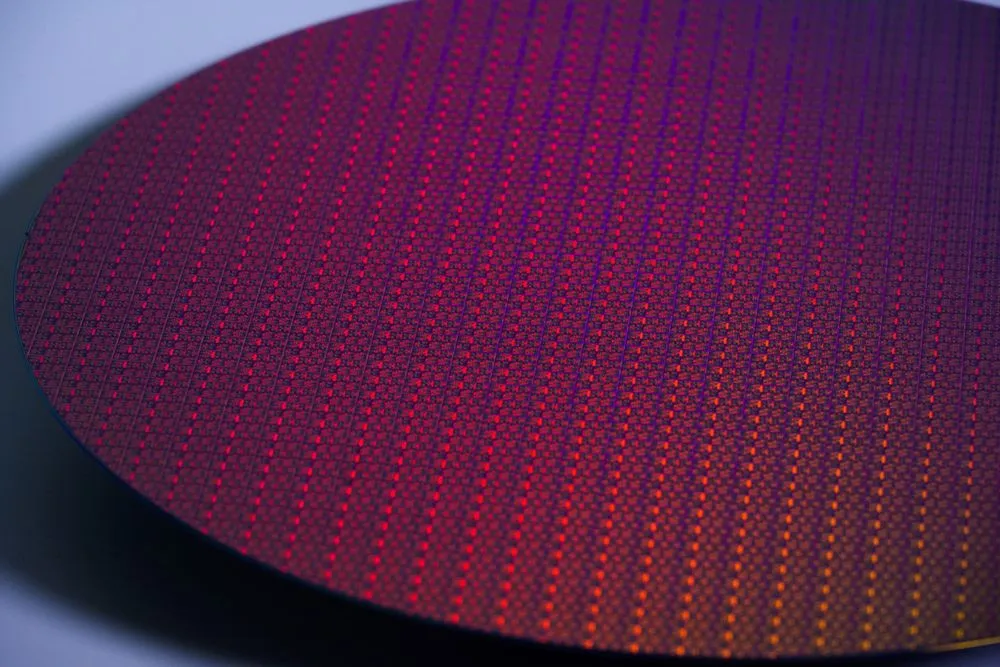
Intel's next-generation manufacturing process, 14A, is reportedly being evaluated by eight major U.S. companies, including Apple and NVIDIA, according to an investment memo from Piper Sandler. Then on September 25, Tom's Hardware reported that Intel expects 14A performance to come within 5% of TSMC's A14. Together, the two stories suggest a widening pool of potential customers and growing expectations for Intel's competitiveness. But the first is not an announcement of orders, and the second is not a like-for-like measured comparison. To judge whether Intel can become an alternative to TSMC, it helps to separate what the two companies' published improvement figures actually mean from the conditions needed to move from evaluation to a volume contract.
How far along are the eight evaluations?
The companies said to be evaluating 14A in the Piper Sandler memo include Amazon, Apple and AMD, along with Google, Tesla and Microsoft. Adding NVIDIA and Qualcomm brings the total to eight. The information spread on September 18 through a public post summarizing the memo. The full memo and the details of each company's evaluation have not been publicly verified, and this is not an announcement that the eight companies have decided to place orders for 14A products.
Still, the breadth of the list is meaningful. Companies that sell CPUs and GPUs and companies that build chips for their own services want different things from a manufacturing partner. Some designs prioritize lower power consumption; others need to pack more compute circuitry into a limited area. If the reported evaluations are advancing, 14A is being tested on whether it can meet such varied demands.
However, the phrase "under evaluation" alone does not reveal whether a company is reviewing technical documentation for a candidate process or has already built it into a specific product design. A supply contract requires not only a credible path to the needed performance, but also manufacturing costs and delivery timing that fit into a product plan. The number of candidate customers cannot simply be converted into future revenue.
Intel's own disclosures also distinguish between customer evaluation and committed demand. Its Form 10-Q for the second quarter of 2026 says that potential major customers have made progress toward performance and design milestones that allow them to evaluate 14A for future products. It also states that the scale and pace of fab expansion will depend on the demand Intel can secure from its own products and from design wins with external customers. There is still a gap between having a technology looked at and receiving the orders needed to justify capital investment.
The official improvement figures start from different baselines
Intel says 14A delivers 15–20% higher performance than 18A at the same power. TSMC says A14 delivers up to 15% higher speed than N2 at the same power. Put side by side, Intel's gain looks larger, but the starting points are not the same.
Intel 14A's 15–20% and TSMC A14's "up to 15%" are improvements measured against different predecessor processes, and they do not represent the performance difference between the two companies.
| Published metric | Intel 14A | TSMC A14 |
|---|---|---|
| Comparison baseline | Intel 18A | TSMC N2 |
| Improvement at same power | 15–20% higher performance | Up to 15% higher speed |
| Improvement at same performance/speed | 25–35% lower power consumption | Up to 30% lower power consumption |
| Density improvement | Up to 30% higher chip density | More than 20% higher logic density |
| Status of the figures | Intel internal analysis as of April 2025 | Outlook presented in the April 2025 A14 announcement |
The table matches the figures on Intel's process overview page (14A section and footnote 1) and TSMC's A14 announcement by baseline and conditions. These are the published values as of September 26, 2026, not benchmarks from the same circuit manufactured by both companies. Intel notes that its figures are based on internal analysis and that results may vary.
How much faster a chip runs at the same power and how much power it saves at the same speed are separate comparisons under different operating conditions. Reading them as specifications that can be achieved simultaneously would overstate the improvement. On density, Intel's "chip density" and TSMC's "logic density" are worded differently, so these values alone cannot determine which process fits more circuitry into the same area.
What the two announcements support is that each process is expected to advance beyond its own predecessor. Comparing 14A and A14 directly would require running a common circuit under common operating conditions and looking at speed, power and area together.
Extrapolating clock speeds cannot verify "within 5%"
The "within 5%" figure reported by Tom's Hardware is said to be an outlook that Naga Chandrasekaran, who leads Intel Foundry, gave to KeyBanc. The remark reached the public through a post, and neither the original KeyBanc document nor any measurement data has been directly verified. It is also unclear whether Intel would be ahead of or behind TSMC within that 5%, and what "performance" refers to.
As its own comparison, the publication took the maximum CPU clock speeds of an Intel product built on 18A and a product built on N2, then multiplied each by the improvement rate for its next-generation process. That calculation suggests 14A would come out ahead, so the outlet argued that "within 5%" may be conservative. It acknowledged that the frequencies of different CPUs cannot simply be read as differences in process performance.
That caveat carries over to the result. A CPU's maximum clock speed reflects differences in circuit architecture and is also affected by operating voltage and cooling conditions. Multiplying it by process improvement rates measured under other conditions does not erase the design differences. Lining up the overall power envelopes of laptop and server products likewise does not mean the compared circuits were given the same power.
This extrapolation cannot determine whether Intel's outlook contradicts the published specifications. To confirm whether within 5% is competitive enough, the comparison circuits and voltages would need to be disclosed, along with area and power consumption. At this stage, it is too early to conclude either that Intel is being cautious or that it has lowered its target.
14A's value depends on whether customers' circuits can unlock it
Intel lists second-generation gate-all-around transistors, RibbonFET 2, and backside power delivery, PowerDirect, among 14A's building blocks. Backside power moves the wiring that delivers power to the back of the chip, easing congestion with the signal wiring on the front. Performance depends not only on making circuits smaller but also on how power and signals are delivered.
For designers, the more concrete feature is what Intel's technical documents call Turbo Cells. Chip design combines standard cells, the basic circuit building blocks. Turbo Cells are performance-oriented cells for paths that most affect speed; they reportedly use twice the usual height to raise drive current. Intel says they are built into the design tool flow, allowing high-performance and low-power cells to be mixed within a compute block.
In other words, drawing out 14A's performance does not end with choosing the process. Designers must decide, for their own products, which paths get performance-oriented circuits and where to hold down power. Even with the same nominal improvement rates, the benefits realized in a product can differ. When reading reports of eight-company evaluations, the next piece of information needed after the company names is which products and which circuits were judged to benefit.
A decision to keep developing versus orders to fill fabs
Intel's Form 10-Q for the second quarter of 2026 states that it has decided to complete development of 14A. Multiple future Intel products are designed to use 14A, and manufacturing expansion projects are under way. It would therefore be inaccurate to describe the previously raised possibility of canceling development as the current baseline policy. But this decision does not mean external customer orders have been secured.
On timing, a direct response from Intel published by Wccftech in September gave late 2027 for risk production for its own products and 2028 for volume ramp. Risk production is the stage in which the process and products are validated ahead of volume manufacturing. It cannot be read as a shipping schedule for all eight companies' products. TSMC has also announced A14 production starting in 2028, so the two companies' plans overlap on a yearly basis, but that alone does not show which products will reach customers first.
It is also essential to distinguish what a contract actually covers. In its technical documents, Intel also describes approaches that combine chiplets made on other companies' processes, as well as services that handle packaging only. An announced collaboration with Intel does not necessarily mean that company's chips will be manufactured on 14A. Adoption of the manufacturing process and adoption of the packaging technology that connects multiple chips must be confirmed separately.
For 14A to become a serious alternative manufacturing source, it must meet performance and cost conditions on customers' circuits and supply the required volumes on schedule. Once adoption becomes clear, with named products, quantities and volume production timing, the demand supporting Intel's fab expansion will take concrete shape. Only then will the interest of eight companies move closer to an execution plan for widening the supply of leading-edge chips.