

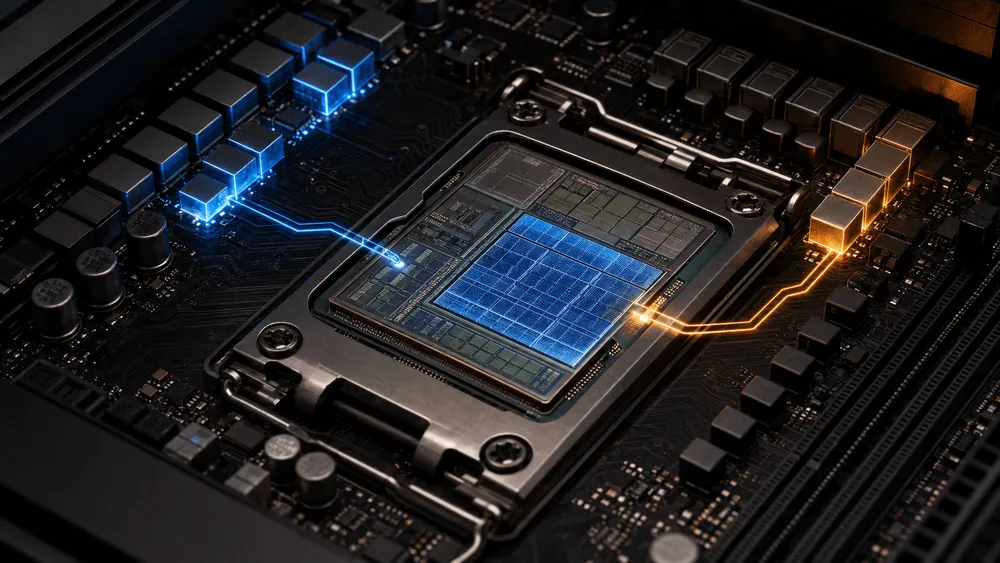
Preliminary information has surfaced indicating that Intel's upcoming desktop CPU "Nova Lake-S" will feature a 65W-class power delivery design segment for the version equipped with 12 Xe3P integrated GPU (iGPU) cores. According to Jaykihn, who continuously shares information on Intel products, achieving full graphics performance requires 2-phase VCCGT, and within Nova Lake-S, only this configuration qualifies.
65W is neither the measured power consumption of the iGPU nor the TDP of the entire CPU package. What has been revealed this time is a classification of the motherboard's capability to supply power to the graphics power rail. If this information carries over to the final product, it would mean that even among boards claiming the same Nova Lake-S compatibility, support for the iGPU's full performance would vary.
12 Xe3P and 65W-Class: Information Accumulating from April to July
On April 13, 2026, Jaykihn posted about a desktop SKU combining 4 P-cores, 8 E-cores, and 4 LP-E-cores with 12 Xe3P cores, stating it would require 2-phase VCCGT. Both pieces of information carried the caveat "Preliminary."
The July 28 post delved deeper into the reason 2 phases are required. According to this post, the 12 Xe SKU of Nova Lake-S requires a specific "65W-level PD segment" to achieve full graphics performance, and only this segment demands 2-phase VCCGT. To the large-scale iGPU that was visible as of April, a platform-side condition—power supply capability—has now been added.
Intel has not announced the product name, core configuration, or power requirements for the 12 Xe3P version. Meanwhile, the company's June 2026 edition of the "Instruction Set Extensions and Future Features Programming Reference" lists CPUID 12_01H as Nova Lake's hybrid architecture for desktop, also mentioning Coyote Cove P-cores and Arctic Wolf E-cores. While the generation name Nova Lake and the CPU core names have appeared in official documentation, the 12 Xe3P and 65W-class power delivery remain unannounced information.
The PD referenced here does not refer to USB Type-C's "USB Power Delivery," but rather to power delivery around the CPU socket. It's also worth noting that the post qualified this with "full graphics performance." Whether boards falling short of 65W-class would prevent the CPU itself from operating, or merely restrict access to the iGPU's upper performance states, has not been specified.
Is 65W the iGPU's Power Consumption?
Intel's current datasheet for Core Ultra 200S defines VCCGT as the dynamic SVID power rail for graphics, and VCCCORE as the dynamic SVID power rail for the IA core. In other words, the CPU core cluster and the iGPU receive power from separate power systems on the motherboard. The 2-phase information mentioned here refers to a design that provides two power conversion paths on the VCCGT side, distributing load and heat generation.
For the current Core Ultra 200S, the maximum current IccMAX for VCCGT is set at 40A across many 125W, 65W, and 35W configurations. The upper limit of the operating voltage range is 1.52V, but these two figures are not meant to be multiplied together to calculate actual power consumption. Per-phase supply capability also varies depending on the power stages, inductors, and cooling design used.
The same datasheet describes IccMAX as the maximum current observed under stress conditions, requiring the voltage regulator to sustain it for at least 10ms. The current that flows under normal application use is separately defined as IccMAX.App, which is lower than IccMAX. Even in current products, power delivery design values and everyday load power consumption are treated separately.
Therefore, from the leaked 65W-class figure, one cannot conclude that "the iGPU constantly consumes 65W" or "the GPU alone reaches 65W." It's more reasonable to interpret this as a supply margin intended for board designers to accommodate load fluctuations at full performance. The final power consumption is determined by GPU frequency and voltage, plus load conditions and control values set by Intel.
The 285K's 4 Xe vs. the 388H's 12 Xe
Intel's current top-tier desktop chip, Core Ultra 9 285K, has 24 cores on the CPU side and 4 Xe cores on the iGPU side. Its Processor Base Power is 125W, and Maximum Turbo Power is 250W. These are power indicators for the entire CPU package, not upper limits dedicated to VCCGT. If the Nova Lake-S 12 Xe3P configuration is indeed real, the Xe core count would be three times that of the current top-tier desktop chip.
An Intel iGPU with 12 Xe cores has already been productized in the mobile-oriented Panther Lake. The Core Ultra X9 388H features Arc B390 with 12 Xe cores, combined with 4 P-cores, 8 E-cores, and 4 LP-E-cores. Its Processor Base Power is 25W, and Maximum Turbo Power is 80W—again, the latter being an upper limit for the entire CPU package. The scale of 12 cores is thus already known. What's new in this unannounced information is bringing this configuration to socketed desktop platforms and requiring a dedicated VCCGT design on the motherboard.
When Intel announced Panther Lake, it stated that the Arc GPU with up to 12 Xe cores was over 50% faster than the previous generation, based on measurements across multiple games and 3DMark Solar Bay on Intel's own reference hardware. This is not a guarantee of Xe3P's performance. Nevertheless, it confirms that Intel has a track record of productizing iGPUs at the 12 Xe scale and has gained implementation experience, including driver development.
AMD's desktop APU, the Ryzen 7 8700G, also features 12 graphics cores in its Radeon 780M, with a Default TDP of 65W. However, AMD's 65W figure represents the TDP for the entire package, including 8 CPU cores. This differs in scope from the 65W-class VCCGT mentioned in the Intel leak. Additionally, since Intel Xe and AMD Radeon cores differ in internal architecture, one cannot derive relative performance simply from the shared figure of "12."
The Wall of Motherboard Compatibility and Memory Bandwidth
If 2-phase VCCGT becomes a product requirement, motherboard manufacturers will need to decide on compatibility at the early stages of board design. Power circuitry cannot be added via a BIOS update. Even if a 1-phase board were designed to boot the CPU, whether it would limit GPU frequency or simply not support the 12 Xe3P SKU remains unclear until Intel releases official electrical specifications.
Board quality cannot be judged solely by phase count. Actual capability varies depending on per-phase current capacity, response to load fluctuations, and component temperature. However, if Intel makes 2 phases a mandatory requirement, it doesn't necessarily mean a robust single-phase circuit would be an acceptable substitute. Beyond the CPU compatibility list, meeting VCCGT's electrical specifications will determine product classification.
Another condition is memory. The Core Ultra X9 388H supports LPDDR5X-9600, while the Ryzen 7 8700G supports 2-channel DDR5-5200. In both cases, the iGPU uses system memory, so even if more GPU cores are added with sufficient power supply, insufficient bandwidth would prevent the compute units from being fully utilized. Nova Lake-S's supported memory speeds and memory controller specifications have not yet been disclosed.
The 65W-class VCCGT suggests the possibility that Intel is expanding the desktop iGPU from a small circuit meant for display output into a computing resource that influences overall platform design. After the official announcement, rather than judging based solely on the CPU compatibility chart, it will be necessary to verify each motherboard's VCCGT support, along with sustained clock speeds and actual power consumption under GPU load. Once sufficient memory bandwidth is also secured, the 12 Xe3P could genuinely expand desktop options for systems that don't rely on discrete GPUs.