


In July 1969, the 21.6 kilograms of rock and fine regolith that Apollo 11 brought back from the Sea of Tranquility told the story of a lunar surface that had been continuously exposed to the solar wind. On the Moon, which has neither an atmosphere nor a global magnetic field of its own, high-energy particles streaming from the Sun relentlessly bombard mineral surfaces, shattering their crystal lattices and trapping themselves within the resulting damage.
More than half a century later, efforts to reproduce this agonizingly slow process of space weathering inside a laboratory vacuum chamber—compressed into a matter of hours—are now gaining momentum. On August 26, 2026, US space-resources startup Interlune announced that it had succeeded in artificially irradiating and implanting helium ions into lab-prepared ilmenite (FeTiO₃) simulant particles, producing a gas-bearing lunar soil simulant whose heat-release behavior closely matches that of genuine lunar soil collected during the Apollo missions.
According to the company's announcement, a roughly four-hour plasma irradiation process conducted inside a high-vacuum chamber reproduced a dose of solar-wind exposure that would naturally take about 15,000 years to accumulate on the lunar surface. It should be noted, however, that this announcement is a corporate press release describing a technology demonstration, not an independent, peer-reviewed academic paper. Below, we objectively assess the engineering significance of this technology, compare it with prior academic research, and lay out the scientific and technical questions that remain unresolved.
15,000 Years of Solar-Wind Scarring and the Role of Ilmenite
Lunar regolith—the sandy layer of deposits covering the Moon's surface—is rich in volatile substances originating from the solar wind. Bulk analysis of the soil returned by Apollo 11 demonstrated that the adsorption of noble gases such as helium on the lunar surface is primarily supplied through direct implantation of solar-wind particles.
Because the ions in the solar wind strike the lunar surface at relatively low energies of only a few tens of kiloelectronvolts (keV), they cannot penetrate deep into mineral grains; instead, they lodge in an extremely shallow layer just tens of nanometers below the surface. This constant barrage of particles destroys the orderly crystal lattice of the minerals, forming an amorphous altered layer—known as a "rim"—around the outer edge of each grain. Gas atoms such as the implanted helium and hydrogen become physically and chemically trapped within these microscopic lattice defects.
Among the minerals that make up the lunar surface, ilmenite (), a composite oxide of titanium and iron, has a higher capacity to retain helium than other major minerals such as plagioclase, pyroxene, or olivine. As organized in research by Interlune Chief Scientist Elizabeth Frank and colleagues (an abstract presented at the 56th Lunar and Planetary Science Conference in 2025), the helium-3 content of lunar soil shows a strong positive correlation with the abundance ratio of ilmenite, the maturity of the regolith (as measured by the index), and fine particle size (below 20 micrometers).
Additionally, an analysis using closed-system stepwise etching published by Wieler et al. in 1993 in the Journal of Geophysical Research (DOI: 10.1029/93JE01460) showed that solar-wind noble gases such as helium, neon, and argon trapped in the outermost layer of ilmenite are retained with little isotopic fractionation. In other words, when attempting to extract gas resources from the lunar surface, basaltic mare regions rich in ilmenite become promising targets.
To summarize the basic structure of solar-wind implantation: helium and hydrogen ions with impact energies of a few tens of keV penetrate only the outermost tens of nanometers of a grain, creating lattice defects in which gas atoms become trapped. Meanwhile, the ilmenite parent material deeper within the grain remains undamaged, preserving its regular crystal lattice.
Four Hours of Accelerated Plasma Irradiation Inside a Vacuum Chamber
A major obstacle in developing lunar resource-extraction hardware here on Earth has been the shortage of suitable test materials. The total quantity of genuine lunar samples brought back during the Apollo missions is about 382 kilograms, and most of this material is carefully preserved for non-destructive analysis—it cannot be fed into and consumed by large extraction machinery for testing purposes.
Meanwhile, standard lunar regolith simulants made by crushing terrestrial rocks mimic the particle-size distribution and mineral composition of lunar soil, but since they lack any history of solar-wind exposure, they contain none of the crucial volatile gases. Testing extraction machinery with gas-free sand makes it fundamentally impossible to verify whether the equipment can separate and recover gas as designed.
To address this problem, Interlune developed a laboratory method for artificially inflicting radiation damage on ilmenite and trapping gas within it.
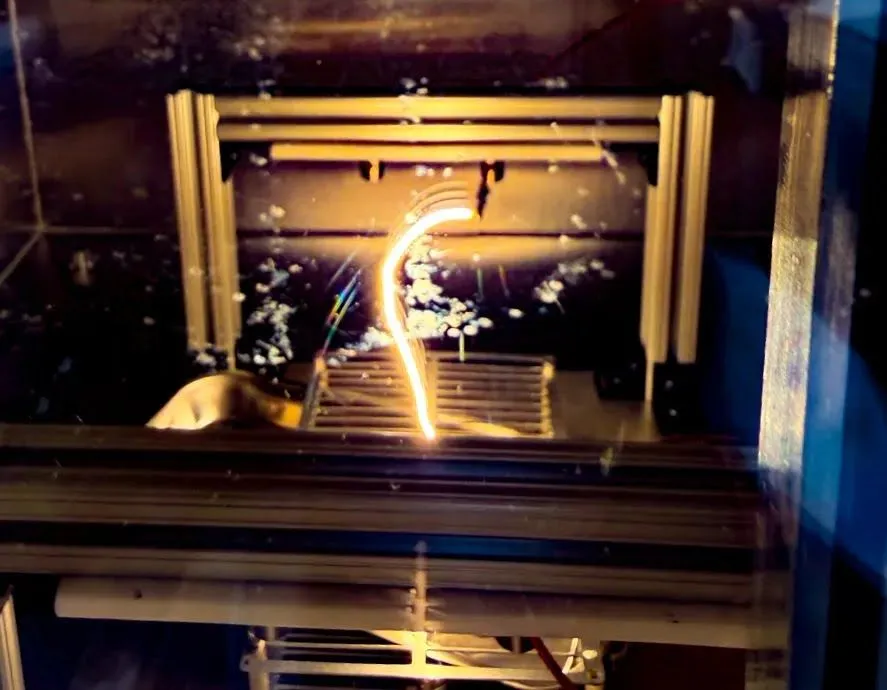
In the process the company disclosed, helium gas is first ionized inside a high-vacuum chamber using thermionic emission from a heated filament, generating a dense plasma. The resulting helium ions are then accelerated by an electric field and directed straight at ilmenite simulant particles at energies comparable to those of the solar wind.
This irradiation creates artificial microscopic lattice defects on the outer edges of the mineral grains, driving helium ions into the defects. According to the company's estimates, this irradiation apparatus delivers ions roughly 32 million times faster than the natural rate of solar-wind exposure, meaning that a fluence (cumulative irradiation dose) equivalent to about 15,000 years of lunar surface exposure can, in principle, be achieved in roughly four hours. However, the absolute fluence values being compared—both the natural baseline and the accelerated target—are not disclosed in the publicly available materials we were able to confirm.
The manufacturing and verification procedure is straightforward. First, electron emission from a heated filament ionizes helium to generate plasma, which is then directed at ilmenite particles with kinetic energy comparable to the solar wind. Next, artificial defects form on the mineral surface, fixing helium atoms inside; vacuum heating combined with mass spectrometry confirms desorption occurring between 300°C and 800°C. Finally, the gas-bearing ilmenite is blended with other terrestrial minerals to reproduce the soil characteristics of various lunar locations.
To confirm that implantation had been carried out correctly, the company incrementally heated the treated ilmenite inside a vacuum chamber and measured the desorbed gas using a quadrupole mass spectrometer. The results showed that helium was released in stages across a temperature range of roughly 300°C to 800°C. This thermal-release temperature profile is consistent with data from thermal desorption experiments conducted on genuine Apollo lunar soil samples in the 1970s.
The company states that by blending this gas-bearing ilmenite with other terrestrially sourced minerals, it has established a system capable of producing gas-bearing soil simulants—ranging from gram to kilogram quantities—tailored to the characteristics of specific lunar landing sites.
Comparison with Prior Research and Technical Boundary Conditions
Attempts to implant noble gases into minerals or simulants using ion beams in a laboratory setting have been conducted intermittently by the academic community for decades, aimed at elucidating the mechanisms of space weathering and reconstructing the environmental conditions of the early solar system.
In prior research using the Solar Wind Implanter (SWIM) apparatus at the Fusion Technology Institute at the University of Wisconsin–Madison, helium ion implantation experiments were performed on JSC-1A, a standard lunar regolith simulant, and it was reported that the resulting thermal release patterns resembled those of Apollo 11 samples. Additionally, in a study published in 2011 in the Journal of Environmental Sciences by a Chinese research team, helium-4 ions at an energy of 50 keV were irradiated onto crystalline ilmenite and lunar simulant, and their desorption characteristics were investigated. In this Chinese study, the overall shape of the release curve matched that of lunar soil, but the peak temperature was observed to shift slightly toward lower temperatures compared with genuine lunar soil—a discrepancy attributed to differences in long-term thermal diffusion and re-trapping effects that occur naturally over geological timescales.
More recently, a peer-reviewed paper published in 2026 in The Planetary Science Journal by Trivedi et al. (DOI: 10.3847/PSJ/ae6074) reported detailed crystallographic and microstructural analysis reproducing the amorphous rims characteristic of the lunar surface on the surface of ilmenite, using synthetic solar-wind irradiation with deuterium ions.
| Research Group | Year Published | Target Material | Irradiating Ion Species & Conditions | Primary Verification Method | Peer Reviewed | Main Purpose |
|---|---|---|---|---|---|---|
| University of Wisconsin (SWIM) | 2000s | JSC-1A simulant | Helium ions (keV range) | Thermal desorption gas analysis | Conference proceedings, etc. | Basic evaluation of gas-retention properties in simulants |
| Chinese research team | 2011 | Crystalline ilmenite, simulant | (50 keV) | Thermal decomposition mass spectrometry | Yes (J. Environ. Sci.) | Elucidation of irradiation defects and helium diffusion behavior |
| Trivedi et al. | 2026 | Ilmenite single crystal | Deuterium ion beam | Transmission electron microscopy (TEM), etc. | Yes (Planet. Sci. J.) | Elucidation of altered rim formation via solar-wind weathering |
| Interlune (this announcement) | 2026 | Ilmenite simulant particles | Accelerated helium plasma | Temperature-ramped mass spectrometry (300–800°C) | No (corporate announcement) | Manufacturing simulant for testing resource-extraction hardware |
Given this body of prior academic work, the novelty of Interlune's effort lies not in discovering a new principle, but in packaging the process into a manufacturing technology capable of supplying a meaningfully large quantity of test material for resource-extraction hardware.
However, closer scrutiny of this announcement reveals several important caveats.
The gas used in the demonstration was helium-4 (), not the rare isotope helium-3 () that is the ultimate target of future commercial mining. Citing prior literature (including a 1998 study by Kuhlman et al.), the company explains that because helium-4 and helium-3 have nearly identical diffusion properties within minerals, verification using helium-4 is sufficient from an engineering standpoint. Setting aside the slight difference in diffusion coefficients arising from isotope effects, this reasoning is physically understandable, but it should be noted that the demonstration itself did not directly show recovery of helium-3.
It is also worth noting that the validation criterion was limited to matching the thermal-release profile within the 300°C–800°C range. While matching thermal release temperatures is a necessary condition indicating that gas has been trapped within defects possessing a certain binding energy, it is not a sufficient condition. Real lunar soil undergoes complex, simultaneous environmental changes beyond solar-wind exposure alone—including the formation of agglutinate particles from micrometeorite impact melting and the precipitation of nanophase metallic iron (). Whether the artificial defects created by short-duration laboratory irradiation faithfully reproduce genuine lunar regolith in terms of implantation depth distribution, the microstructural density of defects, or interfacial behavior with coexisting minerals cannot be conclusively determined without detailed structural observation using techniques such as transmission electron microscopy (TEM).
The Energy Wall Facing Lunar Resource Development
Interlune's push to produce its own gas-bearing soil simulant is rooted in the unique design philosophy behind its lunar extraction hardware, called the "Harvesting System."
Most previously proposed technologies for extracting volatile gas from the lunar surface have relied fundamentally on "thermal extraction," in which the entire volume of collected regolith is heated to roughly 800°C–1000°C using solar furnaces or electric heaters. However, regolith has low thermal conductivity, and heating large volumes of sand uniformly to near 1000°C requires enormous amounts of electrical power. In a lunar environment where transportable mass and available power are both severely constrained, consuming megawatt-scale power purely as a heat source has been a factor driving hardware toward impractically large sizes.
In contrast, Interlune advocates a "mechanical extraction" approach that avoids bulk heating altogether, instead relying primarily on mechanical processing—abrasion, crushing, agitation, and the like—to liberate gas from the altered outermost layer of the mineral grains.
This approach is grounded in the physical picture that, because gas implanted by the solar wind is concentrated in the outermost tens of nanometers of a grain, it should be possible to extract that gas by efficiently breaking down and disturbing the brittle surface layer, without needing to heat the entire particle all the way to its core. The company has set a design target of reducing power consumption by up to a factor of ten compared with conventional bulk-heating methods using this mechanical technique. That said, the absolute power-consumption figures for each method being compared are not disclosed in the publicly available materials we were able to confirm, and this tenfold energy-efficiency figure represents the company's own design target rather than data validated through independent testing that simulates actual lunar conditions.
To verify on Earth whether a mechanical extraction system actually works, one must measure whether the designed amount of gas is released when appropriate stress and heat are applied to the particle surface. Because this verification cannot be performed using conventional gas-free simulants, securing gas-implanted simulant material has been a critical challenge in the company's hardware development effort.
To advance this research and development, Interlune established the Interlune Research Lab (IRL) near NASA's Johnson Space Center in Houston, Texas. The Texas Space Commission has decided to award the company a grant of up to $4.84 million through the Space Exploration and Aeronautics Research Fund (SEARF), with the grant period running through February 29, 2028. The company has raised $18 million in seed funding to date, and has also outlined a business plan to supply the simulant it manufactures, along with contract testing services, to other space agencies and private companies.
Remaining Scientific Questions and the Outlook for a 2027 Demonstration Mission
Even with this progress in Earth-based simulant synthesis technology, significant scientific and engineering uncertainties remain before lunar resource utilization can be realized.
As a next development step, the company plans to introduce a process for implanting hydrogen alongside helium. Hydrogen ions (protons), the dominant component of the solar wind, are known to chemically alter the crystal lattice by reducing iron oxide within ilmenite to form water () and hydroxyl groups (), which in turn affects the mineral's capacity to trap and retain gas. Progressing from helium-only irradiation to mixed helium-hydrogen irradiation will be necessary to build a material model that more closely approximates actual lunar conditions.
Three main verification challenges remain for lunar helium extraction. First, there is a lack of measured depth-distribution data on how much vertical mixing of gas has occurred due to past impact churning by meteorites at depths beyond the reach of the solar wind. Second, a quantitative assessment is needed of how much impurity gas or hazardous volatile material might be released alongside helium during mechanical crushing caused by impact or abrasion. Third, direct on-site verification is needed in unexplored regions to establish the correlation between titanium concentration maps derived from orbital observation and actual local gas concentration levels.
To address these challenges, Interlune is planning an uncrewed exploration mission called "Prospect Moon," targeting a mare region near the equator on the near side of the Moon, for 2027. The primary objectives of this mission are to measure the spatial distribution of helium-3 on-site and to operate a small extraction device under development directly in the lunar environment, thereby directly confirming the technology's feasibility.
The four-hour laboratory irradiation technique provides a foundation for smoothing out the development loop for lunar exploration hardware. However, whether it represents a genuine breakthrough for lunar resource development will ultimately be determined by the detailed materials-science data yet to be released and by the results of the lunar demonstration mission planned for 2027.