

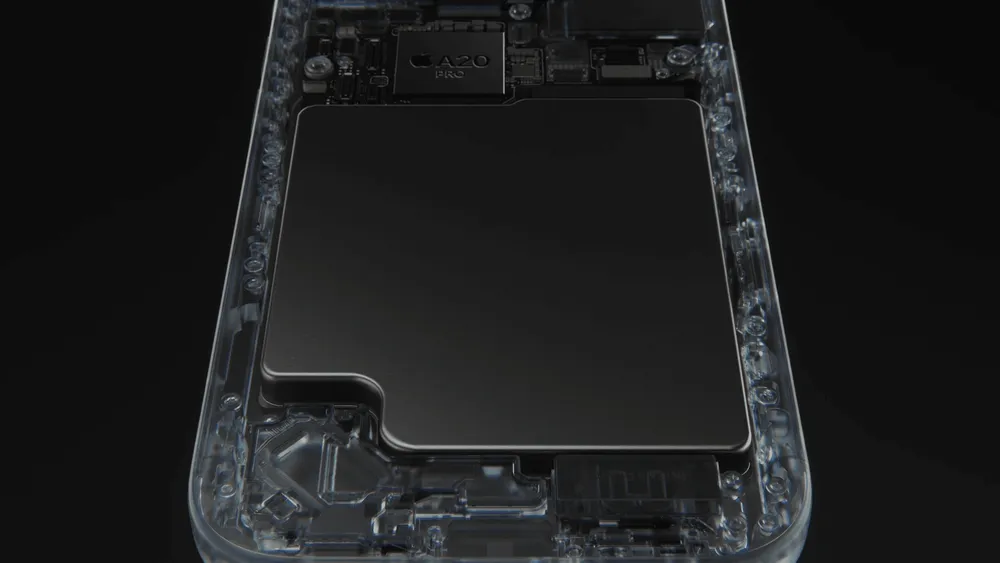
In a sustained-load test published by Geekerwan on September 16, 2026, the iPhone 18 Pro Max held 5.9W of power while keeping its surface temperature at 44.3°C. The previous-generation iPhone 17 Pro Max, by comparison, sustained 5.4W at 45.2°C. Apple's simultaneous redesign of the A20 Pro's packaging and its vapor chamber shows up not simply as "getting cooler," but as maintaining higher power than the prior generation while lowering the measured surface temperature. Still, this result alone doesn't mean the phone has surpassed Android gaming smartphones in performance.
What 5.9W and 44.3°C Together Reveal
Under the same sustained load, the iPhone 18 Pro Max drew 5.9W, the 17 Pro Max drew 5.4W, the OnePlus 15 drew 6.1W, and the iQOO 15 Ultra drew 5.9W with its fan off and 7.3W at maximum fan speed.
Surface temperatures in the same test were 44.3°C for the iPhone 18 Pro Max, 45.2°C for the 17 Pro Max, 47.2°C for the OnePlus 15, 47.2°C for the iQOO 15 Ultra with its fan off, and 46.2°C for the iQOO 15 Ultra at maximum fan speed.
| Device and Test Condition | Sustained Power | Measured Surface Temp |
|---|---|---|
| iPhone 18 Pro Max | 5.9W | 44.3°C |
| iPhone 17 Pro Max | 5.4W | 45.2°C |
| OnePlus 15 | 6.1W | 47.2°C |
| iQOO 15 Ultra, fan off | 5.9W | 47.2°C |
| iQOO 15 Ultra, fan max | 7.3W | 46.2°C |
Compared with the 17 Pro Max, the 18 Pro Max sustained 0.5W more power — an increase of roughly 9.3% — while its measured surface temperature dropped by 0.9°C.
The fact that both changes happened together matters. If only the surface temperature had dropped, it could simply mean the chip's performance was throttled earlier. If only the power had increased, it could mean the device simply ran hotter to maintain performance. Here, comparing large models from the same maker under the same load, sustained power — a rough proxy for how much heat the chip can handle — rose, while the measured case temperature fell. At least relative to the prior generation, this is consistent with an improved path for spreading heat and releasing it to the exterior.
That said, 44.3°C is not a temperature that feels cool to the touch. Surface temperature is not the same as the chip's internal junction temperature, and a higher reading isn't inherently bad. A design that moves internal heat to the case faster could result in a warmer exterior while still protecting the chip. What makes this figure meaningful is not the temperature in isolation, but its pairing with higher sustained power than the previous generation.
However, the published video doesn't fully establish room temperature, the load application used, or sensor placement, and the settings and OS versions of each device remain unknown. It's also unclear whether the 5.9W figure reflects the SoC alone or a device-level measurement. The numbers are a strong early signal of a design improvement, but they are no substitute for a lab comparison with disclosed conditions.
From A20 Pro's Packaging to the Vapor Chamber
According to Apple, the A20 Pro uses a 2nm process and places the silicon die and memory side by side rather than stacking memory on top in the heat path, as in previous designs. This allows the A20 Pro to connect directly to a next-generation vapor chamber. Apple also expanded the vapor chamber's surface area to three times that of the iPhone 17 Pro and claims sustained performance up to 40% higher. These three elements, laid out together in Apple's announcement, aren't separate improvements — they form a single heat-dissipation pathway.
A vapor chamber works by evaporating working fluid at the heat source and condensing it in cooler regions, moving heat concentrated at a single point across a wider surface. A larger area does create more room to spread heat, but "3x the surface area" cannot simply be read as "3x the cooling performance." Thermal resistance is determined by the entire path — the contact between chip and cooler, heat transfer to the chassis, dissipation to outside air, and even the device's orientation or whether it's in a case.
What stands out here is that the entry point to this path has also changed. Moving memory from atop the die to beside it thins the stack between the heat source and the vapor chamber. The die connects directly to the cooler, which then spreads the received heat across a surface three times larger. Add in the power-efficiency changes from the shift to 2nm, and it becomes impossible to separate how much of Geekerwan's observed 0.5W increase and 0.9°C decrease comes from the packaging, the vapor chamber, or the process shrink. What the measurements confirm is not the superiority of any single component, but the result of an integrated thermal design.
Apple's "up to 40%" figure also doesn't describe the vapor chamber's performance in isolation. It's a maximum value that depends on the comparison baseline, workload, duration, and temperature conditions, so the gap between 5.9W and 5.4W falling short of 40% is not a contradiction. At the same time, this particular test cannot be treated as reproduction evidence for that 40% improvement claim.
Not Yet a Win Over Android Gaming Phones
At the same 5.9W as the iQOO 15 Ultra with its fan switched off, the iPhone 18 Pro Max measured 2.9°C cooler. Compared with the OnePlus 15, its sustained power was slightly lower, but its surface temperature was also 2.9°C lower. Viewed as a large, passively cooled smartphone, Apple's new design has clearly entered the same territory as high-performance Android devices.
However, when the iQOO 15 Ultra's fan is set to maximum, it sustains up to 7.3W — 1.4W more than the iPhone. Its temperature of 46.2°C is somewhat higher than the iPhone's, but this can also be read as active cooling absorbing more heat generation and redirecting that headroom toward performance. The iPhone's lower temperature and the iQOO's higher power ceiling don't represent a win for one side or the other — they reflect different trade-offs between comfort and sustained performance.
The designs themselves also differ. OnePlus built the OnePlus 15 around 360-degree Cryo-Velocity cooling, aerogel insulation, and white graphite. iQOO equipped the 15 Ultra with an 8K vapor chamber and a 17×17mm, 59-blade cooling fan rated at up to 0.315 CFM of airflow. A fan can boost heat transport, but it also adds design challenges around power draw, noise, intake/exhaust pathways, and long-term protection against debris. The iPhone, with its sealed passive cooling, is pursuing a different product vision altogether.
Wattage also isn't frame rate. Differences in SoC architecture, game optimization, resolution, OS, and the scope of power measurement mean that the same 5.9W can translate into different rendering performance. What this comparison shows is how much power and surface heat each device tolerated under sustained load — not a ranking of "fastest gaming smartphone."
Other Tests Show Improvement, But Not the 40% Figure
In Tom's Guide's 3DMark measurements, the iPhone 18 Pro Max scored a stability rating of 79.4%, compared with 65.2% for the 17 Pro Max. That's a gap of 14.2 percentage points, which translates to a relative increase of about 21.8%. Simply writing this as "a 14.2% improvement" would confuse a percentage-point difference with a ratio. Apple's "up to 40%" figure describes sustained performance, while Tom's Guide's number is the ratio of the lowest score to the highest score during a stress test — neither the denominator nor what's being measured is the same.
The gap narrows further on the smaller model. In the same test, the iPhone 18 Pro scored 62.8% versus 61.1% for the 17 Pro — an improvement of just 1.7 points. This suggests the results seen on the larger 18 Pro Max, with its bigger chassis and 3x vapor chamber area, can't simply be generalized to the 18 Pro. Device dimensions and thermal mass shape sustained behavior even with the identical A20 Pro chip.
Real-world observations reinforce the general direction. TechRadar's review reported that during extended video recording, both the 18 Pro and 18 Pro Max still warmed up, but the temperature rise was gentler than on the 17 generation, with heat spreading more broadly and dissipating faster. The change isn't limited to a single benchmark figure — it also shows up in how heat spreads and how quickly it recovers. That said, this isn't a comparison under matched quantitative conditions and should be treated as a supplementary observation.
What to Check Before Buying
The benefits of the new cooling design are likely to show up not in benchmarks lasting a few minutes, but in tasks where heat accumulates over time: demanding games, extended high-resolution video capture, on-device AI processing, or video export. Even with identical peak performance, if the time before frequency throttling kicks in is extended and localized hot spots on the case are reduced, the performance users actually experience will change.
Making a purchase decision calls for at least three further checks:
- Compare against the previous generation with matched room temperature, case usage, screen brightness, network conditions, load duration, and sensor placement, in order to isolate differences caused by test environment.
- Measure not just power draw and surface temperature but also frame rate, 1% lows, and battery drain in actual games, to confirm whether the thermal design improvements translate into performance users can actually feel.
- Check whether the same trend holds not only on the larger 18 Pro Max but also on the smaller 18 Pro, in order to separate out the contribution of chassis size.
OS and game updates in the weeks ahead, along with unit-to-unit variation, could also shift these results.
At this point, the sturdiest conclusion isn't that the iPhone 18 Pro Max runs "cooler than Android gaming phones." It's that Apple redesigned everything from the chip's packaging to its heat-spreading surface as an integrated system, sustaining more power than the previous generation while lowering surface temperature. If this trend is reproduced across multiple independent measurements with clearly disclosed conditions, and if it translates into stability in real games going forward, then the true advance of the A20 Pro generation can be judged to lie not in peak performance, but in performance that holds up over sustained use.