


Storage pricing for Apple's iPhone 18 Pro has changed significantly from the previous generation. In the US, the upgrade from 256GB to 512GB stays at $200, but the upgrade from 512GB to 1TB doubles from $200 to $400. Behind the shift is rising prices for NAND flash memory, which is used to store data. According to estimates from The Wall Street Journal (WSJ) and research firm TechInsights, the component cost of adding capacity rose from the previous generation for both 512GB and 1TB. However, when the estimated component cost is subtracted from the extra charge buyers pay, 512GB and 1TB moved in opposite directions.
iPhone 18 Pro storage pricing: the 1TB model is $300 higher than last generation
Apple's US direct prices for the iPhone 18 Pro are $1,199 for 256GB, $1,399 for 512GB, $1,799 for 1TB and $2,399 for 2TB. All are pre-tax prices for purchases made without a carrier plan and without a trade-in. By contrast, according to Apple's US launch announcement, the previous-generation iPhone 17 Pro started at $1,099 for 256GB. Adding the per-capacity upgrade charges shown by the WSJ, the 512GB model works out to $1,299 and the 1TB model to $1,499.
Comparing the same capacities, the iPhone 18 Pro is $100 more at 256GB and 512GB, and $300 more at 1TB. However, the upgrade charge from 256GB to 512GB is $200 for both generations. The charge from 256GB to 1TB, on the other hand, rose from $400 to $600. The iPhone 18 Pro also adds a new 2TB model. In the previous generation, only the iPhone 17 Pro Max offered 2TB; the iPhone 17 Pro topped out at 1TB.
A comparison chart published by the WSJ includes WSJ and TechInsights estimates of the added component cost for each capacity. Using the 256GB version of each model as the baseline, the upgrade charges and estimated component costs compare as follows. The iPhone 18 Pro upgrade charges match the prices listed on Apple's US site.
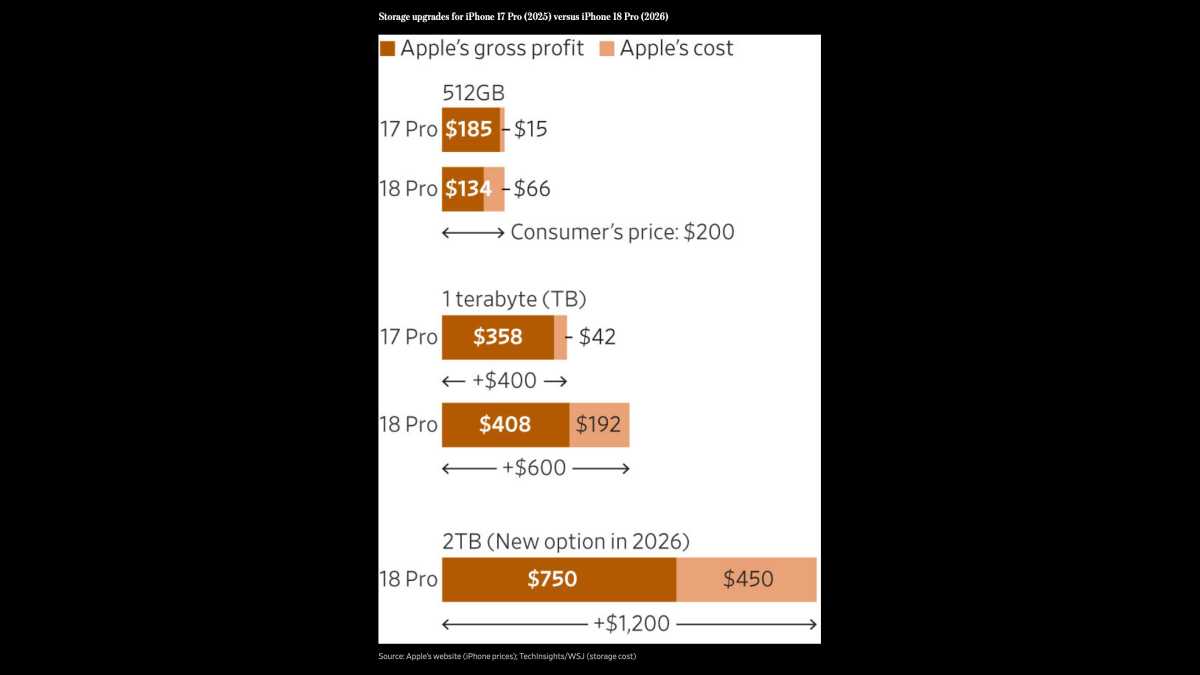
| US model and capacity | Upgrade charge from 256GB | Estimated added component cost | Difference between charge and estimated cost |
|---|---|---|---|
| iPhone 17 Pro, 512GB | $200 | $15 | $185 |
| iPhone 17 Pro, 1TB | $400 | $42 | $358 |
| iPhone 18 Pro, 512GB | $200 | $66 | $134 |
| iPhone 18 Pro, 1TB | $600 | $192 | $408 |
| iPhone 18 Pro, 2TB | $1,200 | $450 | $750 |
For the 512GB model, the estimated component cost of moving up from 256GB rose $51, from $15 to $66, yet the upgrade charge stayed at $200. As a result, the difference between the charge and the estimated cost fell $51, from $185 to $134. For the 1TB model, the estimated added component cost rose $150, from $42 to $192, but the upgrade charge rose $200, from $400 to $600. The difference therefore increased $50, from $358 to $408.
In other words, by this calculation Apple did not pass on the higher component cost in the 512GB upgrade charge, but raised the 1TB price by more than the increase in component cost. That said, the comparison covers only the upgrade charge and the estimated cost of adding capacity. It does not show the iPhone's total manufacturing cost or Apple's profit margin.
The 512GB-to-1TB upgrade doubles from $200 to $400
The most notable change for buyers is the price gap between 512GB and 1TB. On the iPhone 17 Pro, going from 512GB to 1TB cost $200; on the iPhone 18 Pro it costs $400. The estimated added component cost for the same step, meanwhile, rose $99, from $27 to $126.
These figures come from subtracting the 512GB values from the 1TB values for each generation. For the iPhone 17 Pro, the $200 charge against a $27 estimated component cost leaves a difference of $173. For the iPhone 18 Pro, the $400 charge against a $126 estimated cost leaves $274. Component cost rose $99, while the charge buyers pay rose $200, so the difference widened by $101.
When going directly from 256GB to 1TB, the ratio of the upgrade charge to the estimated component cost fell from about 9.5x ($400 ÷ $42) in the previous generation to about 3.1x ($600 ÷ $192). This is because the estimated component cost rose at a far faster rate than the upgrade charge. In dollar terms, however, the increase in the charge exceeds the increase in component cost, so the difference grew. The falling ratio and the growing difference do not contradict each other; they are the same data viewed from different angles.
Similar pricing can be seen in Japan. Apple's SIM-free iPhone 18 Pro is priced at ¥219,800 for 256GB, ¥254,800 for 512GB, ¥324,800 for 1TB and ¥429,800 for 2TB, all including tax. The charges between adjacent capacities are ¥35,000, ¥70,000 and ¥105,000 in order. The US follows the same proportions at $200, $400 and $600: with the first capacity step as the baseline, the next step costs twice as much and the step to the top tier costs three times as much.
Growing demand for AI server SSDs affects the NAND market
The supply and demand picture for NAND flash memory is key to understanding rising storage prices. NAND is non-volatile memory that retains data even when the power is off, and it is widely used in smartphone internal storage and SSDs. DRAM, which temporarily holds data while AI is processing, plays a different role. Enterprise SSDs and smartphone storage are also separate products, but because both use NAND, allocation of production capacity can affect supply and demand in each.
According to TechInsights' mobile memory price tracker published on September 10, 2026, the price of 256GB TLC UFS NAND rose from about $68 in June to about $82 in September. The firm forecasts it will reach about $92 in March 2027. The 96Gb LPDDR5 DRAM it tracks also rose, from about $140 in June to about $165 in September. However, the 256GB NAND figure is in bytes and the 96Gb DRAM figure is in bits, and the uses differ, so the prices cannot be compared directly. These are also market price indicators, not the specifications of components in the iPhone or Apple's actual procurement prices.
NAND price trends are not uniform across applications, either. In a research summary published on October 28, TrendForce said contract prices for enterprise SSDs, where demand is strong, are expected to rise, while demand for smartphones and PCs is weak and price negotiations have stalled because of slow inventory digestion. Even if demand for AI server SSDs grows, the resulting price increases will not necessarily spread to smartphone NAND at the same pace.
Increasing supply capacity also takes time. Kioxia's Fab 3 at its Kitakami site, announced in August 2026, is planned to start with land preparation, with an operational target within fiscal 2029. Details of the capital investment will be decided based on market conditions, and the investment assumes government support. Plans like this show that there is a lag of several years between rising demand and new production facilities coming online.
Apple's manufacturing-related purchase obligations rise by $32.7 billion
Changes can also be seen in Apple's procurement. According to the annual report (Form 10-K) the company filed on November 3, 2026, manufacturing-related purchase obligations reached $89.7 billion as of September 26. That is up $32.7 billion from $57.0 billion as of June 27. The amount due within the next 12 months also rose, from $56.2 billion in the prior quarterly report (Form 10-Q) to $82.7 billion.
Manufacturing-related purchase obligations represent the amounts Apple is contractually committed to pay for future component purchases, contract manufacturing and similar items. However, because they include contracts covering multiple components and manufacturing processes, it is impossible to determine whether the increase stems from NAND procurement. Nor is it possible to separate higher unit prices from higher purchase volumes, so it would be inappropriate to link the rise in obligations directly to rising memory prices.
To assess how capacity-based pricing affects Apple's earnings, it would also be necessary to know the actual procurement prices and how many buyers choose each of the 256GB, 512GB, 1TB and 2TB models. What the current estimates show is limited to the fact that the relationship between the component cost of adding capacity and the selling price has changed from the previous generation.
The key thing to watch is how Apple adjusts its per-capacity upgrade charges when mobile NAND contract prices move. In particular, it will matter whether the $400 gap between 512GB and 1TB on the iPhone 18 Pro is maintained, narrowed or widened. By continuing to compare component transaction prices with Apple's per-capacity retail prices, it should become possible to judge how much changes in the memory market are reflected in what buyers pay.