

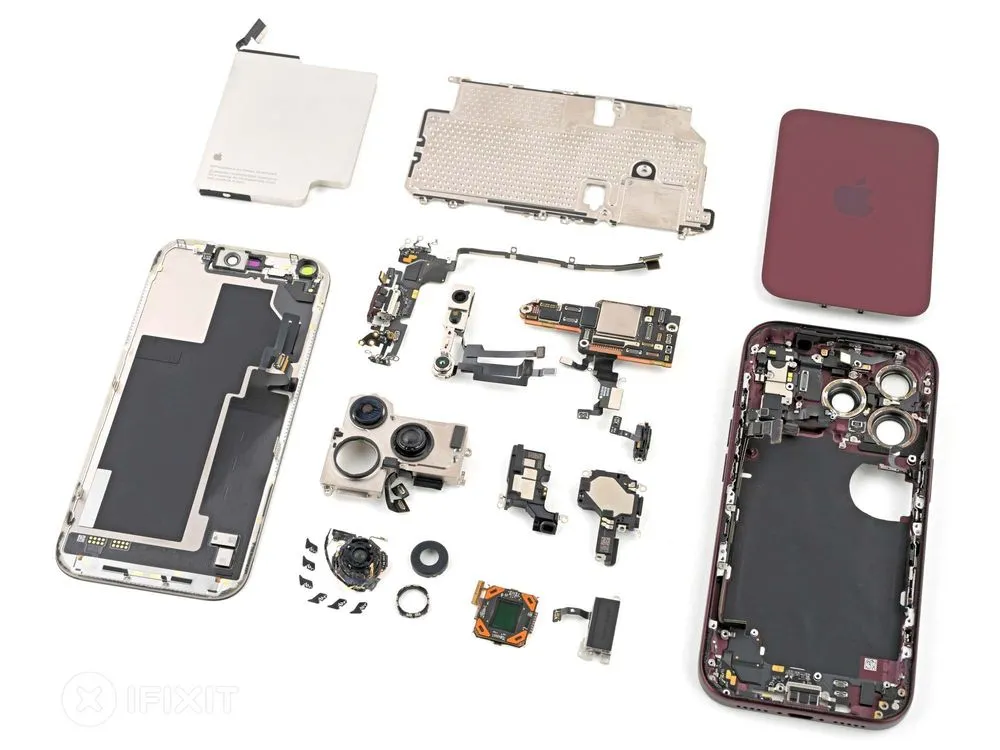
iFixit has taken apart the iPhone 18 Pro and Pro Max, showing the tiny blades of the variable aperture and the Face ID infrared camera that has moved beneath the display. Looking at Apple's announced features in the flesh reveals an aperture moved by magnets and a display whose pixels are thinned out to let infrared light through. Of the four phones iFixit opened, three suffered damage to the resin frame around the screen when the display was removed. Inside, the phone pairs cooling and camera improvements with designs that make the battery and camera easy to remove as complete units, but getting to them is difficult.
Six hair-thin blades, with the whole camera as the replacement unit
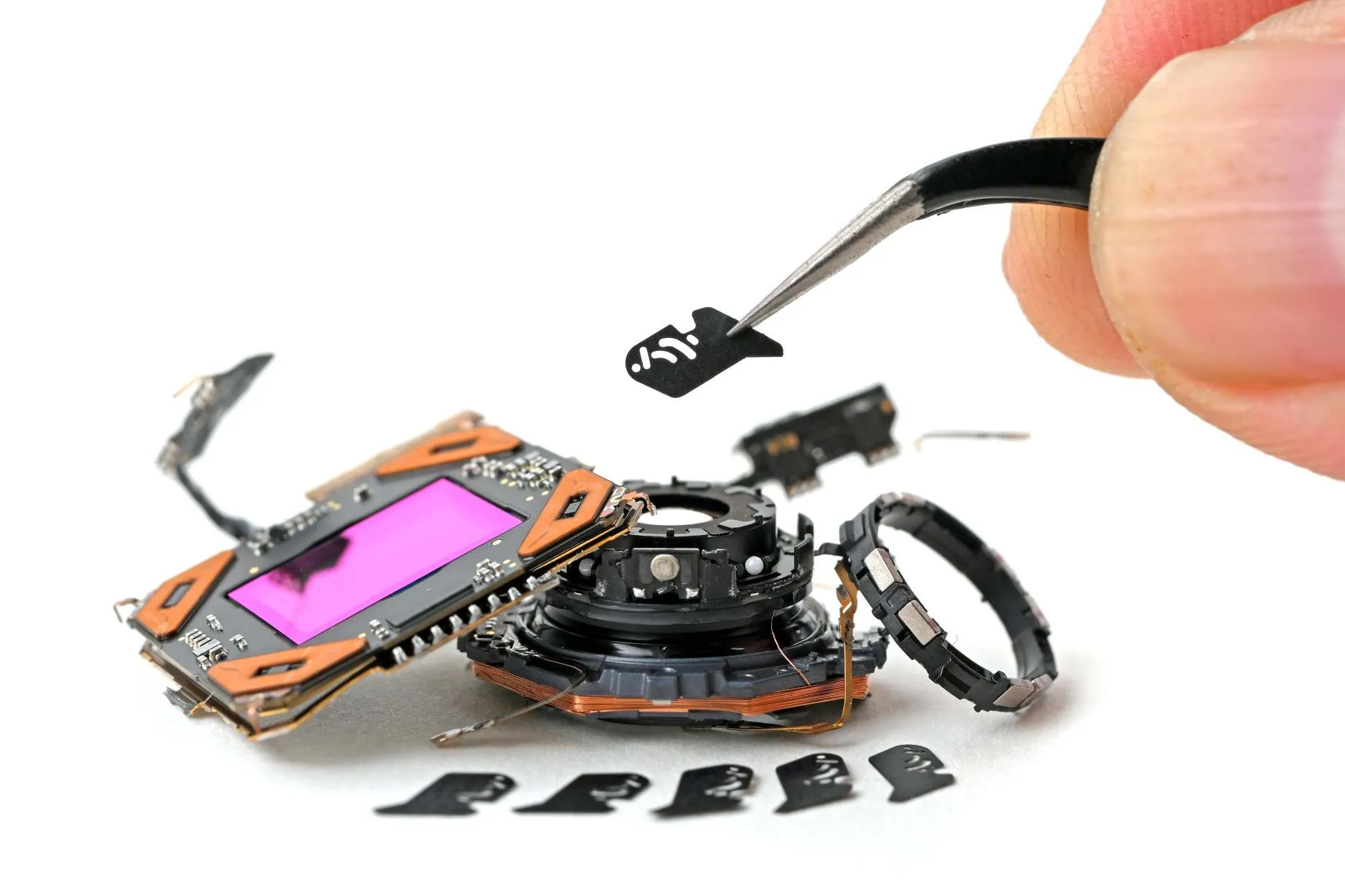
The main camera's variable aperture changes the path of light using six blades, each about as thick as a human hair. In iFixit's teardown, the aperture opened and closed when a magnet was brought near the mechanism, even with surrounding parts removed. Small holes and grooves in the blades engage pins on the drive mechanism, letting them overlap and move without snagging on each other.
Apple had already disclosed the six laser-cut blades. What the teardown shows is how the tiny mechanism is built and how hard it is to put back together once taken apart. While heating and prying off the lens cover, iFixit sent the blades flying, and only one could be made to move again. Because the tolerance for misalignment is tiny and the adhesive is hard to work with, the company judged that repairing only the blades inside would be extremely difficult.
That does not make the camera as a whole unreplaceable. The camera is a removable module, and iFixit says swapping it was easy on both models. Even if a blade fault cannot be repaired at the component level, replacing the whole camera remains an option. The criticism is that a minor fault requires replacing a large part.
In the Camera app, the aperture can be set in four steps from f/1.48 to f/4.0, with f/1.8 and f/2.8 in between. In comparison photos published by iFixit, background blur increased as the aperture opened, but tools and logos in the background were still recognizable. The same examples suggest limits to any expectation of strongly blurred backgrounds.
Apple's explanation, meanwhile, also covers gathering more light in dim scenes and stopping down to keep the back of a group photo sharp. The value of a variable aperture is not determined by background blur alone. iFixit's photo comparison cannot be extended to every shooting condition, nor can it be said that precision moving parts alone mean more failures; real-world durability and replacement costs will be factors to weigh later.
Under-display infrared camera: pixels removed in alternating rows

The Face ID infrared camera has moved under the upper-left part of the screen. Examining the area under a microscope, iFixit found that every other row of display pixels is missing, creating gaps for infrared light to pass through. Toward the edges, the pixel layout changes gradually, making the boundary hard to see with the naked eye.
Hiding a camera under the screen means solving the problem of display layers blocking light. Apple thinned out the pixels above the infrared camera to balance image display and the light path. The teardown confirms, from both the movement of components and the pixel arrangement, how the Dynamic Island could be made smaller.
The selfie camera and the dot projector, which casts infrared dots onto the face, remain in the central cutout. Not all of Face ID has moved under the display, and the selfie camera does not shoot through the display layers. The change is that the infrared camera used for authentication has been moved elsewhere while keeping the field of view of the camera that takes photos.
The front camera unit could be removed without screws or adhesive once its connection was disconnected. But the display has to be opened first, and software calibration is still needed after replacement. Ease of removing a part should be considered separately from the work of getting Face ID working again.
A20 Pro moves to the outside of the board stack, storage to the inside
The A20 Pro sits on the outer side of the stacked boards. Its predecessor, the A19 Pro, was on the inner side of the stack with memory layered on top, but this time the memory has also moved next to the processor. The layout keeps memory from sitting between the heat-producing chip and the cooling component.
The teardown shows in hardware the side-by-side packaging Apple described at launch. Between the A20 Pro and the vapor chamber, iFixit also found a soft thermal material that fills gaps at the contact surface. Microscope photos show a surface that can even look mesh-like, but iFixit has not identified the material's composition.
A vapor chamber spreads heat through a liquid inside that evaporates in hot areas and condenses in cool ones. According to Apple, this one has three times the surface area of the iPhone 17 Pro generation's. The chip layout change and the larger heat-spreading part are parts of one design, but teardown photos alone cannot measure how many degrees temperatures fall or how much performance rises. The figure of three times refers to the area of the heat-spreading part, not a multiple of cooling performance.
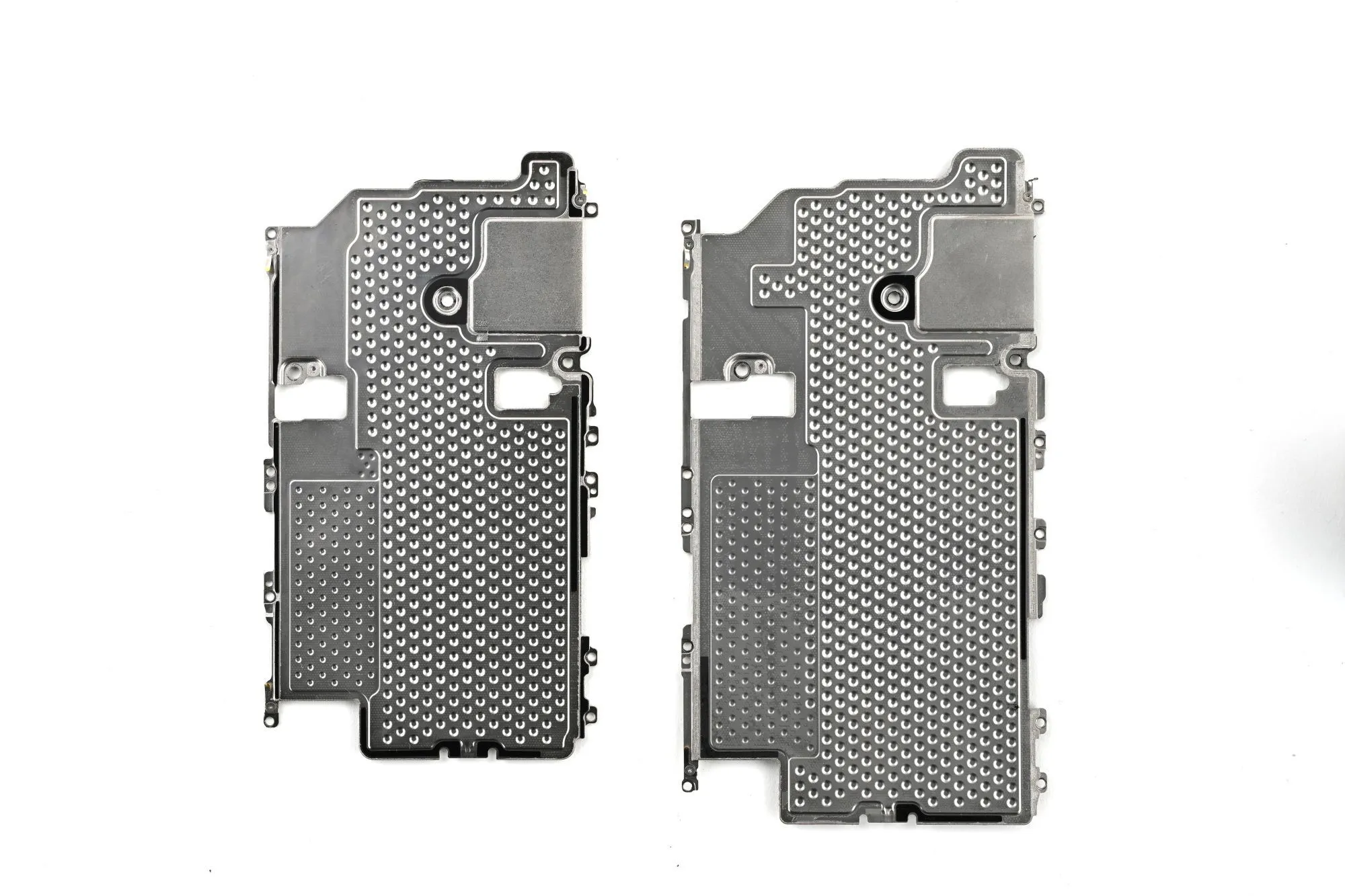
On the other side of the board, the NAND flash that stores data has moved to the inside of the stack. iFixit notes that repairs touching the NAND require separating the boards, which adds heat, labor time and the risk of damaging other areas. This is a constraint in board-level repair, which differs from everyday part replacement.
In data recovery, too, moving only the NAND to another device does not make its contents readable. Apple's data protection overview explains that encryption keys are managed hierarchically and combined with hardware encryption features. iFixit also explains that specialists generally repair the original board to a bootable state and extract a backup. The layout change adds work when access to the original NAND is required; it does not mean every recovery job now requires separating the boards.
There are regional differences in communications parts as well. iFixit reported that the US iPhone 18 Pro Max uses a Qualcomm modem, while other 18 Pro/Pro Max models use Apple's C2. The teardown results for the US Pro Max cannot simply be applied to models sold in other regions or to the smaller Pro.
Before the screwed-in battery, the screen frame cracks
The metal tray that holds the battery is secured with 13 screws and comes out together with the battery. This carries over the structure introduced with the previous-generation iPhone 17 Pro. If the whole tray is replaced, there is no need to peel off the battery adhesive.
The battery itself is glued to the tray. iFixit also found an adhesive that can be released with electricity; in the company's work, applying 12V for about 90 seconds separated the battery cleanly. Removing the whole tray and separating the battery from the tray are different jobs.
The problem was the process of reaching the tray. The rear glass can be opened, but what is accessible from the back is the wireless charging coil built into the panel; the battery is reached from the display side. Of the four phones iFixit opened, three had the white resin frame around the screen crack or peel away.
The display panel itself kept working after removal. But the frame is part of the screen unit, and fresh adhesive around the edge cannot repair cracked resin. The question remains whether it can be pressed back into place and closed without gaps. Work to replace the battery may end up requiring repair on the screen side.
Four phones is too few to estimate a general breakage rate. iFixit did open one without damage, and it says other teardowns avoided breakage. What made the difference, whether adhesive, heating conditions or technique, is unconfirmed. Nor is this a case of screens breaking during ordinary use.
The battery labels also revealed the capacities of the eSIM models that were taken apart.
| Model disassembled by iFixit | Battery energy | Battery capacity |
|---|---|---|
| iPhone 18 Pro (eSIM model) | 16.76Wh | 4,288mAh |
| iPhone 18 Pro Max (eSIM model) | 21.751Wh | 5,567mAh |
The source is the battery labels read by iFixit. The company says physical-SIM models have smaller batteries, so these figures should not be treated as values common to products in every region. Confirming capacity also does not reveal how long the battery will last in real use.
Easy-to-swap parts don't make the whole repair easy
The structures iFixit confirmed show that the battery and camera come out easily as complete units, while constraints remain in opening the screen, repairing inside the camera and calibrating after replacement.
The table below lines up iFixit's September teardown report and Apple's Repair Assistant explanation, checked on September 21, by repair stage. It separates physical structure from post-replacement software requirements.
| Repair target / step | Structure or work iFixit confirmed on the actual devices | General post-replacement requirement shown by Apple |
|---|---|---|
| Opening the screen | The entry point for most repairs. The surrounding resin frame broke on 3 of 4 phones | Display replacement is covered by Repair Assistant |
| Battery | Comes out with its screwed-in tray. Peeling the cell adhesive is a separable step | Battery replacement is covered by Repair Assistant |
| Rear camera | Replacing the whole unit is easy. Repairing and reassembling the aperture blades inside is extremely difficult | Rear camera replacement is covered by Repair Assistant |
| Front camera / Face ID | The unit can be removed without screws or adhesive | Face ID cannot be used for authentication until calibration completes |
| USB-C port | A separate part, but its long cable route has other parts and adhesive in the way | This table does not assess software requirements |
| Access to the NAND | Requires separating the stacked boards | This table does not assess software requirements |
The table is not a ranking of repair costs or success rates. It classifies iFixit's teardown observations by work step and adds Apple's general explanation for the relevant parts. Nor does it show that calibration succeeded for every model and every replacement part. Cases like the USB-C port, which can be replaced as a standalone part but takes effort to reach, show that modularity alone cannot evaluate a repair as a whole.
According to Apple, Repair Assistant installs the calibration data needed for replacement parts. It requires a Wi-Fi connection and the latest OS, and the battery must be above 20%. Until calibration is done, Face ID cannot be used for unlocking, payments or signing in to apps. Attaching a part and powering on may not finish the repair.
iFixit's provisional repairability score is 7 out of 10 for both models. It credits the battery tray and the removable camera, while the need to remove the screen for many repairs counts against it. However, the resin frame breakage itself has not yet been reflected directly in the score, because its cause and reproducibility are unknown. Checks of parts availability and software pairing are still under way.
To use this 7 in deciding on long-term ownership, one would need to see under what conditions the screen can be opened without breaking the frame, and how reliably replacement parts can be obtained and calibrated. If that is confirmed, the advantage of a screw-out battery tray can translate into a practical benefit: the phone stays easier to keep using after the battery degrades.