

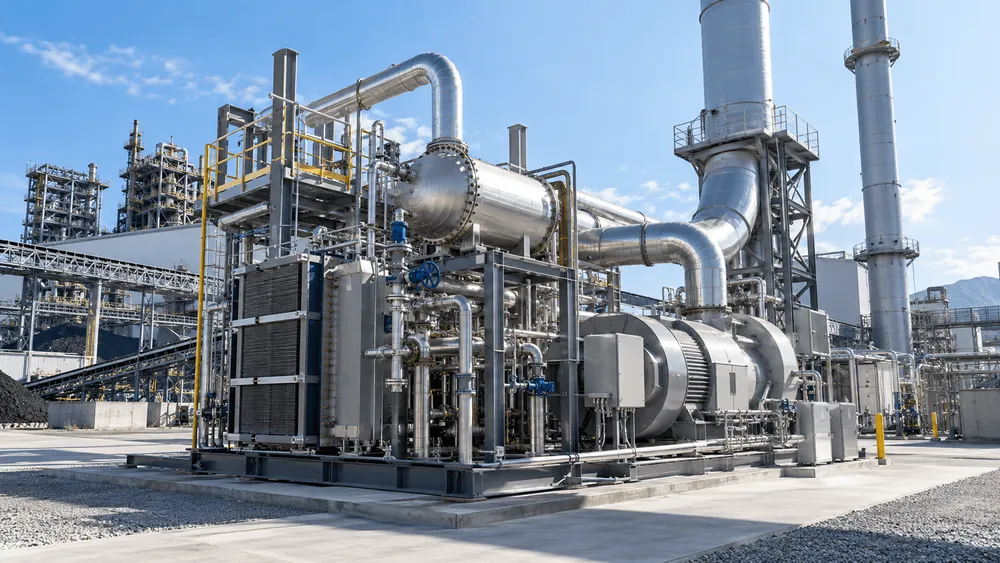
Kanin Energy, a clean energy company based in Calgary, Canada, and Houston, Texas, announced on September 16, 2026, that it has closed a new equity funding round of up to $100 million (approximately CAD $138 million) to expand its Waste Heat to Power (WHP) and onsite power generation business for heavy industry.
The round is led by S2G Investments (S2G), a U.S.-based investor in sustainable infrastructure, which is committing up to $50 million, matched by an equal contribution of up to $50 million from the Canada Growth Fund (CGF), Canada's federal public investment fund. The proceeds will fund the development, construction, and operation of projects that capture previously wasted heat at North American oil and gas, cement, and steel facilities—generating round-the-clock baseload electricity without consuming any additional fuel.
Turning Heavy Industry's Heat Into Power: Kanin Energy Raises Up to $100 Million as CGF and S2G Back Decarbonization Infrastructure
Kanin Energy is an independent power producer (IPP) specializing in converting industrial waste heat into electricity. Its target market is heavy industry—sectors that consume enormous amounts of thermal energy in their manufacturing processes while venting much of it into the atmosphere through smokestacks.
S2G, which led the round, committed up to $50 million through a structured finance strategy focused on asset-backed energy infrastructure. Its co-investor, the Canada Growth Fund, is an independent, $15 billion public fund established by the Canadian government, managed by CGF Investment Management (CGFIM), a subsidiary of PSP Investments. The pairing of public and private long-term capital is designed to accelerate the real-world deployment of capital-intensive industrial energy infrastructure.
Yannick Beaudoin, President and CEO of CGFIM, commented: "Investing in scalable clean technology strengthens the Canadian economy and helps create reliable, affordable power for heavy industry. Kanin Energy's waste heat-to-power platform delivers both real economic benefits and decarbonization—without requiring operators to shoulder capital expenditure."
Up to 58% of Heat Escapes: The Physics Behind Converting Low- and Mid-Grade Waste Heat Using the Organic Rankine Cycle
The scale of heat loss in industrial operations is enormous. According to Kanin Energy's estimates, up to 58% of the energy consumed in heavy industry manufacturing processes is released into the environment as unused waste heat. If this vast amount of thermal energy could be converted into electricity, industrial energy efficiency could improve dramatically.
However, conventional power generation systems have struggled to capture this waste heat. The steam Rankine cycle widely used in thermal power plants boils water at high pressure to create superheated steam that spins a turbine. To achieve sufficient thermal efficiency with a water-steam cycle and to prevent erosion of turbine blades caused by moisture, an extremely high-temperature heat source capable of producing superheated steam is essential. By contrast, exhaust gas temperatures from sources like refinery furnaces, pipeline compressors, and cement kilns typically fall in the low-to-mid range of 150°C to 350°C—a range where steam-based systems fail to deliver either economic viability or thermodynamic efficiency.
To overcome this physical barrier, Kanin Energy has built its platform around Organic Rankine Cycle (ORC) turbine technology, which has a long track record of industrial use. Unlike steam systems, ORC uses organic fluids—hydrocarbons or low-global-warming-potential refrigerants—with lower boiling points and higher molecular weights than water as the working fluid.
| Comparison | Conventional Steam Rankine Cycle (SRC) | Organic Rankine Cycle (ORC) |
|---|---|---|
| Primary working fluid | Water (steam) | Organic compounds (hydrocarbons, low-GWP refrigerants) |
| Working fluid boiling point | 100°C (at atmospheric pressure) | Can vaporize at room temperature or lower |
| Ideal heat source temperature | Ultra-high temperatures requiring high-temperature steam | Low-to-mid-grade waste heat (150°C–350°C) |
| Steam expansion characteristics | Prone to wet steam formation, risk of blade erosion | Dry expansion behavior, minimal turbine wear |
| Fuel consumption / additional emissions | Often requires additional fuel or high-temperature combustion | Operates solely on existing waste heat (zero additional fuel or emissions) |
The scale of waste heat loss in heavy industry and the recovery advantage of ORC: while up to 58% of the energy consumed by heavy industry (oil and gas, cement, steel) is lost as waste heat into the atmosphere, the Organic Rankine Cycle uses a low-boiling-point, high-molecular-weight organic working fluid to generate continuous baseload electricity from low- and mid-grade waste heat (150–350°C) that conventional steam cycles cannot capture—with zero additional fuel consumption and zero additional emissions.
Organic working fluids generate high vapor pressure even from heat sources in the 150°C to 350°C range. The fluid absorbs waste heat in a heat exchanger, rapidly vaporizes, and becomes a dense vapor that drives the turbine. Additionally, ORC working fluids exhibit a thermodynamic property known as "dry expansion," meaning they resist reverting to liquid form as they expand inside the turbine—reducing blade erosion caused by liquid droplets. As a result, maintenance requirements are minimized, enabling high-uptime operation through unmanned remote monitoring. As long as existing industrial processes continue to emit waste heat, the system generates continuous electricity around the clock, unaffected by weather conditions.
Zero-CapEx "Energy-as-a-Service": A Capital Model That Removes Heavy Industry's Investment Barriers
Even with superior generation technology, industrial companies have faced high barriers to adopting such systems on their own. For oil companies and steel manufacturers, building and operating power infrastructure falls outside their core business, making them understandably cautious about committing tens of millions of dollars in upfront capital expenditure (CapEx) and shouldering technical risk.
To break through this business convention, Kanin Energy has fully embraced an "Energy-as-a-Service" (EaaS) model. The company takes on full responsibility for every stage—from project design, procurement, and construction to asset ownership and day-to-day operation and maintenance (BOOT: Build, Own, Operate, Transfer).
Host companies—the factories and refineries where the systems are installed—bear no upfront investment burden whatsoever. Kanin builds the generation equipment onsite using its own capital and investor funds, then supplies the electricity produced to the host company on a "behind-the-meter" basis. Power is priced at a long-term fixed rate that is cheaper than grid electricity purchased from the local utility.
This allows industrial companies to reduce their electricity costs from day one without straining their balance sheets. Even if regional grid electricity rates spike, the fixed-rate structure provides long-term price protection, and by recycling their own factory's waste heat into their own power supply, companies directly reduce their Scope 2 emissions. Janice Tran, CEO and co-founder of Kanin, explained: "Kanin was founded on the belief that industrial facilities already hold the answer to their own energy challenges—what they need is simply the right partner to execute it."
Proven at Commercial Scale: University of Dayton's 100% Offset and Phillips 66's 7MW Mewbourn Project
Kanin Energy's work has moved beyond early-stage demonstration and now has a track record of commercial-scale operation and an active construction pipeline. The company's commercial portfolio, combining projects currently operating and under construction across North America, totals approximately 50MW.
A flagship example is the project at the University of Dayton in Ohio, which entered commercial operation in July 2026. The system is installed at a natural gas compressor station in Washington Court House, operated by Tallgrass on its Rockies Express Pipeline (REX)—a major energy infrastructure company.
Operational results and offset scale from the pipeline compressor waste heat project: the ORC power generation system, which utilizes waste heat from Tallgrass's Rockies Express Pipeline gas compressor station, produces approximately 78,000 MWh of zero-carbon electricity annually. This offsets 100% of the University of Dayton's annual electricity demand and reduces carbon dioxide emissions by approximately 55,000 tons per year—cutting the campus's overall carbon footprint by 71%.
Under a 15-year power purchase agreement (PPA) routed through local utility AES Ohio, the electricity generated is supplied to the University of Dayton campus. The project continues to operate as a model case demonstrating how fixed-price baseload procurement can be combined with greenhouse gas reduction.
Another major example is the "Mewbourn WHP Power Project," being developed jointly with U.S. energy major Phillips 66 in Platteville, Weld County, Colorado. The 7MW waste heat-to-power project captures heat from gas compression turbines within a natural gas processing complex.
The 7MW of electricity generated is supplied directly to the facility on a behind-the-meter basis. Because the power is consumed onsite without passing through the transmission grid, it functions as a power source that protects critical safety equipment from external grid outages or voltage drops. Without deploying any capital, Phillips 66 plans to simultaneously reduce operating costs and cut greenhouse gas emissions at its natural gas processing operations.
Grid Bottlenecks and Rising Power Costs: The Emerging Strategic Value of "Onsite Baseload" in North America
Behind Kanin Energy's success in securing this major funding round lies a structural crisis shaking the entire North American power market. The explosive growth of AI data centers, the construction of new factories tied to the reshoring of semiconductor and critical materials production, and the ongoing electrification of heating and transportation are converging to expand electricity demand across North American regions at a pace unseen in decades.
Transmission infrastructure expansion has failed to keep pace with this surging demand. At major U.S. and Canadian regional transmission and independent system operators (RTOs/ISOs), interconnection queues—the waiting lists for new generation projects to connect to the grid—now stretch five to seven years or longer. Companies looking to build or expand factories are increasingly told by utilities that they must wait years to secure the power they need. On top of this, industrial electricity rates continue to climb as a result of grid congestion and the need to upgrade aging infrastructure.
In this tightening environment, onsite waste heat power generation offers a decisive advantage. Because it captures heat from compressors and furnaces already operating onsite, it requires no waiting for new long-distance transmission lines to be built. Without placing any additional strain on the external grid, facilities can immediately secure several to more than a dozen megawatts of clean power onsite.
Marisa Sweeney, Principal at S2G, noted: "Waste heat has historically been an underappreciated solution, but as grid constraints persist and power prices keep rising, the incentive to capture that heat and put it to productive use has never been clearer or more urgent."
Unlike solar or wind power, whose output fluctuates dramatically with weather conditions, waste heat generation maintains steady output in sync with a factory's operating rhythm—making it well-suited to industrial use as a baseload power source. Because the amount of waste heat generated is tied to a factory's operating rate, some operational adjustments are still required, such as designing backup power arrangements for scheduled maintenance shutdowns. Even so, Kanin Energy's work—turning heat that would otherwise escape unused into the atmosphere into valuable electricity onsite—points to a practical breakthrough that transforms decarbonization from a cost burden into a weapon for industrial competitiveness.