

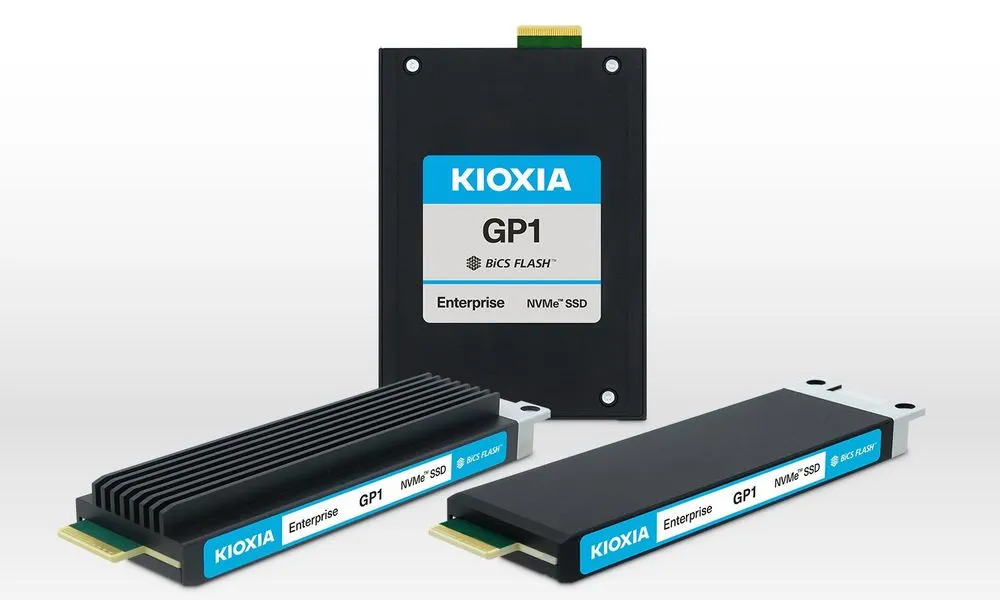
Kioxia has given its first product name to the GP Series, whose development it had previously announced. The GP1 supports PCIe 6.0 and NVMe 2.2, and claims up to 10 million IOPS at 512-byte random reads. It is an SSD designed for AI configurations in which GPUs access storage directly.
Storage performance for AI servers cannot be measured by sequential transfer speed alone. In use cases where small pieces of data are accessed frequently during inference, the granularity of reads and the speed of response become the premises of the design. The GP1 is aimed squarely at this area.
With GP1, the GP Series Enters the Product Stage
In March 2026, Kioxia had announced development of the GP Series, premised on direct access by GPUs. At the time, the plan was to provide evaluation samples to selected customers by the end of 2026. The GP1 is the first-generation product in this series.
The maximum performance figure now presented for the GP1 is 10 million IOPS at 512-byte random reads. This is a maximum value claimed by the product itself, not an independent benchmark result. Whether the same figure would be achieved with writes, mixed I/O, or any given AI workload cannot be determined from this number alone.
Simply multiplying 10 million reads by 512 bytes yields a data volume of 5.12 billion bytes per second, or 5.12GB/s in decimal notation. However, this is a figure derived from the headline IOPS number, not a published value representing the GP1's sequential bandwidth.
Targeting Small 512-Byte Reads
The GP1 combines second-generation XL-FLASH with a dedicated SoC. In Kioxia's Investor Day materials, the GP Series is described as the tier responsible for 512-byte granularity access and high IOPS, given the role of extending GPU memory outward. Meanwhile, the CM Series handles high-bandwidth KV cache movement, and the LC Series handles large-capacity data storage—this is the division of roles.
Kioxia describes NVIDIA Storage-Next as a mechanism by which GPUs access flash-based memory, complementing and extending HBM. However, the GP1 is not a product that replaces HBM. Only once the supporting stack—including the GPU-side connectivity and software—is in place can it be incorporated for this use case.
XL-FLASH's official page states that, as a memory technology, read latency is under 5 microseconds. It also shows options such as a 16-plane configuration and SLC/MLC selection, but these are specifications for XL-FLASH alone. They are not figures representing the GP1's end-to-end latency or QoS.
Numbers Against Optane Can't Be Compared As-Is
When comparing high-IOPS SSDs, lining up IOPS figures alone drops out important conditions. Intel's Optane SSD DC P5800X specified up to 1.5 million IOPS at 4K-byte random reads. Against this, the GP1's 10 million IOPS is a figure at 512 bytes—the block sizes differ.
Intel's product materials also contain a separate figure: for metadata reads on the P5800X, up to 5 million IOPS at 512 bytes. Therefore, directly comparing the GP1's 10 million against the P5800X's 1.5 million at 4K bytes does not yield a conclusion about superiority under identical conditions. Neither product's numbers come from direct benchmarking, and the test conditions do not match either.
The P5800X had specifications of PCIe 4.0 x4 and up to 100 DWPD, but has already been discontinued. Based solely on currently published information, it cannot be concluded that the GP1 is a successor to, or equivalent of, Optane.
Conditions Remaining Before It Enters Servers
The GP1 supports E3.S and E1.S in 9.5mm or 15mm form factors. Air cooling can be used across all form factors, and E3.S and E1.S 9.5mm also support liquid cooling via cold plates. Endurance is stated as up to 50 DWPD, but this is an upper limit for the product line or per configuration, not a guarantee across all capacities and all workloads.
Meanwhile, capacity and price have not been disclosed. Sequential read/write performance, queue depth, detailed latency, QoS, and the test system are also undisclosed. Combined with the software environment for GPU direct access that it supports, how much performance can actually be achieved in real systems has also not yet been shown.
The GP1 was not announced as a consumer SSD. What is to be evaluated is a server configuration that brings GPUs and storage closer together, and under what conditions fine-grained random reads can be sustained.
100M IOPS Is a Goal for the Next Generation
Kioxia's official materials position the first generation as PCIe 6.0 and the second generation as PCIe 7.0, indicating a direction toward targeting 100M IOPS with the latter. First-generation samples are slated for the second half of 2026, and the second generation around 2027, though both are subject to change.
What should be distinguished here is the GP1's current product claims versus its future vision. The current GP1 claims up to 10 million IOPS at 512-byte random reads; 100M IOPS is a target for the next generation. Once evaluation samples emerge and capacity, latency, QoS, and real-system behavior are demonstrated, it will be possible to judge the true picture of this product as a storage tier for GPUs.