

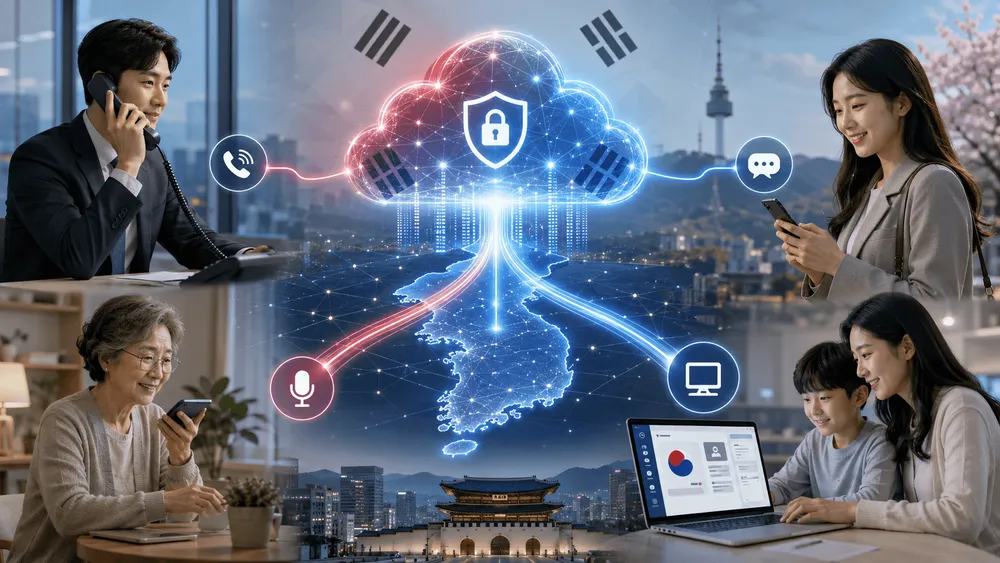
On August 28, 2026, South Korea's Ministry of Science and ICT selected three consortiums led by SK Telecom, Kakao, and KT to operate "AI for All," a nationwide free AI service. Six groups applied, and the government will provide a total of 512 NVIDIA B200 GPUs for the official launch later this year. The core AI chatbot will be free, with no usage cap for normal use. However, this is not a policy of handing every citizen a uniform, free version of a paid commercial AI plan. It is a public-private service in which the government has set detailed rules for which features are free, how usage is controlled, the conditions for using domestic models, and the scope of public funding.
What 'Free and Unlimited' Actually Means
The public tender required each consortium to provide three types of services. Under South Korea's "AI for All" program, the general-purpose AI chatbot and the public AI agent must be free, while company-specific specialized AI agents can be monetized. The general-purpose chatbot must not impose fees or usage limits on ordinary users, though providers may throttle speed and simultaneous connections and block abnormal, automated mass requests. Even where ads or paid add-on features are offered, they must not interfere with smooth access to the free service.
| Service | Charged to Users | Key Conditions |
|---|---|---|
| General-purpose AI chatbot | Not allowed | No usage limits for normal use |
| Public AI agent | Not allowed | Helps users find public services, from guidance to application support |
| Company-specific specialized AI agent | At provider's discretion | Can include paid add-ons, ads, partnerships, and B2B offerings |
The National IT Industry Promotion Agency (NIPA) requires that operations be run so that ordinary users do not feel constrained. Providers are not permitted to segment users by purpose — whether work, study, research, creative work, or business use — and must instead base any controls on usage behavior.
Therefore, "no usage limit" does not mean unconditional access to computing resources. The program balances a provision principle of not setting monthly token quotas for ordinary citizen use with traffic controls designed to keep the service running. The actual speed and number of simultaneous connections have not been disclosed, so we will need to wait for the official terms of service and see how the system behaves under heavy congestion.
The public AI agent is envisioned as a tool that first informs users of support programs suited to them, then handles the application process on their behalf. Applicants were also required to submit a roadmap for evolving this into a "one person, one AI agent" system from 2027 onward, one capable of handling reservations and payments. However, this is a future development goal, not a promise that a finished version will reach every citizen within the year. The government did not specify the scope or targets of the beta program, leaving that to each provider's own plans.
Why 50% Plus 30% Doesn't Add Up to 80%
The requirements of "at least 50% domestic models" and "at least 30% domestic models from other companies" are measured along two separate axes — the first by model type, the second by developer — based on output tokens. The tender's FAQ explicitly rejects the idea of adding these two figures together to read "at least 80% domestic, at most 20% foreign." Through this rule, the "AI for All" program subsidizes usage fees while channeling work toward domestic AI.
At the application stage, reviewers examine the model configuration and routing design rather than measured performance. Once the service launches, output tokens are attributed to whichever model actually generated the text. Input tokens and non-generative processes such as embedding or classification are not counted. When multiple models are called in parallel, the output each one generates is tallied separately.
These two ratios sit on different axes. The 50% figure measures "model type" — whether a model is a foundation model independently pre-trained from scratch. The 30% figure measures "developer" — who built the model — and affiliates within the same corporate group as the lead company count as in-house. If another company supplies a domestic model that meets its own independent criteria, that model's output can count toward both requirements.
Foreign models are restricted to the minimum functionality needed to improve service quality, and their API usage fees may not be covered by either government subsidies or the company's own contribution to the project budget. Any remaining room in the ratio does not automatically translate into a quota for using foreign models.
The rules curb two kinds of bias. They require a certain amount of use of domestic foundation models, while also preventing the lead company from filling the service entirely with its own models. By expanding free usage and distributing the resulting output tokens across multiple domestic developers, the government is trying to link model development directly to real-world service demand.
Phone, Messenger, and Portal: How the Three Consortiums Will Compete
The SK Telecom consortium plans an AI accessible not only through an app and the web but also via phone calls and SMS. It will also develop a feature that links with Government24 and the identity verification service PASS to obtain 83 types of official documents, including resident registration certificates. When the AI makes reservations or phone calls on a user's behalf, the plan calls for confirmation and approval from the user at each step, with personal information use kept to a minimum. According to SK Telecom, 20 organizations are participating in the consortium and it has signed MOUs with 11 more, bringing the total number of involved organizations to 31.
The Kakao consortium will use its widely used messenger app as the entry point, combining the chatbot and AI agent into a single service. Kakao plans to release a Lite version of a phone-based AI with LG Uplus within the year. It will also build a marketplace where outside companies can develop, test, and distribute specialized agents, expanding into areas such as senior care and tax services.
The KT consortium will place AI entry points not only in the Daum portal and app but also in partner services such as Danawa, Musinsa, and Zigbang. It plans to connect KT's telecom network and IPTV service as well, offering specialized services in education and real estate.
Placing the three plans side by side shows that post-selection competition will not be decided by model benchmarks alone. Adoption rates will hinge on how naturally users can move from their existing daily routines — phone calls, messaging, portals — into AI. Connections to public data and administrative systems are only at the stage of talks beginning with relevant ministries, so functions like issuing certificates or booking hospital appointments are not yet actually available. Turning these plans into genuine public services will depend on implementation details such as correcting mistaken guidance, canceling applications, and identity verification.
The Role of 512 B200 GPUs and What Happens After 2027
The government will provide up to 512 B200 GPUs in total in 2026, to be used for development and the initial launch within the year. Because these will be lent out as an online, Kubernetes-managed cluster, physical GPUs are not being handed over to the three companies. As of August 28, the specific allocation order and number of units per company had not been disclosed.
Sustained, nationwide operation will be carried over into the budget from 2027 onward. The government intends to support the necessary infrastructure and costs, but the method and scale will be determined only after discussions between relevant ministries and the National Assembly. Applicant companies were also required to submit plans for maintaining the service using their own infrastructure or additional funding if user growth exceeds the level of government support. The figure of 512 GPUs is not a guarantee that limits on free usage will disappear; it is initial equipment meant to gauge demand.
Options for covering ongoing costs include paid specialized agents, advertising, and enterprise-facing business lines. The Ministry of Science and ICT also cited revenue models based on users' prompt data as one example. Meanwhile, NIPA's FAQ stipulates that personal information should in principle be deleted, and that user consent must be obtained if such data is used. Each provider is responsible for storing and managing the data; the government does not directly collect or view it, but oversees compliance with protective measures.
Each consortium submitted year one-through-year-five targets for monthly active users, average monthly token usage, return-visit rates, and satisfaction. However, neither the selected figures nor any nationwide usage targets have been made public. The scope and targets of the beta program have also been left to each provider's own proposals. Once the September agreements and each company's beta rollout clarify usage eligibility, congestion controls, prompt retention periods, and the division of responsibility for public procedures, it will become possible to judge the conditions under which free AI can continue to serve as living infrastructure.