


The long-standing power structure in the semiconductor industry has reached a major turning point. In January 2026, an analysis by Citrini Research, based on survey data from Mercury Research and Bernstein Research, revealed that in the laptop CPU market, Apple and AMD have each reached a market share of roughly 20%, putting them in a neck-and-neck race.
The stronghold that Intel once held—dominating over 80% of the market as part of the "Wintel" (Windows + Intel) alliance—has been steadily eroded over the past five years. This fact indicates that Apple's complete transition to the Arm architecture and AMD's technical leaps forward have emerged simultaneously as "two distinct threats," fundamentally transforming the very structure of mobile computing.
In this article, based on the latest market data, we will examine the deep structure of this "tripolarizing" CPU market and the technology trends expected from 2026 onward.
The Weight of "20%": The Collapse of the Intel-Dominant Era
Prior to 2018, Intel held an overwhelming share of over 80% in the laptop CPU market. In the desktop market, its dominance approached 90%, with rival AMD relegated to a niche presence. However, the latest data shows that this premise has completely crumbled.
The Structure of Share Loss
According to the newly revealed data, the expansion of Apple's and AMD's shares has pushed Intel's share down by more than 20 points since 2018. Intel currently still maintains about 60% share and remains the largest player, but its dominance has weakened to an unprecedented degree.
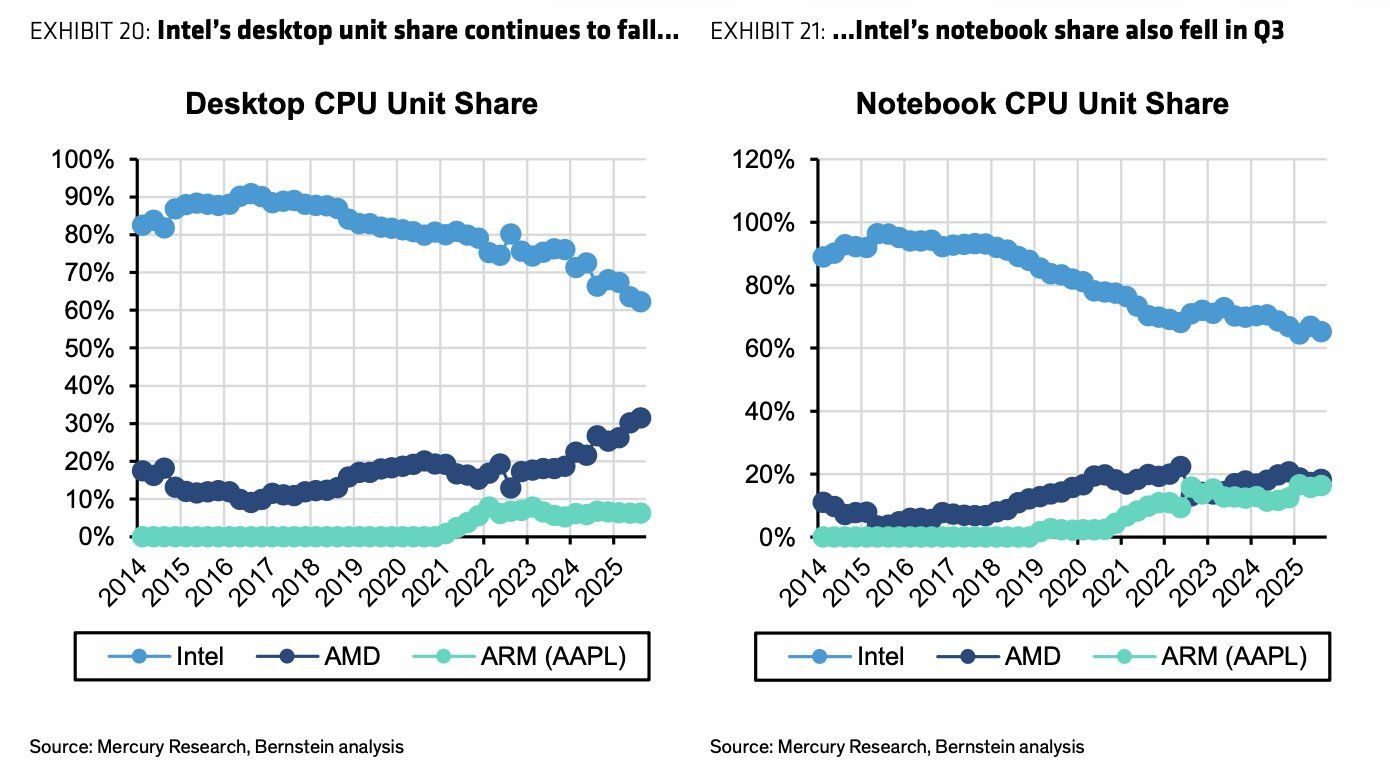
What stands out is the difference in approach between Apple and AMD.
- AMD: As an x86-compatible CPU, it took a direct competitive stance on performance (Ryzen), eating into Intel's share within the Windows ecosystem.
- Apple: By abandoning x86 and transitioning to its own Arm-based silicon (Apple Silicon), it locked users into its own platform entirely, pulling them out of the Intel market altogether.
This "pincer movement" is the primary factor driving the former giant into a corner.
Apple Silicon's Gamble: The "Inevitable 20%" Brought by Vertical Integration
The fact that Apple's laptop market share has reached a level on par with AMD carries significance beyond mere hardware success. This is because it's extremely unusual for a "closed platform"—where consumers can only choose PCs from a single manufacturer—to achieve a share equal to that of an "open platform" (AMD-equipped Windows PCs) with countless manufacturers participating.
Five Years of Progress and the Maturation of the M-Series
In November 2020, Apple announced its break from Intel chips and released its first-generation "M1" chip to the world. In the five-plus years since, Apple has accelerated MacBook sales through the following lineup rollout:
- Entry-level tier: The MacBook Air (M1 through M4), which popularized overwhelming battery life and a fanless design.
- Pro tier: The M4 Pro / M4 Max chips, which brought desktop-class processing power into a portable form factor.
This share growth is the result of Apple's relentless pursuit of improved battery life and macOS optimization. Behind the "20% share" figure lies not only the replacement-cycle demand from users who had been using Intel-based Macs, but also the acquisition of new users drawn to the chips' power efficiency.
Additionally, in the desktop market as well, Apple has steadily maintained a share of about 10%. This suggests that product lines such as the "Mac mini" and "Mac Studio" have deeply penetrated specific segments of creative professionals and general users alike.
AMD's Fierce Pursuit: Overwhelming Support Among Gamers and the DIY Market
While Apple has grown its share through its own ecosystem, AMD has been fighting—and winning—against Intel on pure "performance for the price."
The Achievements of 3D V-Cache and the Zen Architecture
AMD's rise has been underpinned by the cumulative progress made since the introduction of the "Zen" architecture in 2017. Particularly in the desktop market and high-end laptops, the following factors have driven AMD's share expansion:
- Gaming performance: The X3D series, equipped with 3D V-Cache technology, frequently outperforms Intel in gaming performance, and surveys of Steam users show AMD CPU usage rates exceeding 40%.
- Intel's missteps: The instability issues that occurred with Intel's 13th and 14th Generation Core processors (Raptor Lake) shook consumer trust and accelerated the shift toward AMD, which offered stable performance.
AMD is currently pushing into the market with processors built on the Zen 5 architecture, and in particular is aiming to capture the next generation of AI PC demand with mobile processors—such as the "Ryzen AI 400" series—that integrate NPUs (Neural Processing Units).
Outlook for 2026: Intel's Counterattack and the "Fourth Force"
The market currently consists of a "one dominant, two mid-tier" structure—Intel (60%), AMD (20%), Apple (20%)—but this balance is extremely fluid. In 2026, each company will attempt to change the status quo using its own trump card.
Intel's Moment of Truth: Panther Lake and a Process Node Overhaul
Of course, Intel is not simply standing by and watching. The newly launched "Core Ultra 3" series (development codename: Panther Lake) will be a product on which Intel's fate hinges. It will be the first processor manufactured on the company's own "14A (2nm-class)" node, and is expected to serve as a powerful rival to Apple Silicon and Ryzen in both power efficiency and performance. For Intel, the focus is not on reclaiming the 20% it has lost, but on whether it can build a levee to stop any further erosion.
The Stirring of Arm-Based Windows
Furthermore, while still statistically minor, the movement of "Arm-based Windows" is not something to be ignored. In addition to the Snapdragon X series that Qualcomm launched in 2024, NVIDIA is also rumored to be entering the Arm-based consumer CPU market.
According to Mercury Research data, the current Arm CPU market is, in effect, an Apple monopoly. But if Arm adoption within the Windows environment becomes widespread, Intel and AMD (the x86 camp) will face further share erosion. That said, as of now, it cannot be said that user enthusiasm and compatibility challenges have been fully resolved, and 2026 will likely still remain a "run-up period" before wider adoption.
The Benefits to Consumers from Three-Way Competition
The tripolarization of the CPU market means that the pace of technological evolution is accelerating like never before. The principle of competition is simple: Intel must keep developing higher-performance, more power-efficient chips to defend its position, AMD must do the same to seize more share, and Apple must do the same to complete its own self-contained world.
In the coming years, consumers will be forced to make a more fundamental choice than simply "which OS to use"—namely, "which chip architecture best suits my workflow." The fact that Apple and AMD have each captured 20% of the market is the clearest proof that the era when Intel was the only option has become a thing of the past, and that a diverse range of choices has now taken root in the market.
Sources
- Jukan (X)