

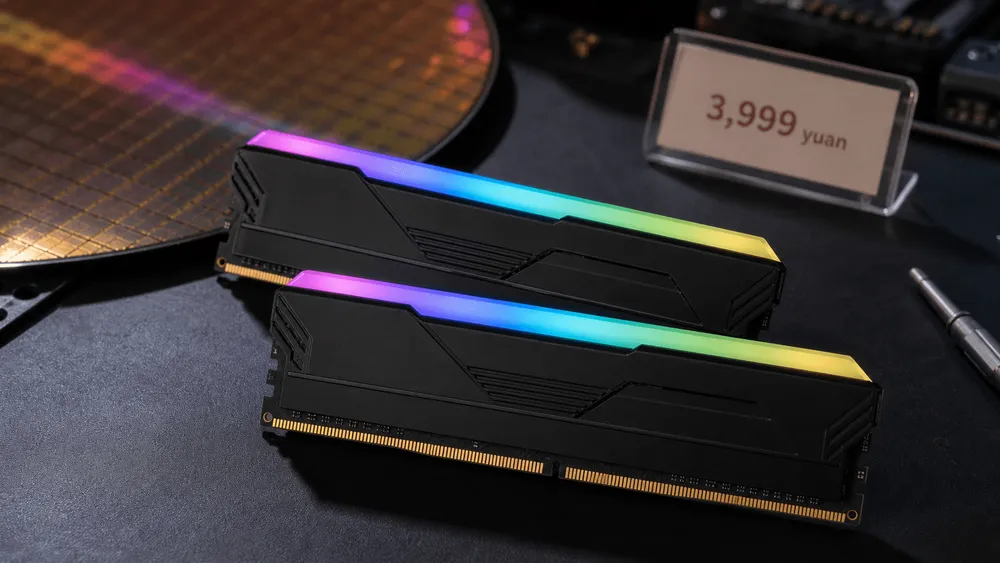
Lexar has listed a 32GB "THOR RGB DDR5 Gen 2" kit using domestically produced Chinese DRAM on JD.com for the Chinese market. The kit consists of two 16GB modules, running at 7200MT/s with a CAS latency of CL38. According to pricing confirmed by Tom's Hardware on August 3, 2026, the kit costs 3,999 yuan (approximately ¥93,300). While the arrival of Chinese-made DRAM in high-clock-speed products is significant, the price point poured cold water on expectations that "more suppliers means cheaper PC memory."
From 6000 to 7200: THOR's Role Has Shifted
The original THOR RGB DDR5, announced by Lexar in November 2024, topped out at 6000MT/s. The company's high-performance tier was instead handled by the ARES RGB Gen 2, which used SK hynix DRAM and reached speeds of up to 8000MT/s. This new China-market THOR represents a 20% increase in transfer speed over the previous generation, pushing into the 7200MT/s range.
While the JD.com product listing mentions "domestic DRAM," it doesn't specify the manufacturer by name. However, a Lexar product preview reported by IT Home on July 7 explicitly named CXMT (ChangXin Memory Technologies, 长鑫存储) DDR5 as the source. The preview outlined two configurations—7200MT/s and 7600MT/s—both with CL38 timing and 16GB×2 capacity. This matches the 7200MT/s version that has now appeared on the sales page.
The details also follow the conventions of high-performance kits. The specifications confirmed by Tom's Hardware are 38-48-48-86 at 1.40V, with support for Intel XMP 3.0 and AMD EXPO. The kit also features an aluminum heat spreader and 8 RGB LEDs. Rather than being designed as inexpensive standard memory, this is a gaming product built around binned DRAM running at elevated clock speeds—a point that should inform any assessment of its price.
What 3,999 Yuan Reveals About the Limits of "Domestic Means Cheap"
The listed price of 3,999 yuan doesn't support the view—at least not for this product—that the emergence of CXMT-based DRAM will pressure the pricing of the existing three major suppliers. Tom's Hardware's same-day survey of U.S.-market 32GB DDR5-7200 kits from G.Skill, Corsair, and Kingston found prices ranging from $585 to $700. Direct comparison between Chinese and U.S. pricing is complicated by differences in taxes and distribution, but even accounting for that, the Lexar product—equivalent to roughly $592—shows no obvious price advantage at a glance.
The DRAM market itself remains in a state of undersupply. TrendForce estimated on July 30 that the 2026 DRAM supply-demand balance would sit at roughly negative 1-2%. Major manufacturers are redirecting production capacity toward high-bandwidth memory (HBM), while AI servers are also consuming large volumes of CPU-grade DRAM. New fabs aren't expected to meaningfully contribute to supply until 2028 or later, meaning upward pressure on DRAM prices is likely to persist through 2027 as well.
Furthermore, the price of a memory module isn't determined solely by the cost of the DRAM chips themselves. Chips capable of running at 7200MT/s must be binned and then mounted on PCBs alongside power management ICs. Costs for thermal components, RGB lighting, warranty coverage, and sales channels also factor into the price of the finished product. The mere fact that a new manufacturer's chips are being used doesn't guarantee that the finished product will be cheaper.
Higher Clock Speeds Are a Joint Effort Between Memory and BIOS
In November 2025, CXMT officially unveiled DDR5 dies capable of speeds up to 8000Mbps and capacities up to 24Gb. The company has expanded its product lineup from UDIMMs to server-oriented RDIMMs, and a 7200MT/s-class desktop product falls well within its previously announced technical roadmap. That said, this roadmap alone isn't sufficient to identify the chip manufacturer behind the JD.com listing.
Achieving high clock speeds also requires cooperation from the motherboard side. On July 14, MSI adjusted the BIOS for its Intel 800-series boards to accommodate CXMT-based DDR5, and verified operation above 8000MT/s on Z890. On the four-slot PRO Z890-S WIFI, two 16GB modules ran at 8200MT/s and passed MemTest at over 100%. With CXMT demonstrating a product lineup reaching up to 8000Mbps and MSI verifying speeds above 8000MT/s on real hardware, the DRAM manufacturer's rated specifications and the motherboard's confirmed operation are beginning to align in the high-clock-speed range.
That said, MSI itself notes that achievable speeds depend on variation between individual CPU memory controllers, module and IC production lots, and overall system configuration. The compatibility list for Lexar's product, confirmed by Tom's Hardware, is limited to just 43 motherboard models—30 from ASUS and 13 from MSI. While Intel Z890/B860 and AMD B850 boards are included, AMD X870 and older chipset generations are notably absent. XMP and EXPO logos are not a guarantee that 7200MT/s will work across all configurations.
Purchasing Decisions Should Be Based on Actual Prices and QVLs, Not Chip Names
What this product changes is that Chinese-made DRAM can now be evaluated as a genuine source of high-clock-speed memory, rather than merely a "cheap alternative." Given that the 2024 THOR RGB topped out at 6000MT/s, bringing a 7200MT/s product to market represents clear progress. At the same time, the 3,999 yuan price tag reflects confident positioning appropriate to this performance tier—it's not a number that signals a price collapse.
When considering a purchase, buyers shouldn't assume affordability based solely on the "domestic DRAM" label or the CXMT brand name mentioned in the product listing. It's necessary to compare actual local retail prices against products of the same capacity, speed, and timings. Buyers should also check the QVL (Qualified Vendor List) for their specific motherboard and confirm which BIOS version is required. Only once the CXMT chips in retail units are verified through SPD information or chip markings—and once we see how far the prices of the 7200MT/s and 7600MT/s versions drop in regular retail sales—will it be possible to judge whether Chinese-made DRAM has truly begun to reshape price competition in the PC memory market.