

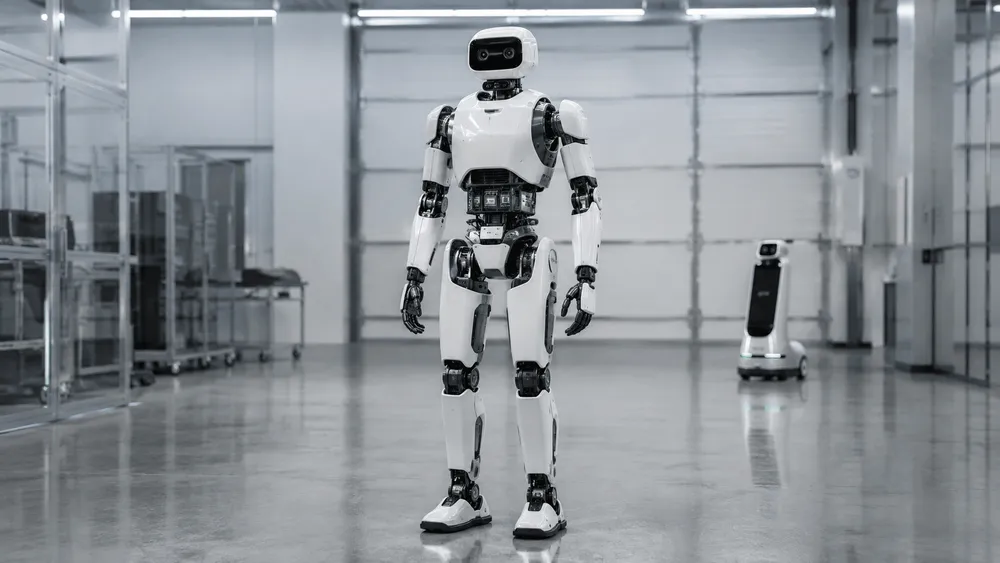
The LG-NVIDIA robotics collaboration has moved from a joint exploration phase into an MOU that includes concrete steps for physical robots and factory validation. On August 14, LG announced that it had signed a strategic business cooperation MOU with NVIDIA the previous day at NVIDIA's headquarters in Santa Clara, California, USA. The two companies have set a goal of unveiling a bipedal humanoid in Q1 2027, and ahead of that, plan to begin a PoC in 2026 by deploying the wheeled LG CLOiD on a washing machine production line in Tennessee, USA.
As of June, NVIDIA had described LG as "considering" the use of Isaac GR00T and "planning" to jointly develop a reference robot. Neither the reveal timing nor the validation site had been disclosed at that point. The details now made concrete include a cycle in which data collected at the factory is fed back into training and validation to refine LG's proprietary Robot Foundation Model (RFM), alongside the bipedal robot itself. Building out the computing infrastructure has also become part of this plan's roadmap.
However, signing the MOU alone does not confirm a product launch or mass production. The nearest real-world validation involves not the bipedal robot but the wheeled CLOiD. This sequencing needs to be read carefully and kept distinct.
June's joint development plan advances to an execution target in August
The August MOU covers three areas—robotics, AI Factory, and mobility—and calls for a joint task force to handle everything from R&D to on-site PoCs and commercialization. In the robotics domain, LG will use Jetson Thor for onboard computing, combined with Isaac GR00T, an open humanoid foundation model, and Halos for Robotics, a robot safety architecture. LG plans to integrate actuators from LG Electronics, sensors from LG Innotek, and batteries from LG Energy Solution.
The target timing is a "reveal" in Q1 2027. LG has not disclosed the robot's dimensions, degrees of freedom, or hand and sensor configurations. Operating time and target tasks also remain unknown, and no performance metrics have been published. Price, unit volume, and launch/mass-production timing are likewise unannounced. "Reveal" cannot be equated with shipment or the start of mass production.
The same caveats apply to safety. Halos is an architecture centered on AI computing and OS that connects everything from sensors to safety applications and inspection, and NVIDIA is offering early access to Halos Core and the Outside-In Safety Blueprint. Inspection Lab is designed to support preparation for third-party certification, but adopting Halos does not mean LG's robot is already certified. The certification standards, evaluating body, and completion timeline have not yet been specified.
The roles of LG's bipedal robot, NVIDIA's existing platform, and CLOiD
The term "reference robot" can make it easy to conflate three distinct machines into one. The bipedal robot LG announced this time, the existing research-oriented design NVIDIA unveiled in May, and the CLOiD being deployed to the Tennessee factory are separate machines serving different validation purposes.
| Robot | Configuration/Status | Role in This Announcement |
|---|---|---|
| LG's bipedal humanoid | Plans to integrate Jetson Thor, Isaac GR00T, Halos, and LG-affiliate components. Target reveal in Q1 2027 | Reference robot integrating LG-affiliate components with NVIDIA's platform |
| NVIDIA's existing reference robot | Integrates Unitree H2 Plus, Sharpa Wave's five-fingered tactile hand, Jetson Thor, and Isaac GR00T. 75 degrees of freedom combining full body and hands | A design enabling research institutions to compare and share behavior on common hardware and software |
| Wheeled LG CLOiD | Consists of a head, torso, two articulated arms, and a wheeled base. Each arm has 7 degrees of freedom; each hand has independently driven five fingers | Begins PoC on a washing machine production line at the Tennessee factory sometime in 2026 |
NVIDIA's existing platform is a research-oriented integrated design that Unitree has stated it will supply starting in the second half of 2026. It consolidates everything from robot bring-up to real-world deployment into a single development platform encompassing data acquisition, simulation, and training/evaluation, allowing research teams to compare behavior within the same environment. LG's robot also shares Jetson Thor and Isaac GR00T, but it was announced as a separate machine using LG-affiliate actuators, sensors, and batteries. The existing platform's 75 degrees of freedom cannot be treated as a spec for LG's robot.
The significance of LG's robot carrying the "reference robot" designation appears to lie less in immediately selling a finished consumer product and more in establishing a benchmark machine for field validation by integrating LG's components with NVIDIA's software. That said, no approval by standardization bodies or adoption as an industry standard has been announced. External sales, spec disclosure, and third-party adoption also remain unannounced.
The 2026 factory PoC moves ahead of the bipedal robot
The first machine LG is bringing into a manufacturing setting is CLOiD. The CLOiD that LG showcased in January 2026 was slated to demonstrate household tasks such as retrieving milk from a refrigerator, placing a croissant in an oven, and folding and stacking laundry. LG explained that it had trained VLM and VLA models using tens of thousands of hours of household task data, but has not disclosed success rates or how long the robot can operate without human intervention.
In the August announcement, LG will deploy CLOiD to the washing machine production line at the Tennessee factory sometime in 2026 to begin a PoC. Based on the results, LG plans to improve performance and use cases before expanding to other production facilities, homes, and commercial spaces. The aim is to shift the focus from home demonstrations to factory work, gathering both training data and real-world operational experience.
The wheeled CLOiD is a different machine from the bipedal robot. Nor does the factory PoC prove the bipedal robot's performance. To judge practical utility, LG will first need to disclose target tasks, success rates, and intervention frequency. Beyond that, questions remain about measuring operating time and safety, and whether a return on investment can be projected. The PoC is merely the entry point for measuring these figures—not a track record of full-scale deployment.
On July 1, LG established a Robotics Business Center reporting directly to the CEO, consolidating business development, sales, and operations. It has also set up a dedicated data factory organization and plans to bring a large-scale data factory online at the Yangjae R&D Campus in Seoul sometime in 2026. LG is building this organization in parallel so that the factory PoC doesn't end as a one-off demo but instead feeds back into improving the robot.
Running the cycle from PhysicalWorks to the AI Factory
Building on LG CNS's PhysicalWorks, the two companies are advancing technical cooperation to build and operate a Physical AI Data Factory on-site—a system for collecting and generating data while repeatedly cycling through training and validation. The robot data and operational experience gained from CLOiD's factory PoC are planned to be used to improve LG's proprietary RFM.
This cycle also connects to the computing infrastructure roadmap. LG has laid out plans to build an AI Factory reference site in the first half of 2027, based on Vera Rubin, where LG's cooling, power, and IT technologies will be applied and validated. Further ahead, in the first half of 2028, LG plans to construct an AI Factory in Cheonan, South Chungcheong Province, South Korea, expanding it to an 80MW scale, and expects to shorten construction time by more than 20% using a prefab approach.
That said, 80MW is a facility-scale figure—not a number representing GPU count, utilization rate, or power dedicated solely to robot training. The "more than 20%" figure is also LG's projected estimate, not an achieved track record. Whether the plan connecting physical robots and field data to the RFM and AI Factory actually moves forward will hinge on whether execution proceeds in the order of MOU signing, factory PoC, and validation site construction. Before the bipedal robot's reveal, what tasks CLOiD performs at the factory—and at what level—will serve as the first concrete piece of evidence for judgment.