

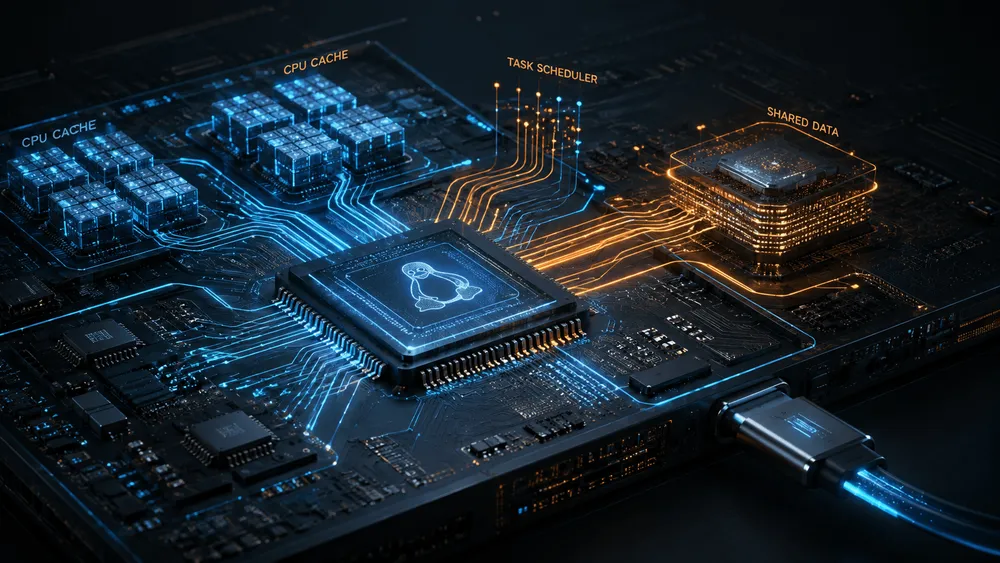
Linus Torvalds released Linux 7.2 on August 16, 2026. This final release incorporates cache-aware scheduling, which rethinks task placement on CPUs with multiple last-level caches (LLCs), MGLRU (Multi-Gen LRU) reclaim handling, and a new data transfer interface using USB4 cables. Meanwhile, DRM's fair policy, which distributes GPU execution opportunities more fairly, had a last-minute change reverted following regression reports before it could become the default. This is a release where one should look not at how many new features were added, but at what actually landed in the final version and where the line was drawn for experimental treatment.
According to Torvalds, the final week ended up bigger than he wanted. Still, rather than delaying the release, he used a late revert to pull back immature code that had caused problems. Linux 7.2 is the upstream mainline version, and as of August 18, 2026, it has not been designated as a longterm release. When each distribution picks it up is now a separate decision to be made individually.
DRM Fairness Default Reverted Right Before Release
DRM's fair policy, an implementation addressing GPU scheduler fairness, remains in 7.2, but it is not the default policy. In an August 11 change, a policy was announced to keep it experimental until the reported regression was resolved, and on the same day, the commit that had switched the default to fair was reverted. In addition to the removal of FIFO and RR, the change consolidating run queues into a single one was also reverted.
What needs to be distinguished here is the existence of an implementation versus its default application for all users. In this final release, the former remains, but the latter was postponed. GPU processing fairness cannot be treated as a completed, standard behavior of 7.2. Whether the cause of the regression gets resolved and the policy moves out of experimental status will need to be confirmed in future merges.
Task Placement and Memory Reclaim Changes with Multiple LLCs
Cache-aware scheduling works on topologies where multiple LLCs exist within a single NUMA node. The aim is to reduce cache misses by grouping tasks that share data onto the same LLC. However, it isn't designed to keep piling tasks onto a preferred LLC even under high load—when overloaded, it holds back on the aggregation. It can also be disabled via debugfs.
In tests recorded in the commit on Sapphire Rapids and AMD Genoa, low-load hackbench improved by 10% to 50%. Meanwhile, there was no clear difference in the harmonic mean across benchmarks ranging from netperf to stream to stress-ng. Since the effect diminishes as load increases, this cannot be called a switch that universally speeds up CPUs. Results depend on whether the workload shares data and whether the CPU's cache configuration meets the necessary conditions.
For memory reclaim, MGLRU moved dirty folio and writeback handling into the reclaim loop. In a single measurement using YCSB Workload B, throughput increased 29.4% from 62,485 ops/s to 80,857 ops/s, and average latency dropped 22.8% from 501us to 387us. File refaults also decreased 43.5%, from 34,522,071 to 19,516,246. These are reported figures for this specific workload and do not mean the same differences will appear across all applications.
Swap table phase IV also unifies swap allocation, accounting, and metadata management for anonymous memory and shmem. In an example with a mounted 1TB swap device, approximately 512MB of memory was saved. This is an example of the effect of trimming management structures in proportion to swap capacity, and it is not a figure that directly guarantees application throughput.
Practical Changes Landing in Btrfs, Encryption, and openat2
Btrfs has enabled large folio by default in 7.2, after it had been experimental since Linux 6.17. With an experimental config, it can also handle huge folios up to 2MiB. Btrfs's pull description reports a 15% improvement in sequential writes and a recovery of 60% of throughput for direct I/O, which had remained serialized. However, both figures apply to individual changes, not a performance guarantee across all storage environments.
device-mapper has gained dm-inlinecrypt. This is a target that goes through blk-crypto to use inline encryption hardware such as UFS. The initial implementation only handles the AES-256-XTS cipher, and it falls back to software block crypto if compatible hardware isn't available. Combining it with fscrypt results in double encryption, making it unsuitable for Android-style configurations, though there is a path to use it as an alternative to dm-crypt.
openat2(2), used for safely opening files, has gained two additions. OPENAT2_REGULAR opens only regular files, returning EFTYPE if the target has been swapped out for a FIFO or device node. O_EMPTYPATH allows reopening a target from an O_PATH file descriptor using an empty path, which removes the dependency on procfs. For programs that handle permissions, how to avoid situations where the target gets replaced while re-resolving the path name becomes an implementation-level concern.
Direct USB4 Transfers, with Still-Limited Hardware Support
USB4STREAM carries data over a Thunderbolt/USB4 cable without going through the network stack. The kernel provides a /dev/tbstreamX character device, and applications transfer data using read(2) and write(2). It's configured via ConfigFS and can handle multiple streams and bidirectional transfers. Since it can be used alongside the existing thunderbolt_net, cable-direct use cases are not limited to networking.
USB4STREAM is a feature that adds a data transfer interface to the kernel. Based on the published feature description, it cannot be confirmed that USB4STREAM itself provides authentication or encryption. If handling sensitive data, users need to separately consider verifying the counterpart and protecting the transferred content.
Hardware support is also something whose completeness cannot be judged from headlines alone. A minimal device tree has been added for Apple M3 (t8122), covering iMac, MacBook Air, and MacBook Pro, targeting basic initialization elements such as the CPU, interrupt controller, and boot framebuffer. However, this does not mean support for everyday use—including GPU, audio, and Wi-Fi—is complete. AMDGPU's HDMI 2.1 support is also only initial support for FRL, and does not mean all HDMI 2.1 features are in place.
NTFS now supports tracking and creating Windows native symlinks, handling relative/absolute links and junctions. However, the default remains the traditional WSL symlink behavior. To create links in native format, one must select a mount option such as symlink=native, so this cannot be called a feature that resolves all the issues Proton or Wine face when using NTFS.
The value of adopting Linux 7.2 early depends on whether you actually use multiple-LLC configurations, large-capacity swap, Btrfs, or direct USB4 transfers. The practical approach is to first check each distribution's config and real-world benchmarks, and then follow up on whether it receives longterm designation and whether DRM's fair policy moves out of experimental status.