


Apple is rumored to be aiming for a late-2025 announcement of its next-generation M5 iPad Pro. A leaked hands-on video claiming to show the actual device has suddenly surfaced, revealing a glimpse of the surprising performance of the next-gen SoC, the Apple M5 chip. While CPU performance appears to represent a solid but modest evolution, GPU performance may have taken a dramatic leap forward—highlighting what looks like a deliberate "selective focus" in Apple's next-generation chip strategy. In this article, we take a thorough look at multiple leaks to uncover the performance of the M5 chip and the full picture of the upcoming iPad Pro.
A Glimpse of the Future, Broadcast from Russia on the Eve of Launch
This leak comes courtesy of the well-known Russian YouTuber "Wylsacom." The same channel previously posted an unboxing video of the (then-unannounced) M4 MacBook Pro in 2024, which lends additional credibility to this new leak. The video features a 13-inch, 256GB iPad Pro model said to be equipped with the M5 chip, with details revealed through comparisons against the current M4 model.
Echoing this development, multiple model numbers that could correspond to unannounced iPad Pro and MacBook Pro models have also been discovered in the U.S. Federal Communications Commission (FCC) database.
- MacBook Pro: A3434
- 11-inch iPad Pro: A3357 (Wi-Fi), A3358/A3359 (Cellular)
- 13-inch iPad Pro: A3360 (Wi-Fi), A3361/A3362 (Cellular)
This circumstantial evidence strongly suggests that Apple may hold a new product launch event as soon as October or November.
Benchmarks Reveal M5 Chip Performance: "Solid CPU Gains" and "GPU Leap"
Perhaps the most noteworthy element of the leaked video is the M5 chip's performance as measured by the benchmarking software "Geekbench 6" and "AnTuTu." What emerges is a clear design philosophy from Apple, with CPU and GPU evolving in markedly different directions.
CPU Performance: A Solid ~10–15% Improvement
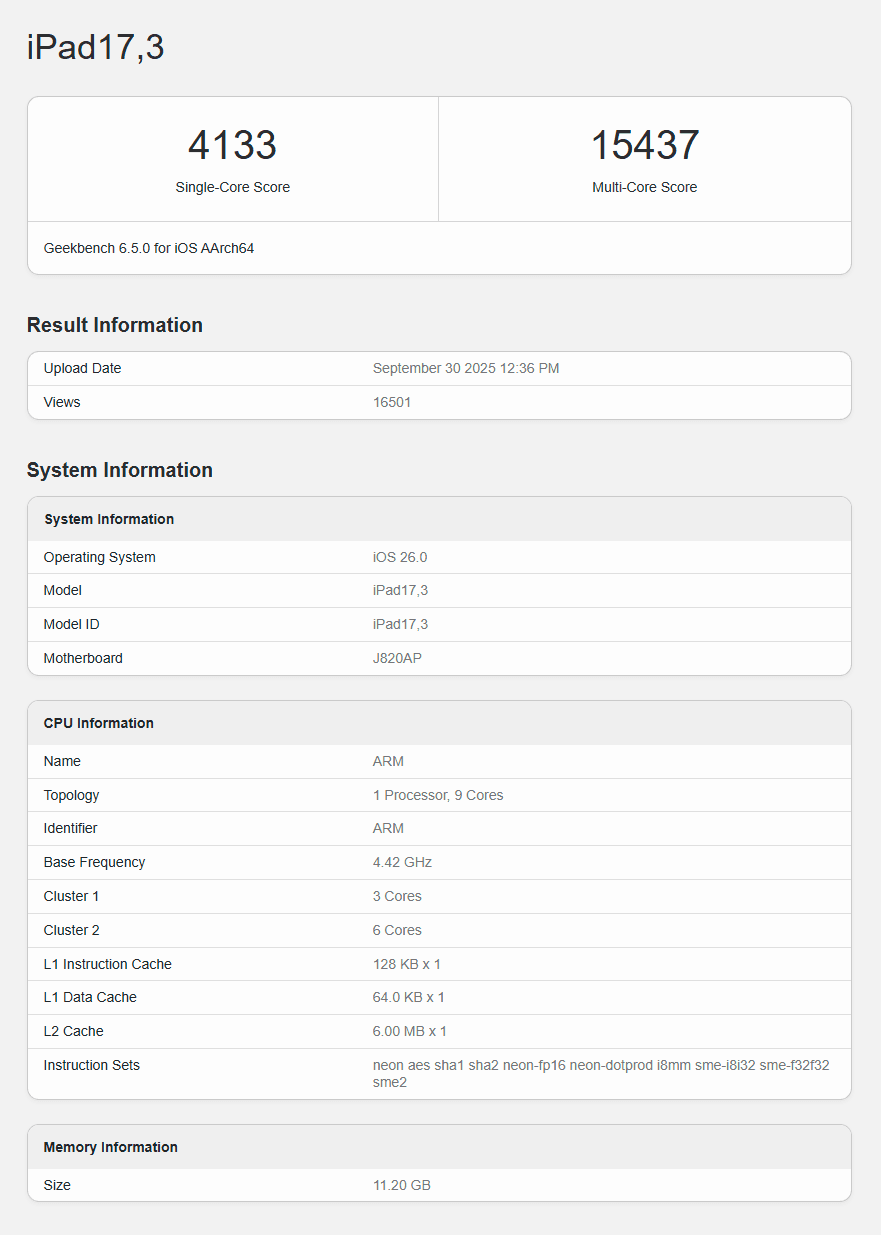
Let's start with CPU performance. The Geekbench 6 scores are as follows.
| M5 iPad Pro (leaked figure) | M4 iPad Pro (reference figure) | Improvement | |
|---|---|---|---|
| Single-core | 4,133 | 3,748 | Approx. 10.3% |
| Multi-core | 15,437 | 13,324 | Approx. 15.9% |
An improvement of roughly 10% in single-core and around 16% in multi-core is by no means a shocking figure for a generational leap. It would be fair to call this a "solid evolution" or a "reasonable update."
What's interesting is that the leaked M5 chip specifications closely resemble those of the current base-model M4 chip (found in the 256GB/512GB models).
- CPU core configuration: 3 performance cores + 6 efficiency cores (identical to the M4 base model)
- Clock frequency: 4.41GHz (nearly identical to the M4)
So how did Apple achieve a 10–15% performance boost while keeping the core count and clock frequency unchanged? The key likely lies in the increased L2 cache and architectural improvements. According to the leaked information, the M5's L2 cache is 6MB, a 50% increase from the M4's 4MB. Since cache memory directly affects CPU processing efficiency, this increase almost certainly contributed directly to the performance gains. In addition, improvements in operating efficiency from adopting TSMC's refined 3nm process, "N3P," along with architecture-level optimizations to internal instruction processing, likely also factored into this score.
GPU Performance: A Leap of Over 35%, Ushering in a New Era for Gaming and AI

In stark contrast to the CPU's solid but modest gains, the GPU has undergone a truly striking leap in performance.
| M5 iPad Pro (leaked figure) | M4 iPad Pro (reference figure) | Improvement | |
|---|---|---|---|
| Geekbench 6 Metal | 74,568 | 55,702 | Approx. 33.9% |
A jump of more than 30% is too significant to be dismissed as a mere generational refresh. This is likely influenced heavily by the GPU architecture featured in the "A19 Pro" chip found in the iPhone 17 Pro. In recent years, Apple has tended to carry over GPU architectures introduced in its iPhone-bound A-series chips into subsequent M-series chips. Given reports that the A19 Pro deepened its integration with the Neural Engine (the AI processing unit) and dramatically boosted graphics performance through AI-driven image rendering techniques and similar technologies, it's highly plausible that the M5 is benefiting from the same advancements.
This leap in GPU performance holds the potential to fundamentally reshape iPad Pro use cases.
Take, for example, full-fledged AAA gaming experiences. Advanced graphics processing techniques like ray tracing should become comfortably achievable at higher resolutions and frame rates. And in professional creative work such as video editing and 3D modeling, users should feel the benefits directly, in the form of shorter rendering times and smoother previews.
RAM Standardized at 12GB, Boosting Multitasking Performance
This leak also confirmed that the base 256GB model comes equipped with 12GB of RAM. On the current M4 iPad Pro, the equivalent-capacity model has just 8GB of RAM—making this a substantial 50% increase.
This RAM boost is especially significant for improving the usability of iPadOS's multitasking feature, Stage Manager. It should make running multiple applications simultaneously smoother, further reinforcing the iPad Pro's value as a "PC replacement."
Design Carries Over, Changes Concentrated Internally
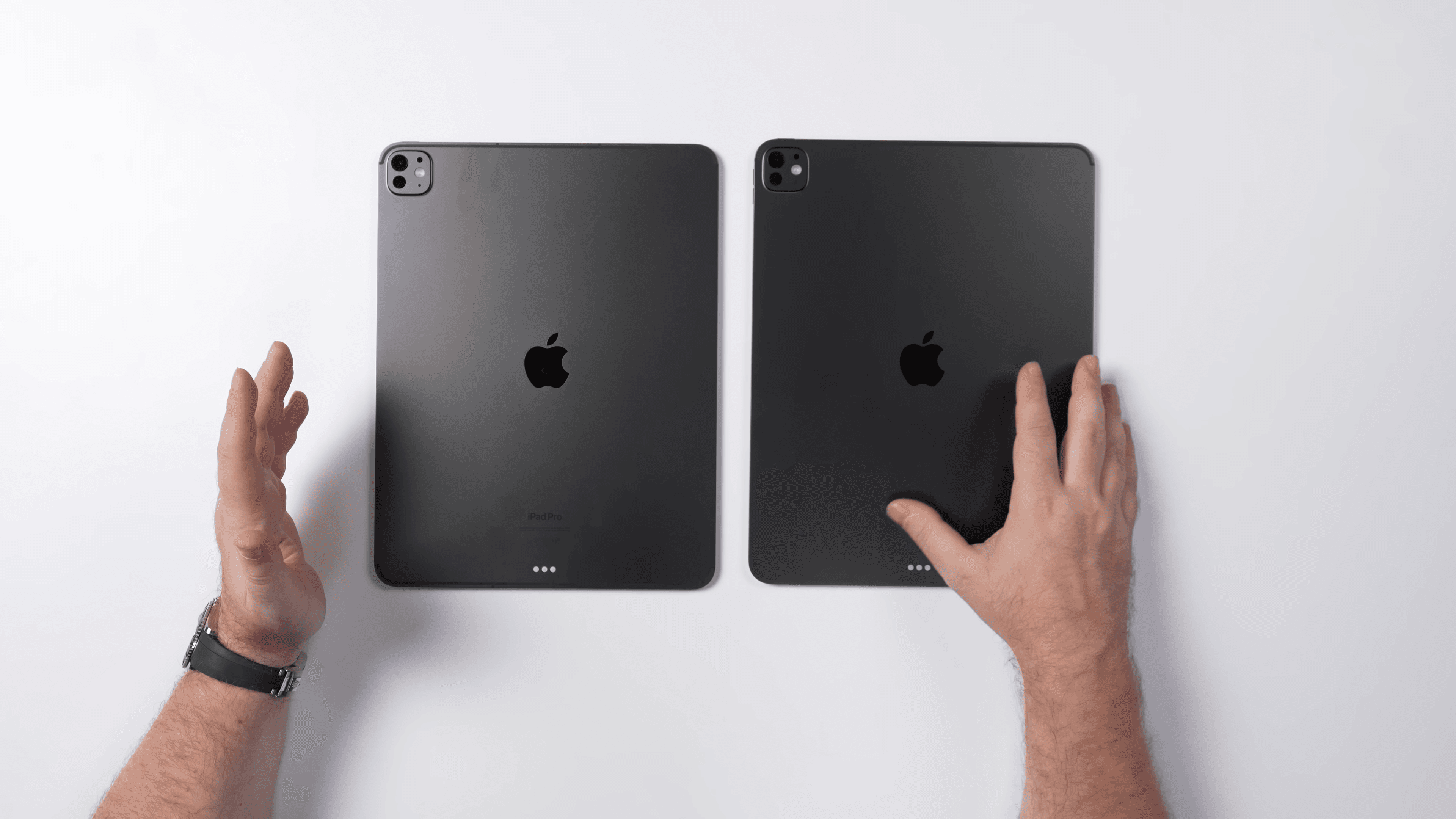
Judging from the leaked device, the M5 iPad Pro's design is largely unchanged from the current M4 model. The ultra-thin chassis and the rear camera arrangement remain the same.
A few subtle changes are worth noting, however—namely, the disappearance of the "iPad Pro" product logo and regulatory markings on the back. This likely reflects the same minimalist design trend seen in recent iPhone models.
On the other hand, there are reported changes to the accessories. The bundled USB-C charger is said to have been upgraded from the current 20W to 45W. If true, this could result in significantly faster charging speeds.
What This Leak Reveals About Apple's Next-Generation Strategy
This leak offers a window into Apple's broader product strategy and design philosophy going forward.
Is the iPad Pro a Testbed for "Early Deployment of the Latest Chips"?
Apple debuted the M4 chip in the iPad Pro before bringing it to the Mac. If this leak proves accurate, the M5 chip is likely to follow the same pattern, launching first in the iPad Pro. This strategy of deploying the latest chip first in a tablet—a device with far stricter thermal design constraints than a MacBook—suggests that Apple may be positioning the iPad Pro as a "testbed" to build familiarity with new manufacturing processes and gather extensive data on power efficiency and heat generation.
The M5 MacBook Air Could Potentially Surpass the M3 Pro
This M5 benchmark data is also an extremely important indicator for forecasting the performance of the next-generation M5 MacBook Air, expected to arrive in 2026.
The iPad Pro and MacBook Air share a key trait: both use fanless passive cooling systems. As a result, this M5 iPad Pro score is likely to be quite close to what we can expect from the M5 MacBook Air.
If we apply the performance gap observed between the M4-generation iPad Pro and MacBook Air to this new M5 score, the M5 MacBook Air's multi-core score could approach 17,000.
That would be a remarkable figure, surpassing the M3 Pro-equipped MacBook Pro (multi-core score of approximately 15,300). If this comes to pass, the MacBook Air would gain CPU performance rivaling the professional-grade MacBook Pro—a shift that could dramatically reposition the Air within Apple's product lineup.
The M5 chip appears set to boost power efficiency through steady CPU refinements while delivering a dramatic leap in GPU performance—opening the door to a new generation of application experiences. This leak may well be giving us a glimpse of the future Apple has in store. With an official announcement expected within the next few weeks, anticipation is only building.
Sources
- Wylsacom (YouTube): iPAD PRO M5 2025 – РАСПАКОВКА РАНЬШЕ APPLE!!!
- MacRumors: FCC Leaks Upcoming MacBook Pro and More