

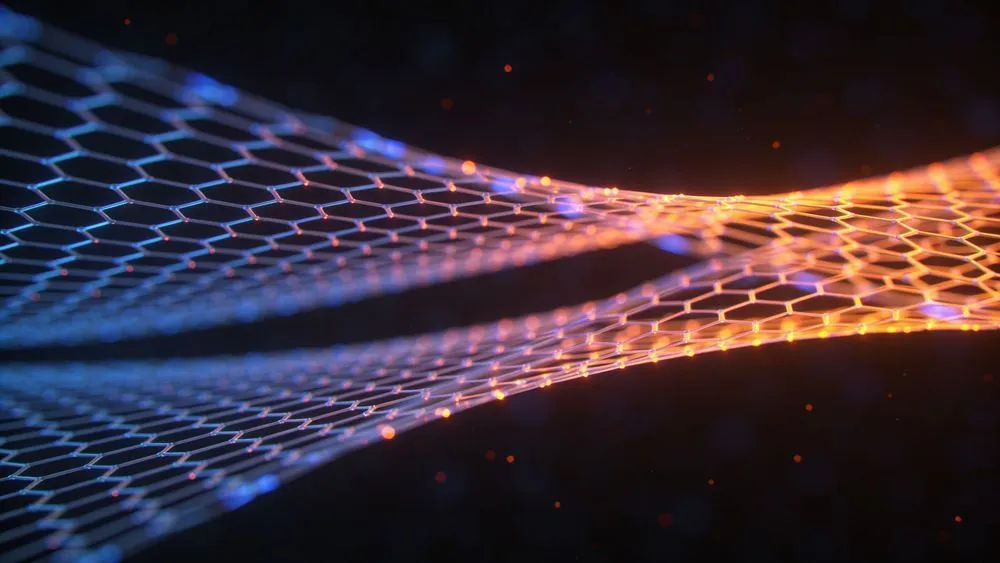
At airport security gates and observatory telescopes, sensors that can see through hidden matter serve as the eyes of modern society. But when it comes to far-infrared light or terahertz waves—which can penetrate deep behind thick shielding or reveal cold interstellar matter drifting through space—the situation changes. The energy carried by this light is so minuscule that capturing it with existing electronic components is extremely difficult.
The Physics of Seeing Invisible Light
The Penetrating Power and Resonance of Terahertz Waves
Humanity has learned to visualize the invisible world by exploiting different wavelengths of electromagnetic radiation. Short-wavelength X-rays let us see through bone; infrared light lets us sense the heat of objects. Sitting right in the middle of this vast electromagnetic spectrum, between light and radio waves, lies the region known as terahertz waves or far-infrared light.
Their wavelengths span roughly from tens of micrometers to a few millimeters, corresponding to frequencies around 1 terahertz (one trillion oscillations per second). This light has excellent ability to pass through non-metallic materials such as paper and clothing. At the same time, because it resonates with the characteristic vibrations of specific molecules, it holds the potential to identify substances like explosives or illegal drugs simply by shining light on them. In medicine, too, research is progressing on using it to image tissue just beneath the skin's surface without damaging cells, unlike X-rays. In astronomy, this wavelength band is essential for observing cold cosmic dust and regions where stars are born.
The Terahertz Gap: An Obstacle to Detecting Faint Energy
However, this band has long been called the "terahertz gap"—a technologically underdeveloped region. There are physical constraints on using this light. A longer wavelength means each individual photon carries extremely little energy. A typical digital camera sensor generates an electrical signal when light strikes a semiconductor and knocks an electron up into a high-energy state (the conduction band). But the tiny energy of a terahertz photon cannot clear the semiconductor's energy barrier (the bandgap).
On the other hand, techniques like those used in radio receiving antennas for smartphones—which shake electrons as waves—also fail here, because the frequency is too high for electronic circuits to keep up. Terahertz radiation falls precisely into the gap between optical technology and electronic engineering.
As a result, detecting faint long-wavelength radiation has relied on devices called bolometers, which sense light as heat. These absorb the light's energy, causing a slight temperature rise, and then read out the resulting change in electrical resistance. To achieve extreme sensitivity, today's most advanced observational instruments use superconductors cooled to near absolute zero.
The Brute-Force Limits of Photo-Response
The Enormous Energy Once Required for Phase Transitions
The approach of using light to fundamentally alter a material's properties has been studied for a long time, not only in semiconductors. In particular, light-induced phase transitions that convert an electrically insulating material into a metal represent a major theme in modern physics.
But under conventional physical wisdom, triggering this phenomenon required brute-force energy. For example, researchers would fire ultrafast laser pulses into a special insulator known as a Mott insulator, temporarily distorting the crystal structure itself or forcibly pushing electrons into high-energy states. Such methods demand photon energies of several electron volts and the powerful electric fields of femtosecond lasers capable of generating enormous output in an instant.
This approach has a clear limitation. Even if one tries to use far-infrared light with its long wavelength and low energy, the electrons within the material only jitter slightly—no large-scale change capable of triggering a phase transition occurs. This energy barrier stood as a major obstacle to building new detectors capable of capturing weak signals. The field had long been governed by the assumption that breaking down an insulator with light requires strong light.
The Fragile Collective Order Created by the Magic Angle
Flat Bands Arising in a Moiré Superlattice
The method published in Nature Communications by an international research team including scientists from the National University of Singapore and the University of Manchester in the UK overturns this framework entirely. Rather than strong light, they turned their attention to the extreme fragility of the material itself.
The research team used graphene, a sheet-like material made of carbon atoms bonded in a hexagonal lattice. Ordinary graphene hosts a special type of massless electron known as a Dirac electron and conducts electricity extremely well. But when two sheets are stacked and twisted at a particular angle relative to each other, entirely different properties emerge.
In 2018, researchers at the Massachusetts Institute of Technology discovered that stacking two sheets with a twist of about 1.1 degrees—the so-called magic angle—causes a dramatic change in electron behavior. At this magic angle, the two sheets' lattices interfere with each other, giving rise to a moiré superlattice with a period far larger than the original hexagonal lattice. While the distance between carbon atoms is only about 0.14 nanometers, the period of this moiré superlattice reaches as much as about 13 nanometers. It's the same principle as the large pattern that emerges when you overlay two screen doors and shift one slightly relative to the other.
Within this giant periodic structure, graphene's normally high electron mobility is lost, and a state called a flat band forms, in which the electrons' kinetic velocity drops to nearly zero. Having lost their kinetic energy, the electrons become strongly influenced by the repulsive force between their negative charges—that is, by Coulomb interactions. When an external voltage is applied to tune the system to a specific electron density, the electrons become immobilized, locking into an orderly arrangement. This is the state known as a correlated insulator.
An Electron Arrangement That Collapses With Just a Slight Temperature Rise
What matters here is that this insulating state is extremely fragile. The energy barrier (gap) confining the electrons is only a few millielectronvolts. In temperature terms, warming the system to just around 10 kelvin (minus 263°C) is enough to easily destroy this collective order.
Shrinking the Electronic Heat Capacity to Its Extreme Limit
Localized Heating Enabled by an Ultra-Cold Environment
The research team turned this fragility to their advantage. In their experiments, they sandwiched magic-angle twisted bilayer graphene between layers of hexagonal boron nitride, applied a voltage to precisely tune the electron density, and established the correlated insulator state. They then irradiated the sample with millimeter-wave or far-infrared light with wavelengths of several millimeters.
When photons carrying tiny amounts of energy strike the graphene, the electron system alone heats up locally—before the vibrations of the atoms making up the crystal lattice as a whole become active. In an ultra-cold environment near absolute zero, the coupling between electrons and lattice vibrations (phonons) becomes extremely weak, making it possible to create a non-equilibrium state in which only the electrons reach a high temperature.
What made this non-equilibrium state possible was the nature of the flat band. A population of electrons with no kinetic energy has an extremely small heat capacity—its ability to store heat. Given even a small amount of heat, the electron temperature rises sharply.
This slight temperature rise triggers the sudden collapse of the collective order the electrons had formed. The few-millielectronvolt correlation gap that had confined the electrons vanishes, and the material—once an insulator—instantly takes on metallic character, with its electrical resistance plunging.
If conventional photo-response is like smashing solid rock with a hammer, this new mechanism is more like melting the surface of thin ice with just a little heat—a structural transformation. Rather than using the light's energy itself to move electrons, this method exploits the electrons' tiny heat capacity to destroy the correlation gap, making it possible to convert an extremely small amount of energy into a massive electrical change.
A Measurement Principle That Inverts the Superconducting Bolometer
A Large Voltage Response Maintained Even Under Strong Magnetic Fields
Today, superconducting hot-electron bolometers are widely used as high-performance devices for measuring faint light. These work by using the heat of light to warm electrons, breaking the superconducting state (a state of zero resistance) and detecting the resistance that emerges as a result.
The graphene-based device presented here completely inverts that principle. When light strikes it, the insulating state—which has extremely high resistance—breaks down, and current begins to flow. This inverted structure yields several practical advantages.
| Characteristic | Conventional Superconducting Bolometer | This Study's Graphene Photodetector |
|---|---|---|
| Measurement principle | Breakdown of the superconducting state (zero resistance) | Breakdown of the correlated insulator state (high resistance) |
| Change upon light exposure | Resistance increases | Resistance drops sharply |
| Resistance to magnetic fields | Vulnerable to magnetic fields; superconductivity easily destroyed | Operates stably up to about 4 tesla |
| Voltage responsivity | Varies widely depending on sensor specifications | About 17 million volts per watt absorbed |
As quantitative confirmation, across a broad band spanning wavelengths from 85 to 2,140 micrometers, the device recorded a huge voltage responsivity of about 17 million volts per watt of absorbed light. This shows that even an extremely small amount of absorbed light can be read out as a clear electrical signal. According to the research team, this internal responsivity exceeds that of many commercially available bolometers operating in the same band.
Furthermore, the photo-response was maintained even as the temperature rose from 6 to 7 kelvin. Particularly noteworthy is its robustness against magnetic fields. While superconductors lose their function when placed in strong magnetic field environments, this correlated insulator retains its characteristics up to about 4 tesla. This makes it a new option for specialized scientific instruments that rely on magnetic fields.
The device's practical response time was measured at about 50 nanoseconds. Since the intrinsic cooling rate of the electrons themselves is far faster than this, the research team expects that further miniaturizing the device could shorten the response time by an order of magnitude.
Remaining Hurdles Toward Harnessing Invisible Light
If long-wavelength light could be captured with high sensitivity, the way we see the world would change dramatically. The range of applications is broad—from technology that non-destructively inspects the interior of objects opaque to visible light, to observing faint signals drifting through outer space.
However, several hurdles remain before this becomes a finished commercial detector. The current device is still at the basic-research stage, and it does not yet incorporate the antenna structures or metamaterials needed to efficiently couple light traveling through free space into the graphene. In addition, the manufacturing technology needed to scale up magic-angle graphene—with its twist angle precisely controlled to 1.1 degrees—to wafer-scale areas while maintaining high quality has not yet been established.
Above all, the requirement for an ultra-cold environment still remains. Over what temperature range can the fragility of the correlated insulator actually be exploited? How would the response characteristics change if multilayer graphene were used instead? And how would noise be controlled when integrating the device into a large-scale sensor array? Faced with a phenomenon in which faint light triggers a massive response, a new set of engineering questions is piling up.