

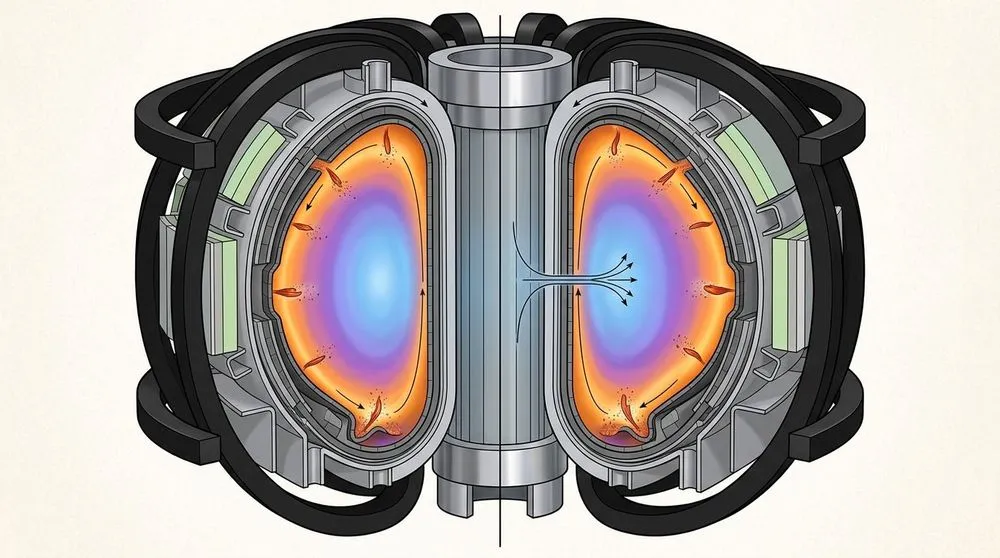
On February 4, 1982, at the Max Planck Institute for Plasma Physics in Garching, West Germany, Fritz Wagner encountered an unexpected phenomenon during a neutral beam heating experiment. The plasma's confinement performance suddenly doubled, and turbulence at the edge nearly vanished. This state, later named the H-mode (High-confinement mode), became the biggest springboard toward realizing fusion power. ITER's design assumes H-mode operation, and tokamaks worldwide now treat H-mode as the standard.
However, as Wagner himself recognized from the outset, H-mode comes with a price. The better the confinement, the more pressure builds up at the plasma edge, until it eventually becomes unsustainable and is released explosively. This periodic instability phenomenon is called ELM (Edge Localised Mode). In 1996, systematic classification based on ASDEX Upgrade data advanced, and by the early 2000s a theoretical framework had been established as the peeling-ballooning model (a magnetohydrodynamic instability triggered by the coupling of current gradients and pressure gradients at the plasma edge).
The problem lies in scale. A single Type-I ELM event slams up to 10% of the plasma's stored energy into the wall within a few hundred microseconds. The ELM heat load on ITER's tungsten divertor plates is estimated at 0.5–1.5 megajoules per square meter—a level that would instantly melt the tungsten surface. Repeated exposure would trigger a chain of recrystallization, macroscopic cracking, and reaching the critical heat flux of the cooling system. For a commercial reactor to run continuously over multiple years, ELMs cannot be tolerated.
Four Ways to "Release the Pressure"
MAST Upgrade, located at the UK Atomic Energy Authority (UKAEA)'s Culham campus, is a low-aspect-ratio spherical tokamak (major radius 0.8 meters, minor radius 0.5 meters) that has tackled this ELM problem head-on. During its Fifth Campaign, conducted from 2025 to 2026, the device generated over 1,100 fusion plasma shots and recorded the highest plasma pressure in MAST Upgrade's history while suppressing ELMs. This achievement, announced by UKAEA on August 6, 2026, was also reported at the European Physical Society Conference on Plasma Physics 2026, held in Edinburgh.
Notably, the team accessed ELM suppression through four independent methods simultaneously. Though each mechanism differs, they share a common principle: "release the pressure gradually before it reaches a critical threshold."
QCE mode (Quasi-Continuous Exhaust mode) generates high-frequency, low-amplitude filamentary structures at the plasma edge, continuously bleeding off pressure. Think of it as letting air escape steadily through small holes before a large explosion can occur. A recent EUROfusion review paper showed that the pedestal top values achieved in QCE mode are nearly equivalent, after normalization, to those in a typical ELMy H-mode—highlighting that confinement performance isn't sacrificed.
RMP (Resonant Magnetic Perturbations) applies three-dimensional magnetic field perturbations via internal coils, locally disrupting the pressure gradient at the plasma edge to avoid the very conditions that trigger ELMs. MAST Upgrade uses two rows of in-vessel coils (four above the midplane, eight below), and this marks the world's first observation of RMP-based ELM suppression in a low-aspect-ratio tokamak.
QH mode (Quiescent H-mode) maintains a steady electromagnetic instability at the edge called an Edge Harmonic Oscillation (EHO), continuously exhausting excess heat. Rather than sudden explosive bursts like ELMs, this mechanism releases heat as gentle oscillations.
I-mode (Intermediate-mode) exploits asymmetric transport characteristics: a steep temperature barrier forms at the edge while only particles are allowed to pass through. Heat is confined while particles (and the associated pressure) escape, preventing the pressure buildup that triggers ELMs.
| Method | Mechanism | Pressure release mode | Impact on confinement |
|---|---|---|---|
| QCE mode | High-frequency filaments at the edge | Continuous, low-amplitude | Pedestal top comparable to ELMy H-mode |
| RMP | Local disruption of pressure gradient via 3D magnetic perturbation | Continuous | Possible slight reduction in confinement |
| QH mode | Steady release via EHO (Edge Harmonic Oscillation) | Continuous, oscillatory | Maintains H-mode confinement |
| I-mode | Separation of temperature barrier and particle transport | Selective release of particles only | Good thermal confinement |
Demonstrating all four modes on a single device carries significant weight. James Harrison, MAST Upgrade's Head of Science, stated that "accessing four stable, high-performance plasma operating regimes has direct implications for the design of future fusion power plants." Methods that had previously been confirmed individually on different devices could now be integrated and verified on a single spherical tokamak, expanding the design options available for ITER and STEP.
Pinpointing Plasma Position with Light
Another achievement from the Fifth Campaign is a real-time plasma position control technology. The MAST Upgrade team developed a method to detect minute shifts in plasma position by measuring visible light emitted from deuterium in the upper and lower divertors (exhaust systems). UKAEA has described this as "a world-first method."
Why does position control matter so much? Fusion plasma must be sustained at temperatures of hundreds of millions of degrees while being kept magnetically suspended, never touching the vessel walls. Even a slight positional shift concentrates heat load locally on the wall surface, damaging equipment. In a commercial reactor, having humans continuously monitor and operate the system is unrealistic, making an automated real-time control system essential. This new visible-light-based detection method demonstrates that it can serve as an input signal for such a control system.
Integrating the Super-X Divertor with Nitrogen Radiative Cooling
Even with ELMs suppressed, the heat escaping from the plasma itself doesn't disappear. How to handle this exhaust heat is another major challenge. MAST Upgrade features a unique exhaust structure called the Super-X divertor. Whereas in a conventional divertor, magnetic field lines strike the vessel wall at a near-perpendicular angle (about 8 degrees), Super-X extends the magnetic field line connection length from 12 meters to 22 meters, shallowing the incidence angle to about 1 degree. This has been experimentally shown to reduce the peak heat flux on the divertor target by at least a factor of 10 under attached conditions.
The team further demonstrated radiative cooling by injecting small amounts of nitrogen at the plasma edge. Nitrogen ions volumetrically radiate the plasma's exhaust heat as light, dissipating heat before it reaches the wall surface. UKAEA believes that if the Super-X geometry alone cannot sufficiently reduce heat loads for a commercial reactor, combining it with this impurity radiative cooling will be necessary.
MAST Upgrade's Super-X divertor, with its enclosed baffle structure and the ability to independently control both upper and lower divertor chambers, represents the world's first detailed research platform of its kind for a spherical tokamak.
Negative Triangularity Opens an ELM-Free World
The Fifth Campaign also included another effort drawing attention from the international fusion community: exploration of a plasma shape called "negative triangularity." While conventional tokamaks produce a D-shaped plasma cross-section (positive triangularity), reversing this shape had been theoretically predicted to enable high-power operation without ELMs. MAST Upgrade observed, for the first time in a low-aspect-ratio tokamak, a transition from ELMy H-mode to high-performance L-mode using negative triangularity.
If this shape were adopted in a commercial reactor, it could eliminate the need for additional coils and control systems dedicated to ELM suppression. Simplifying the device has direct implications for construction cost and maintainability.
The Path to STEP and Remaining Questions
MAST Upgrade will undergo further upgrades this year. Two additional neutral beam injectors will be added, doubling the current heating capacity of roughly 3.8 megawatts, alongside the introduction of an Electron Bernstein Wave (EBW) heating system (1.6 megawatts). EBW is a technology that uses high-frequency electrostatic waves to heat and drive current within high-density plasma, and it is planned for adoption in STEP. The Sixth Campaign is scheduled for 2028, and UKAEA's 2026–2030 strategy explicitly states the goal of "providing the experimental evidence for confinement and current drive needed for STEP's plasma scenarios."
STEP (Spherical Tokamak for Energy Production) is the UK's prototype fusion reactor, to be built on the site of the former West Burton coal power station in Nottinghamshire, with a target operational start in the early 2040s. The UK government has committed £1.3 billion to the project, with UK Fusion Energy Ltd leading construction. MAST Upgrade's results feed directly into this reactor's design.
That said, some caveats are needed to avoid overstating these achievements. MAST Upgrade's plasma current reaches a maximum of 1 megaampere (design value 2 megaamperes), two orders of magnitude below ITER's 15 megaamperes. Whether these ELM suppression methods will function the same way at ITER-scale plasmas remains unverified. It's also known that QCE mode's access conditions depend on separatrix density, leaving open the question of whether the same parameter regime can be reached under commercial reactor operating conditions. Furthermore, while the four modes have been "demonstrated," verifying long-duration steady-state maintenance or performance under burning plasma conditions—where fusion reactions dominate—is fundamentally impossible at MAST Upgrade's scale.
The fight against ELMs continues even now, 44 years after the discovery of H-mode. MAST Upgrade's experiments have shown, for the first time in this battle, that multiple weapons can be wielded simultaneously. The next question is whether those weapons will hold up on the real battlefield.