


When running heavy data-processing tasks on a laptop, the underside can become hot enough to feel like a burn. Listening to the whir of the cooling fan, many readers have probably felt firsthand just how hard modern technology has to fight against "heat."
In the server racks of massive data centers, as well as in the smartphones we use every day, much of the digital information generated daily is stored on magnetic recording media such as hard disk drives (HDDs). These devices have recorded information by mapping the magnetic orientation (spin) of nanometer-sized magnets to "0" and "1" data. However, as magnets are made smaller and packed together at higher density to store more data, the heat generated with every information-processing operation causes a serious problem.
A research group at the University of Tokyo's Graduate School of Frontier Sciences has presented an entirely new approach that could fundamentally solve this heat problem. Without flowing any electric current at all, and using only the quantum mechanical "force" acting between a probe tip and an atom, the group succeeded for the first time in the world in reading and writing the magnetic information held by a single atom.
The Path to the "Ultimate Memory" Blocked by the Curse of Joule Heating
In current magnetic recording systems, electric current is indispensable for reading and writing data. For many years, humanity has poured enormous effort into increasing the integration density of magnetic memory. Reading information relies on the "magnetoresistive effect," in which the electrical resistance of a material changes under an external magnetic field, while writing relies on magnetic fields generated by electric current or on spin-torque technology, which slams the spin of electrons into a magnet. Both approaches involve passing current through a minuscule device element.
Whenever current flows through a conductor, Joule heating inevitably occurs due to electrical resistance. As memory elements are miniaturized and more elements are packed into a limited area, the current density per unit area rises, and the amount of heat generated increases explosively. This heat causes a significant energy loss. Even more serious is that this thermal energy can be transferred to neighboring tiny magnets, causing the recorded spin orientation to flip unintentionally—a "malfunction." The smaller the device becomes, the weaker its resistance to surrounding thermal fluctuations.
The ultimate form of storage media is an array of "single-atom magnets" (one atom = one bit), in which a single atom serves as a single data bit. Current mainstream hard disks require a collection of tens of thousands to millions of atoms to record just one bit of information. If this could be shrunk down to a single atom, recording density would improve dramatically. However, if the conventional current-driven approach is simply scaled down to the single-atom level, the magnetic state of the atom instantly collapses due to the energy of incoming electrons and Joule heating. The conventional method of reading and writing states by slamming electrons into them was like spraying a tiny sandcastle with a garden hose. Unless a "heating-free recording method" could be invented, the ultimate high-density memory was, in principle, impossible to realize.
A Reversal in Thinking: Using "Force" Instead of Current
Facing this physical limitation, the research group abandoned the conventional approaches of "current" and "electromagnetic fields," and instead opened a new path to controlling spin using locally acting "force" itself. What they developed is a groundbreaking method using magnetic exchange force microscopy (MExFM).
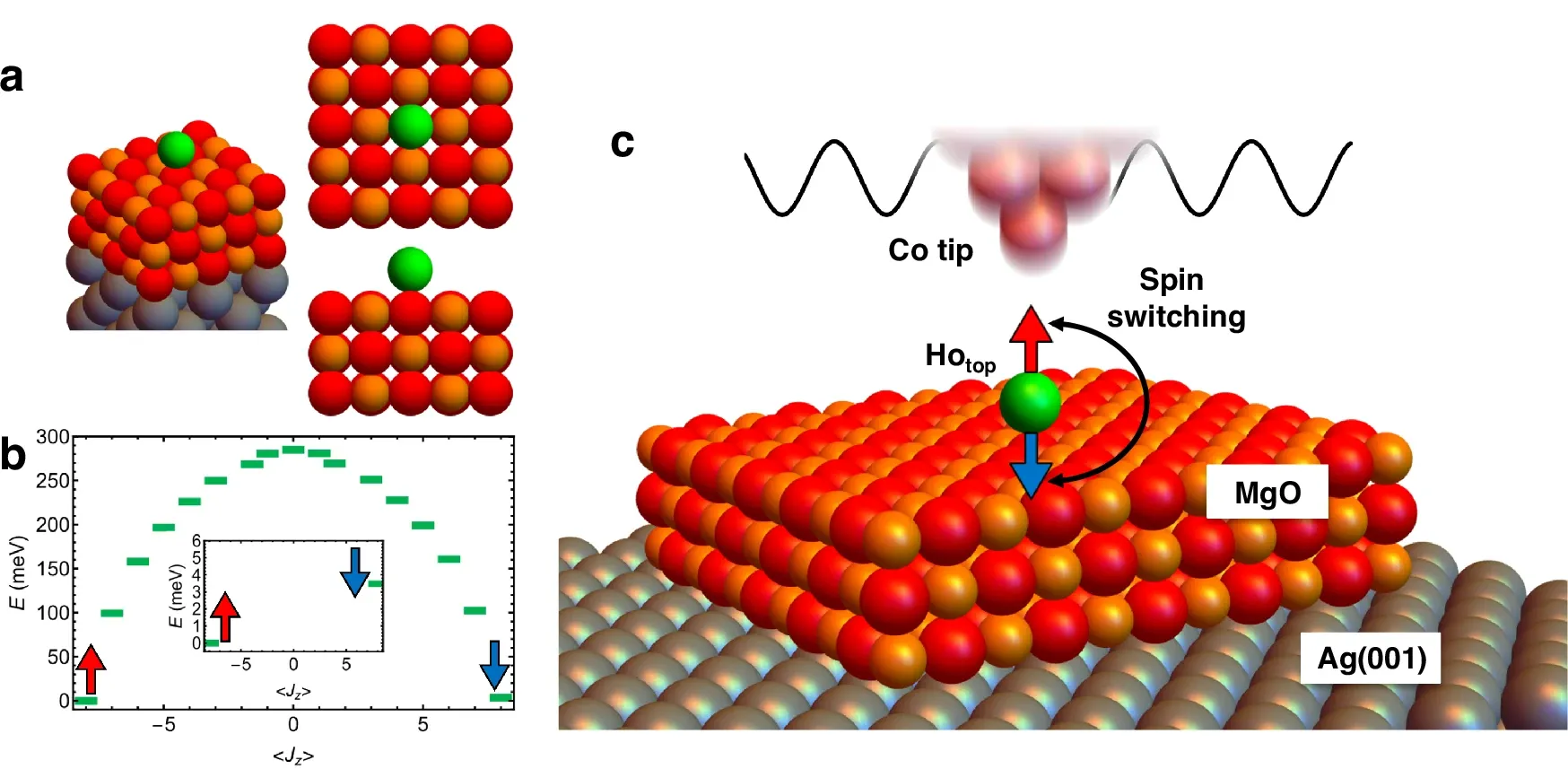
Whereas an ordinary scanning tunneling microscope (STM) measures surface topography by the magnitude of the tunneling current, MExFM detects tiny changes in the physical attractive or repulsive force acting between the probe tip and the sample. The stage for this experiment was a thin film of magnesium oxide (MgO) on a silver substrate, placed in an ultra-low-temperature (4.5 K, about minus 269°C) and ultra-high-vacuum environment. Onto this thin film, a single holmium () atom—playing the role of a data bit—was adsorbed. Under the influence of the crystal field (electrostatic field) created by surrounding oxygen atoms, the holmium atom, like a macroscopic magnet, can stably hold its intrinsic spin in either an upward or downward orientation.
The research team prepared a special probe tip with a single cobalt () atom attached to its apex, and brought it as close as possible to the holmium atom. Here, what is measured is not the tunneling current but the faint "magnetic exchange force" acting between the cobalt atom on the tip and the holmium atom on the substrate.
Magnetic exchange force is a quantum mechanical force that originates from the Pauli exclusion principle, which forbids electrons with the same spin orientation from occupying the same quantum state. It is far stronger than the magnetic dipole interaction between ordinary magnets, and it acts only at extremely short range. The first hurdle was capturing this force, which arises at the instant the 3d electrons of the cobalt at the tip's apex spatially overlap with the deeply localized 4f electrons of the holmium.
A Difference of Mere Nanonewtons in Attractive Force Distinguishes "0" from "1"
Reading data is similar to tracing Braille with only the sense of touch in complete darkness and accurately reading the information written there.
As the MExFM probe tip (fingertip) approaches the holmium atom (Braille), an attractive force (sense of touch) arises between the cobalt atom at the tip's apex and the holmium atom. At this point, depending on whether the holmium atom's spin is oriented upward () or downward (), the strength of the mechanical attractive force felt by the tip differs ever so slightly.
According to the experimental data, when the tip was brought to a distance just before contact with the holmium atom (), an attractive force of (nanonewtons) was measured for the upward spin state, and for the downward spin state. One nanonewton is an extremely tiny unit—one billionth of a newton—but by precisely capturing this minute difference of just in attractive force, the team succeeded in identifying the spin orientation without flowing any electric current at all.
When the distance was further reduced to , the attractive forces for both spin states became equal at , and upon approaching even closer to , a reversal was observed: for the upward spin and for the downward spin. This distance dependence vividly illustrates the complex quantum behavior in which the interaction between the cobalt's 3d electrons and the holmium's 4f electrons transitions from ferromagnetic attraction to antiferromagnetic coupling.
Notably, this mechanical readout method is "non-invasive," meaning it imparts no extra energy to the target atom. It was demonstrated that the holmium atom's spin state remained extremely stable for over 218 seconds even during readout, confirming that the data is not destroyed.
The "Strain" Created by the Tip Breaks Spatial Symmetry and Flips the Spin
Going beyond mere readout, the team also achieved "writing" (spin flipping) using only mechanical manipulation. The mechanism behind this writing process is rooted in deep physical phenomena involving atomic-scale strain and crystal symmetry.
Normally, the holmium atom is stably adsorbed directly above an oxygen atom on the magnesium oxide surface (). This position possesses a spatially elegant fourfold symmetry (), and this high symmetry suppresses the mixing of specific quantum states, keeping the spin long-lived and stable.
However, when the tip is brought to an extreme, threshold distance (for example, ), the tip physically pushes the holmium atom. This mechanical pressure displaces the holmium atom laterally from its originally stable top position to a bridging position between adjacent atoms ().
Unlike the original site, this bridging position has an environment with reduced spatial symmetry, down to twofold symmetry (). This is easy to picture by imagining a spinning top that was stably rotating on a flat table (high symmetry), suddenly pushed onto a tilted or uneven surface (low symmetry): it loses its balance, topples over, and begins spinning in the opposite direction. In this environment of reduced symmetry, a phenomenon called "strain-induced state mixing" occurs, in which the quantum states of the upward and downward spins mix, ultimately inducing spin flipping (writing).
When the tip is withdrawn, the holmium atom settles back into its original stable state while retaining its new spin orientation. Thus, a completely new writing principle—mechanically modulating the surrounding environment of the target—was established, entirely different from injecting current.
The Blueprint for a Future Drawn by Nanomechanospintronics
The greatest breakthrough of this research lies in presenting a new operating principle that completely nullifies the conventional framework of the heat-generation problem. This mechanism, which does not depend on electric current, represents a fundamental paradigm shift toward realizing next-generation ultra-high-density memory.
| Comparison Item | Conventional Magnetic Recording Devices (HDD, etc.) | This Study's Method (Mechanical Spin Control) |
|---|---|---|
| Information Carrier (Size of 1 Bit) | Nanometer-sized magnetic material (tens of thousands to millions of atoms) | A single holmium atom (1 atom) |
| Readout Principle | Magnetoresistive effect (uses electric current) | Detection of magnetic exchange force (uses only force) |
| Writing Principle | Current-driven magnetic field / spin torque | Strain-induced state mixing (mechanical approach) |
| Occurrence of Joule Heating | Present (the largest barrier to miniaturization and high integration) | Absent (operation with ultra-low heat generation is possible) |
| Substrate Constraints | Must be conductive | Also applicable to bulk insulator substrates |
Compared to existing electrical spintronics technology, this mechanical approach opens up a new academic field called "nanomechanospintronics." Because it requires no electric current, it offers great extensibility, making it possible to read and write spins even on single atoms on insulating substrates, which have conventionally been technically difficult to access.
The impact this technology could have if implemented in society is immeasurable. Currently, with the rapid spread of generative AI, the enormous power consumption and cooling costs at data centers around the world have become a serious societal problem. If the power consumed by data storage can be minimized to the utmost limit while simultaneously achieving the ultimate recording density, an ultra-efficient next-generation data center that does not require massive cooling equipment could be realized. In the long term, this technology has the potential to fundamentally transform the market for existing large-capacity archival HDDs and enterprise storage, where power consumption remains a challenge.
Several hurdles remain to be overcome before practical application. This demonstration experiment was conducted at an extremely low temperature of 4.5 K, under an externally applied strong magnetic field of 3.0 T (tesla). The read/write speed is also still at a developmental stage compared with existing memory devices. Going forward, this innovative mechanical control method will need to be applied to a wider variety of material systems, along with materials exploration and mechanistic elucidation aimed at achieving stable operation closer to room temperature and at zero magnetic field.
As a further application, the ripple effects on the field of quantum computing should not be overlooked. A technology that mechanically and non-invasively reads out the quantum state of spins—which serve as qubits—without imparting heat or disturbance (decoherence) from electric current could become a foundational technology directly linked to improving the computational accuracy and extending the operational lifetime of quantum computers.
A tiny needle tip touches an atom, and information is inscribed using force alone. The "ultimate heat-free memory" that humanity has long dreamed of is now beginning to move, as a real and tangible technology, through the manipulation of faint attractive forces and symmetry in the quantum world.