

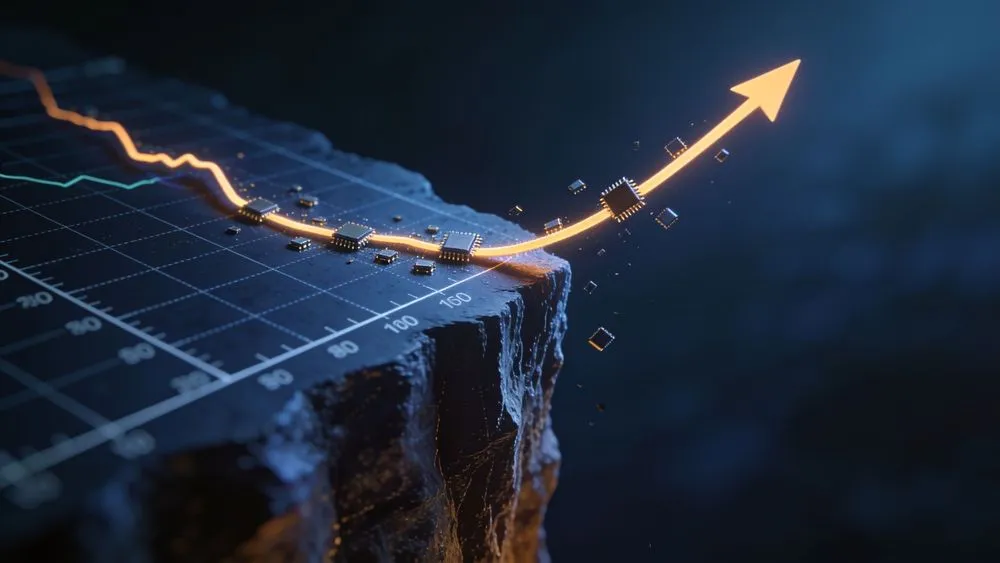
In August 2026, Daniel Lemire, a computer science researcher and software performance expert, posted a graph on X (formerly Twitter). With years on the horizontal axis and price per gigabyte of memory on a logarithmic vertical scale, the graph showed a downward-sloping line that had held steady since 1957 suddenly bending at a right angle around 2025, shooting back up to 2007 levels. Lemire called this a "historical anomaly," writing, "I know of no other case where the price of technology hardware has reverted to levels from decades earlier."
According to the memory price database compiled by David Shim of Stanford University's DAM project, as of 2026 the actual selling price of DDR5 memory ranges between $11.41 and $13.28 per gigabyte. The last time prices sat at this level was in 2008, when DDR2 was trading at $11 to $15 per gigabyte. Adjusted for inflation to 2024 dollars, today's DDR5 works out to a real value of $10.94 to $12.74, which overlaps with 2011 DDR3 pricing ($11.85 per gigabyte). By either measure, memory prices have effectively rolled back 15 to 20 years.
The Half-Century-Old "10x Every 5 Years" Rule Has Stalled
The long-term decline in memory prices was one of the most stable rules of thumb in the technology industry. According to an analysis by AI Impacts using John C. McCallum's historical dataset, the price per gigabyte of DRAM fell by a factor of 10 roughly every five years between 1957 and 2020. Converted to an annual rate, that's a decline of about 36% per year—nearly in sync with Moore's Law, which holds that the number of transistors on an integrated circuit doubles roughly every two years.
This trend had already begun slowing after 2010. The pace of price decline eased to about one order of magnitude per decade (roughly 15% annually), losing much of its earlier momentum. Still, the direction remained consistently downward. A halt in decline is one thing; a reversal is another matter entirely. In fact, the DRAM industry has historically seen 4-to-5-year cyclical swings in price, with upward phases occurring in 2009, 2013, 2017, and during the pandemic. But the magnitude of those swings was orders of magnitude smaller than what's happening now.
| Metric | Historical Trend (1957–2024) | Reality in 2024–2026 |
|---|---|---|
| Long-term DRAM price change | 10x decline every 5 years (~36% annual decline) | Up over 400% from early 2024 through late 2026 (J.P. Morgan estimate) |
| DDR5 actual selling price (per GB) | Fell to roughly $2–3 by mid-2024 | $11.41–$13.28 (per Stanford DAM data) |
| NAND spot price (512Gb TLC wafer) | About $2.70 in July 2025 | About $15 in January 2026 (5.5x, per J.P. Morgan) |
| Annual supply growth rate | About 20% | About 20% (unchanged) |
| Annual demand growth rate | About 20% (historically roughly matched supply) | Over 200% (per Musk's remarks, SpaceX Q2 earnings call) |
How HBM Is Squeezing Out Consumer DRAM
The price surge isn't the result of technological regression or manufacturing trouble. Rather, it stems from an explosion in demand for AI-oriented HBM (High Bandwidth Memory), which is absorbing memory manufacturing capacity wholesale.
HBM stacks bare DRAM dies (chip cores) in 12 or more layers, connecting them via through-silicon vias (TSVs) to achieve bandwidth far beyond what conventional DRAM can offer. NVIDIA's latest GPU, the "B300," carries eight HBM chips, each stacking 12 DRAM dies. According to SemiAnalysis estimates, HBM manufacturing costs run roughly three times those of standard DRAM, accounting for more than 50% of the cost of a packaged GPU.
The problem is that HBM production doesn't happen on a separate, independent manufacturing line. The DRAM wafers at the core of HBM share the same manufacturing process (the 1α, 1β nm generations) as standard DDR5 and LPDDR5. Because the three major players—Samsung, SK hynix, and Micron—prioritize the more profitable HBM production, they redirect that same wafer capacity toward HBM. The result is a structural squeeze on the supply of general-purpose DRAM used in PCs, smartphones, and game consoles.
According to TrendForce estimates, HBM demand grew more than 130% year-over-year in 2025, with growth continuing above 70% into 2026. Micron CEO Sanjay Mehrotra has projected that the overall HBM market will expand from $35 billion in 2025 to $100 billion by 2028—a figure that would exceed the entire DRAM market's size in 2024.
Can Anything Close a Tenfold Gap Between Supply and Demand?
On August 5, 2026, during SpaceX's Q2 earnings call, Elon Musk laid out the memory supply-demand mismatch in simple arithmetic terms: "Memory production is growing at roughly 20% per year, which is an extraordinary growth rate for a mature, large-scale industry. So is demand growing at 20% a year? No—demand is growing at 200% or more per year. When demand grows far faster than supply, basic economics tells you prices go up. They don't go down."
In response to this supply-demand gap, the industry is answering with massive capital investment. Micron has announced plans to invest more than $250 billion in the United States by 2035. SK hynix is building a $4 billion advanced packaging plant in Indiana. Samsung plans to bring a new plant in Pyeongtaek, South Korea, online by 2028, and the South Korean government is backing plans to double domestic memory production capacity within five years through investments of roughly 400 trillion won (about $266 billion) each for SK hynix and Samsung.
However, it takes at least 18 months—typically longer—from breaking ground on a new plant to reaching mass production. The cluster of DRAM plants Micron has begun constructing in Onondaga County, New York, won't reach full production until 2030. Deloitte forecasts that the current supply crunch and elevated prices will persist through 2029, and possibly into 2030.
Price Pass-Through Spreading from Game Consoles to Laptops
The memory price surge isn't confined to data centers. According to J.P. Morgan economist Abiel Reinhart, both the consumer price index (CPI) for software and peripherals and the producer price index (PPI) for storage devices have each risen 23% since late 2024. The import price index for computers, peripherals, and components has climbed 37%. Every 10% increase in hardware costs is estimated to push up core CPI and PCE inflation by about 0.1%.
The impact on consumer products has already shown up in concrete figures. In March 2026, Sony implemented its second price increase for the PS5 in the United States, raising the disc edition from $549.99 to $649.99 and the PS5 Pro from $749.99 to $899.99. Nintendo raised the U.S. price of the Switch 2 by $50, from $449.99 to $499.99, and announced a ¥10,000 increase in Japan, from ¥49,980 to ¥59,980. Nintendo expects roughly ¥100 billion (about $640 million) in additional costs for the fiscal year ending March 2027, driven by rising component prices—chiefly memory—and tariff measures.
HP, Dell, and Apple have also raised laptop prices, and the memory price surge is pushing up manufacturing costs across electronics broadly, not just in specific product categories.
Will 2027 Be the Worst, or Has the Peak Already Passed?
Industry outlooks diverge sharply. SK hynix CEO Kwak Noh-Jung, in a Reuters interview on the day of the company's Nasdaq listing on July 10, 2026, said, "We predict that next year (2027) will be the worst year in the industry's history in terms of supply. Customer demand will continue to exceed our supply capacity even beyond 2030." Nvidia CEO Jensen Huang has likewise said that the AI memory shortage will persist "for several years." Intel CEO Lip-Bu Tan stated flatly, "There will be no relief until 2028." UBS forecasts that the DRAM industry will remain in a state of supply shortage at least through Q2 2028.
On the other hand, Bloomberg Intelligence analyst Shuli Ren argues that the global memory shortage may have already peaked in Q2 2026. Under this scenario, supply and demand could ease from late 2026 into 2027, with the market potentially even swinging into oversupply by 2028.
At the crux of this divide between optimistic and pessimistic outlooks lies the sustainability of AI investment itself. Bank of America estimates that global hyperscaler capital expenditure will reach approximately $851 billion in 2026 and about $1.15 trillion in 2027. If this investment proceeds as planned, memory demand will remain elevated. Conversely, if speculative capital inflows into the AI sector contract sharply, demand forecasts could be revised downward all at once, potentially subjecting the memory market to the opposite shock: oversupply and a price collapse.
Lemire poses two possible paths forward: "Either we find ways to build AI systems that use far less memory, or we find clever ways to make far more memory far faster." Which of these will materialize first—or whether neither will, and the market instead settles into some other equilibrium—remains an open question. The memory market of 2026 is making visible, through consumers' wallets, the underlying dynamics driving the infrastructure economics of the AI era.