

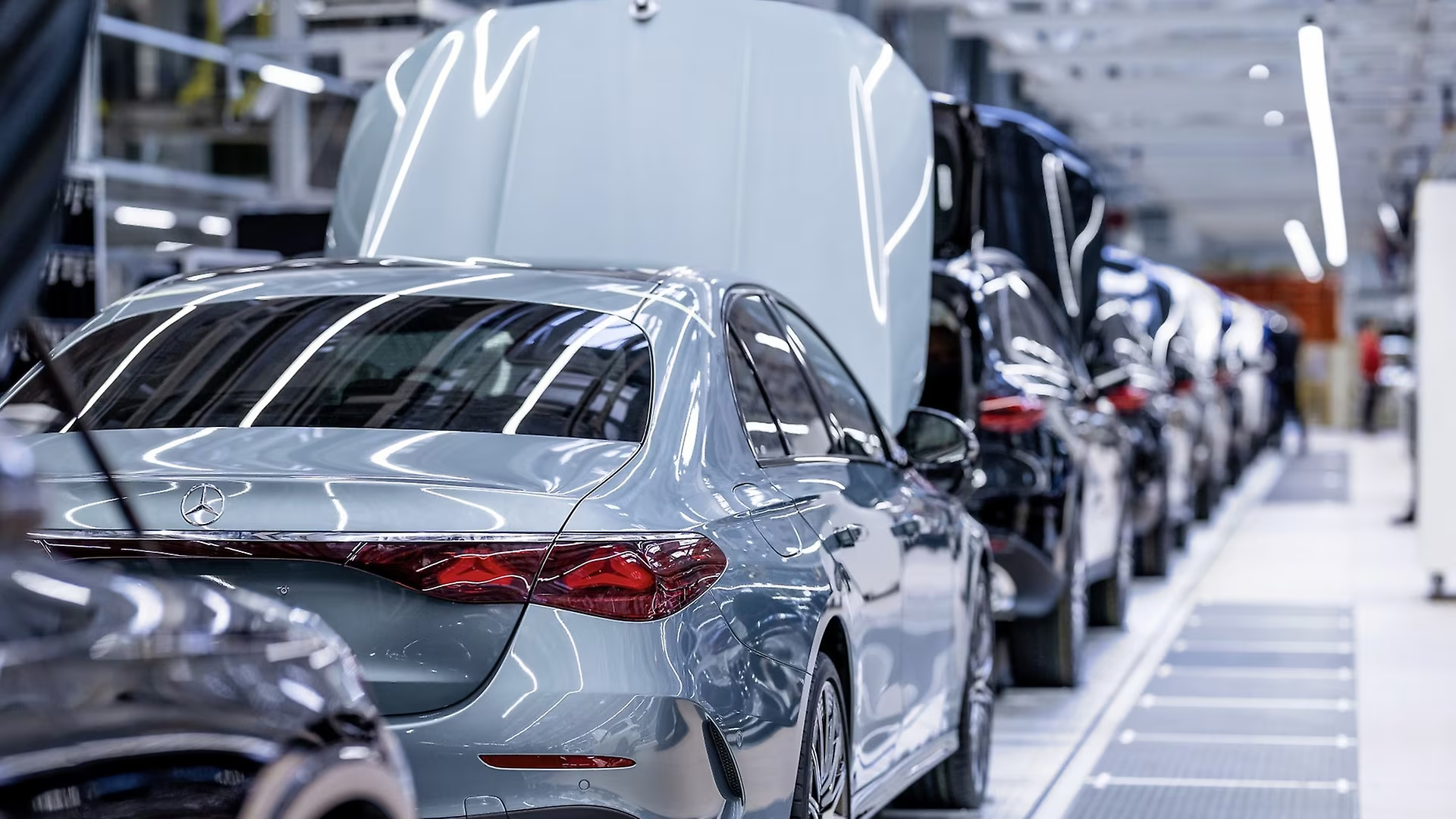
Germany's Mercedes-Benz has halted additional investment in its domestic sites. According to AFP, Michael Schiebe said in an internal interview published on November 12, 2026 that the board of management had decided to stop the investment. Reuters reports that talks with employee representatives and labor unions over cutting labor costs have failed to reach agreement, and that the company is now seriously considering plant closures. No closure has been decided at this point, but the company says that because preparing next-generation vehicles for volume production takes a long time, it needs to decide on future production sites now. The negotiations over domestic labor costs have begun to feed directly into management's decision on where next-generation vehicles will be built.
Behind the move lies declining profitability in the passenger car business. In Mercedes-Benz's latest results, group reported operating profit rose, but adjusted profit, which excludes one-off factors, fell, and profitability in the passenger car division deteriorated. The investment halt appears to be part of the cost-cutting measures the company has been pursuing against this earnings backdrop.
Cost negotiations that could decide where next-generation vehicles are built
According to an employee memo seen by Reuters, Britta Seeger of Mercedes-Benz said the company wants to avoid plant closures but has no choice but to examine them concretely. In September, the company had already warned that it might consider closing two domestic plants if cost-cutting talks failed to make progress. This time, it has gone beyond a warning: it has decided to stop additional investment and has stepped up its examination of plant closures.
In an internal interview obtained by the German newspaper WELT, Schiebe explained the timing for deciding where next-generation vehicles will be produced. Starting volume production requires a long lead time, so the production site has to be decided now, working backward from the planned launch date of the new model. In other words, the outcome of the current labor cost negotiations will also affect vehicle production several years from now.
Schiebe reportedly said the company wants to keep building its next-generation vehicles in Germany, but that if the domestic cost structure does not improve, successor models could be built solely at overseas sites. This, however, is the stance should cost reductions fail to materialize; no decision has been made to shift production abroad. The plants under review and the specific timetable have not been announced as confirmed matters. The total amount of investment halted, the duration of the halt, its impact on existing contracts and ongoing projects, and any exceptions have likewise not been disclosed.
Group profit up, but passenger car profitability falls sharply
In its third-quarter 2026 results, announced on October 28, Mercedes-Benz reported that group EBIT (earnings before interest and taxes) rose from a year earlier. Adjusted EBIT, which corrects for one-off gains and losses, fell for both the group and the passenger car division. Reported and adjusted EBIT moved in opposite directions, so both figures need to be checked to assess the business's underlying earning power.
| Metric | Jul–Sep 2026 | Jul–Sep 2025 |
|---|---|---|
| Group reported EBIT | €1.77 billion | €750 million |
| Group adjusted EBIT | €1.78 billion | €2.1 billion |
| Passenger cars reported EBIT | €455 million | €430 million |
| Passenger cars adjusted EBIT | €560 million | €1.139 billion |
| Passenger cars adjusted return on sales | 2.5% | 4.8% |
Mercedes-Benz cited a decrease in adjusted items compared with the same period last year as the main reason for the rise in group reported EBIT. Group adjusted EBIT, meanwhile, fell 15% year on year, and passenger car adjusted EBIT dropped to less than half of the prior-year level. The division's adjusted return on sales also declined from 4.8% to 2.5%. Group revenue fell from €32.1 billion a year earlier to €30.7 billion, and in contrast to the rise in reported profit, the core earnings environment has become tougher.
Global passenger car sales also fell 8%, from 441,453 units in the same period last year to 407,232 units. By region, Europe was up 5% and the US up 6%, but weak sales in China pulled down the total. Mercedes-Benz named the worsening market environment and intensifying competition in China as the main reasons for the decline.
On the other hand, sales of battery electric vehicles (BEVs) rose 61% year on year, a quarterly record. BEVs accounted for 16.8% of total passenger car sales, reaching 25% when plug-in hybrids (PHEVs) are included. However, the fact that electrified vehicle sales are growing while margins are falling does not mean electrification can be identified as the direct cause of the profit decline. The company pointed to factors that affected results including currency movements, the harsh competitive environment in China, and the costs of launching new products.
On October 27, ahead of the results, Mercedes-Benz also lowered its full-year 2026 outlook. It cut its forecast for the passenger car division's adjusted return on sales from the previous 3–5% to 2–3%, citing the worsening environment in China as well as expected increases in material costs in the fourth quarter. The extent to which domestic labor cost burdens affect margins cannot be calculated separately from the results materials.
Investment halted despite €31 billion in net liquidity
Mercedes-Benz's research and development spending for January–September 2026 was €6.4 billion, and investment in property, plant and equipment was €2.9 billion. Net liquidity of the industrial business at the end of September was €31 billion, down from €32.2 billion at the end of 2025. Net liquidity is a financial metric for the industrial business, and the full amount cannot be regarded as freely available cash.
These figures cover the company's worldwide business and reflect the period before the halt in additional investment in Germany was announced. It is therefore not possible to estimate the scale of the halted investment from past investment or R&D figures. It is also unclear at this point exactly what the halt covers, such as domestic equipment renewal or production lines for new models.
Mercedes-Benz has been working for some time to make capital spending more efficient and to reduce fixed costs. Combined capital expenditure and R&D in the passenger car division for January–September 2026 fell 11% year on year. The company explained that 2025 was the peak of investment for new model launches, which is also behind the decline. Building on a record of cutting fixed costs by about 25% since 2019, it has stepped up productivity efforts, mainly in Germany, since June 2026. From December, it also plans to reopen a voluntary severance program for indirect departments in Germany.
Digitalization of development and production processes is another pillar of the efficiency drive. According to the results materials, the company's "PLM.AI" aims to link operations from development through procurement, production, sales and aftersales, cutting development time by up to 30%. However, the 30% figure is a design target and not an achieved result. The company has also introduced AI into its production management system "MO360," but it is unclear how the investment halt will affect such initiatives.
Union demands investment commitments; company prioritizes cost cuts
In the dispute over Mercedes-Benz's domestic production, labor unions are seeking commitments on jobs and investment, while the company argues it must improve its cost structure before deciding on future production sites. On November 6, the union side demanded binding commitments on investment and jobs as a condition for concessions, and on the 12th the company announced the halt to additional investment. However, the statements on the 6th concerned sector-wide wage negotiations and were not a direct response to the investment halt on the 12th.
- November 6: In the context of sector-wide wage talks, Liane Papaioannou of IG Metall Stuttgart argued that if employees are to make concessions on working conditions and other matters, binding commitments on jobs, production sites and investment are needed. The same day, Ergun Lümali, chair of Mercedes-Benz's group works council, also called for a credible outlook on investment, new products and jobs.
- November 12: AFP reported that Mercedes-Benz had halted additional investment in its German sites. According to WELT, Schiebe explained that production sites need to be decided now in order to prepare for volume production of next-generation vehicles. He suggested that if the domestic cost structure does not improve, successor models could be built only overseas.
The two sides differ on what should be committed first in order to preserve future domestic production. Employees want concrete guarantees on the allocation of new-model production and job security in return for concessions on wages and working conditions. The company, for its part, takes the position that it cannot promise future investment unless domestic cost competitiveness improves before it decides where to build next-generation vehicles.
If the dispute drags on, it could affect decisions needed to prepare next-generation vehicles for volume production. New models require a long lead time before production starts, including setting up production facilities and building a parts supply network. Even if an agreement on labor cost cuts is reached, if production of the new model has by then been assigned overseas, allocating new products to domestic plants could become difficult.
The key question going forward is whether Mercedes-Benz and employee representatives and unions can reach agreement before the production sites for next-generation vehicles are decided. Particularly important will be the scope and duration of the investment halt, the allocation of new models to domestic plants, and commitments on job security. The investment halt is not merely a short-term cost-cutting step; it could shape Mercedes-Benz's future production setup.