

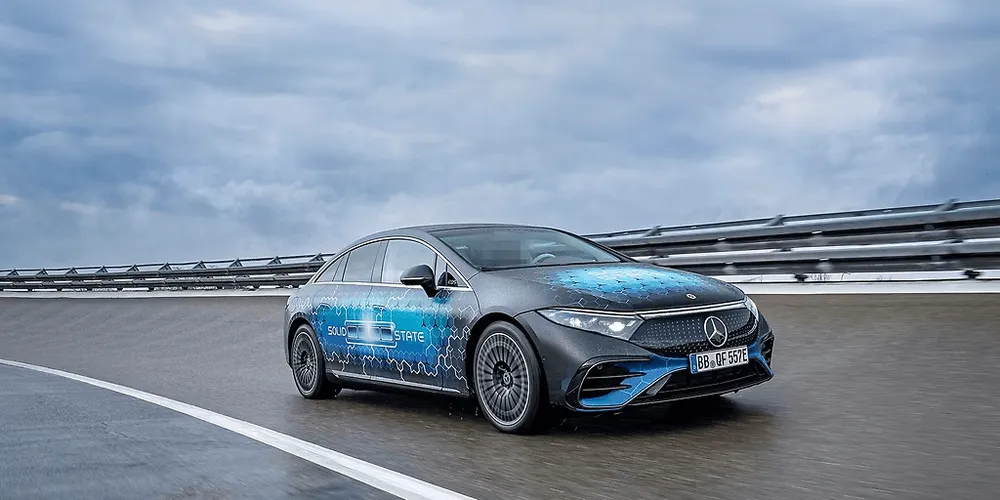
On September 24, 2026, Mercedes-Benz and Taiwanese battery maker ProLogium signed a contract to jointly test next-generation solid-state battery cells. Under the agreement, Mercedes-Benz will gain priority access to ProLogium's Gen4 cells and evaluate their electrical characteristics, thermal behavior, and safety using its own facilities as well as external specialized institutions. The test results will inform decisions on whether the cells can be adopted in future electric vehicles (EVs).
However, the announcement does not specify that this contract includes on-road vehicle testing. Adoption in mass-production vehicles has also not been decided. While ProLogium touts high energy density, fast-charging performance, and safety, the announcement does not disclose cell capacity or cycle life. The testing timeline, pass/fail criteria, and the volume of cells to be supplied to Mercedes-Benz remain unknown. What this contract advances is the transition of lab-demonstrated performance into an automaker's formal evaluation process.
What Mercedes Is Starting: A "Joint Evaluation of Gen4"
The joint announcement specifies three testing categories: electrical characteristics, thermal characteristics, and safety. In addition to Mercedes-Benz's dedicated facilities, external specialized institutions will also be utilized. For ProLogium, this marks a step beyond in-house evaluation, advancing Gen4 into Mercedes-Benz's own evaluation process.
On the other hand, the announcement does not detail how far testing will extend—whether to modules, battery packs, or entire vehicles. Cell form factor, capacity, cathode material, and the number of charge-discharge cycles to be tested also remain undisclosed. The term "priority access" does not imply exclusive supply, an adoption decision, or an order. Mercedes-Benz will assess the test results before determining whether the cells can potentially be adopted in future vehicles.
The relationship between the two companies did not begin now. Mercedes-Benz announced technical cooperation and an investment in ProLogium back in 2022, also gaining a seat on the company's board of directors. At that time, the goal was to deploy test vehicles equipped with jointly developed solid-state batteries within a few years, with eventual adoption in passenger cars. What this new contract materializes is a step within that roadmap: advancing Gen4 cells into Mercedes-Benz's evaluation phase.
Mass Production Is a Different Generation—Gen4 Is Just Entering Cell Evaluation
Within the roughly decade-long collaboration with Mercedes-Benz, Gen4 as of September 2026 is at the cell evaluation stage. Meanwhile, the generation ProLogium has announced entering mass production is a different one: Gen3.5.
On September 2, ProLogium announced the start of mass production of its Gen3.5 Lithium Ceramic Battery at a GWh-scale facility in Taiwan. By contrast, the Gen4 cells that Mercedes-Benz will test represent a next-generation product that switches to an all-inorganic electrolyte. While ProLogium states that the cell structure and major manufacturing processes carry over, a change in material composition requires re-verifying factors such as cycle life, yield, and uniformity in large-format cells. The fact that Gen3.5 achieved mass production does not guarantee that Gen4 can be manufactured with the same quality or cost.
Within Mercedes-Benz itself, solid-state battery development is progressing across multiple stages. The cells the company installed in an EQS at the end of 2024 and began testing on public roads in February 2025 were lithium-metal cells made by U.S.-based Factorial. That modified EQS traveled 1,205 km without recharging from Stuttgart to Malmö at the end of August of the same year, arriving with a displayed remaining range of 137 km. This is a track record for a vehicle system using Factorial cells—not a figure demonstrating ProLogium Gen4 performance.
Lining up the development stages makes the differences clear. ProLogium's Gen3.5 has reached the stage where the manufacturer has announced mass production; Gen4 is at the stage where Mercedes-Benz is evaluating the cells; and Factorial's cells are at the stage of being integrated into the EQS and driven on public roads. Even under the same label of "solid-state battery," the materials used and the maturity of development differ significantly.
The Solid-State Battery Challenge Gen4 Aims to Solve
At the core of Gen4 is a material ProLogium calls the Superfluidized All-Inorganic Solid-State Electrolyte. While solid electrolytes allow the use of materials that are less prone to burning, ion movement tends to become difficult at solid-to-solid contact interfaces. As the anode expands and contracts during charge-discharge cycles, the contact state changes as well, leading to increased resistance and degradation. ProLogium explains that by combining an all-inorganic electrolyte with a ceramic separator, it can maintain a favorable interface between the electrolyte and active materials without requiring additional external pressure.
In addition to the all-inorganic electrolyte, the cells adopt a ceramic separator and an all-silicon anode. Silicon can store large amounts of lithium, but it undergoes significant volume changes during charge-discharge cycles. According to ProLogium, its proprietary cell structure and separator suppress interface degradation caused by this expansion. However, this is the company's own technical explanation—Mercedes-Benz has not confirmed that performance and cycle life can be maintained "without additional external pressure."
On the safety front, the company states that the electrolyte is composed of non-flammable inorganic materials, and that an Active Safety Mechanism (ASM) is incorporated to stabilize electrode materials at high temperatures. ProLogium explains that this mechanism halts reactions that could lead to thermal runaway partway through, but it has not been confirmed that thermal runaway can be prevented under all conditions, including actual accidents. The thermal and safety testing to be conducted by Mercedes-Benz and external institutions exists precisely to verify this kind of performance under conditions simulating real-world vehicle use.
381 Wh/kg Is Gen3.5, 860 Wh/L Is Gen4—Company-Reported Figures
The figures ProLogium has published need to be read carefully, separated by generation and measurement target. The third-party test results of 381 Wh/kg and 903 Wh/L were announced for a large-format Gen3.5 cell with a capacity of 185.4 Ah. According to ProLogium, these were measured by TÜV. Additionally, UL Solutions reportedly conducted a vacuum test at 120°C for six hours in accordance with China's GB/T 43568-2026 standard, finding mass loss of less than 0.05%—below the 0.5% threshold used to classify a battery as solid-state.
For Gen4, meanwhile, the representative figures ProLogium presents include a maximum energy density of 860 Wh/L, an ionic conductivity of 57 mS/cm at room temperature, and a charging performance that takes 4 to 6 minutes to go from 5% to 60-80% remaining capacity. However, these figures represent different metrics entirely. 860 Wh/L is the cell's volumetric energy density, while 57 mS/cm indicates how easily ions move within the electrolyte. Even if the electrolyte's ionic conductivity is high, factors such as interfacial resistance with the electrodes, heat generation, charge control, and degradation determine the cell's overall output and cycle life.
Moreover, publicly available materials do not allow all of Gen4's performance claims to be confirmed within a single third-party test report. Treating 381 Wh/kg and 903 Wh/L as measured Gen4 values, or combining Gen3.5's mass production start with Gen4's fast-charging performance to describe it as "mass-produced ultra-fast-charging cells," would conflate different generations and testing conditions. While the published figures are eye-catching, the conditions for a direct, apples-to-apples performance comparison do not yet exist.
Next Milestones: "Can It Fit in a Car?" and "Can It Be Made With Consistent Quality?"
ProLogium expects that transitioning to Gen4 will require modifying only about 10% of its existing GWh-scale production lines and related equipment. For its Dunkirk plant in France, the company has outlined plans to begin Gen4 mass production at a scale of 0.8 GWh in 2028, expanding to 4 GWh by 2030 and 12 GWh by 2032. The site reportedly has room to expand up to 48 GWh, but this represents future expansion potential rather than production capacity that already exists today.
The difficulty of mass production is not determined solely by whether a production line runs. Questions remain around the yield needed to consistently produce large-format cells at stable quality, capacity retention after repeated fast charging, durability across a wide temperature range, and thermal management once integrated into a battery pack. The capacity of cells destined for Mercedes-Benz and the evaluation timeline have not been disclosed. Pass/fail criteria, supply volume, and which vehicle models might adopt the cells remain unknown. There is also no basis for directly linking the plant's 2028 mass-production timeline to the launch timing of any Mercedes-Benz vehicle.
The significance of this contract lies in the fact that ProLogium's Gen4 has entered Mercedes-Benz's formal evaluation process. Going forward, if Mercedes-Benz's own measurement results come to light, if testing progresses from cells to modules, battery packs, and full vehicles, and if it is further demonstrated that cells with the same performance can be stably manufactured at factory scale, then Gen4 will advance to the next stage as a candidate for adoption in mass-production vehicles. At present, it remains a step behind the on-road vehicle testing that Factorial's cells have already reached.