


On July 9, 2026, Meta Platforms began a public preview of the Meta Model API, allowing external developers to use its flagship AI model "Muse Spark 1.1" on a pay-as-you-go basis. The original Muse Spark, released in April, was limited to Meta AI and a private API for select users, and Meta itself had cited long-running agents and coding as weak points. While Meta has distributed model weights through Llama, Muse Spark—reported by Bloomberg as a closed model—does not release its weights; instead, Meta sells access through its own hosted API. Three months later, the company has strengthened 1-million-token context, multi-agent orchestration, and computer control all at once, pricing it at $1.25 per million input tokens and $4.25 per million output tokens. Beyond rejoining the performance race, Meta has moved from a company that supplies AI to its own services to one that sells models to developers.
Closing the Gaps in Long-Horizon Tasks and Coding in Three Months
At the launch of the original Muse Spark, Meta explicitly noted a performance gap remained in "long-horizon agentic systems" and "coding workflows." These are precisely the two areas that 1.1 targets. A primary agent gathers context and plans, then hands off work in parallel to sub-agents with divided roles. The sub-agents are trained to understand which tools they're permitted to use and to return control to the primary agent whenever a judgment call is needed.
The 1-million-token context window includes not just the capacity to handle long inputs at once, but also a mechanism for managing work history. It remembers actions taken during a task, retrieves earlier information, and compresses context to preserve the steps needed for later stages. In work that involves reading and fixing a codebase, then running tests and checking screens, before returning to the code again, the progress itself becomes a massive amount of input. Context compression directly addresses the problem of agents forgetting earlier decisions the longer they run.
For computer operation, Meta didn't lock the model into a fixed method of clicking through screens one step at a time. For repetitive processing, it writes scripts; for situations where direct interaction is faster, it operates the screen; and it can batch multiple operations together. In examples Meta published, the model handles a dinner order where conditions change midway through, and creates a Facebook Marketplace listing from a smartphone video. It's a design that links the model, visual recognition, and the operating environment into one continuous flow.
How to Read the Leap to 72.2
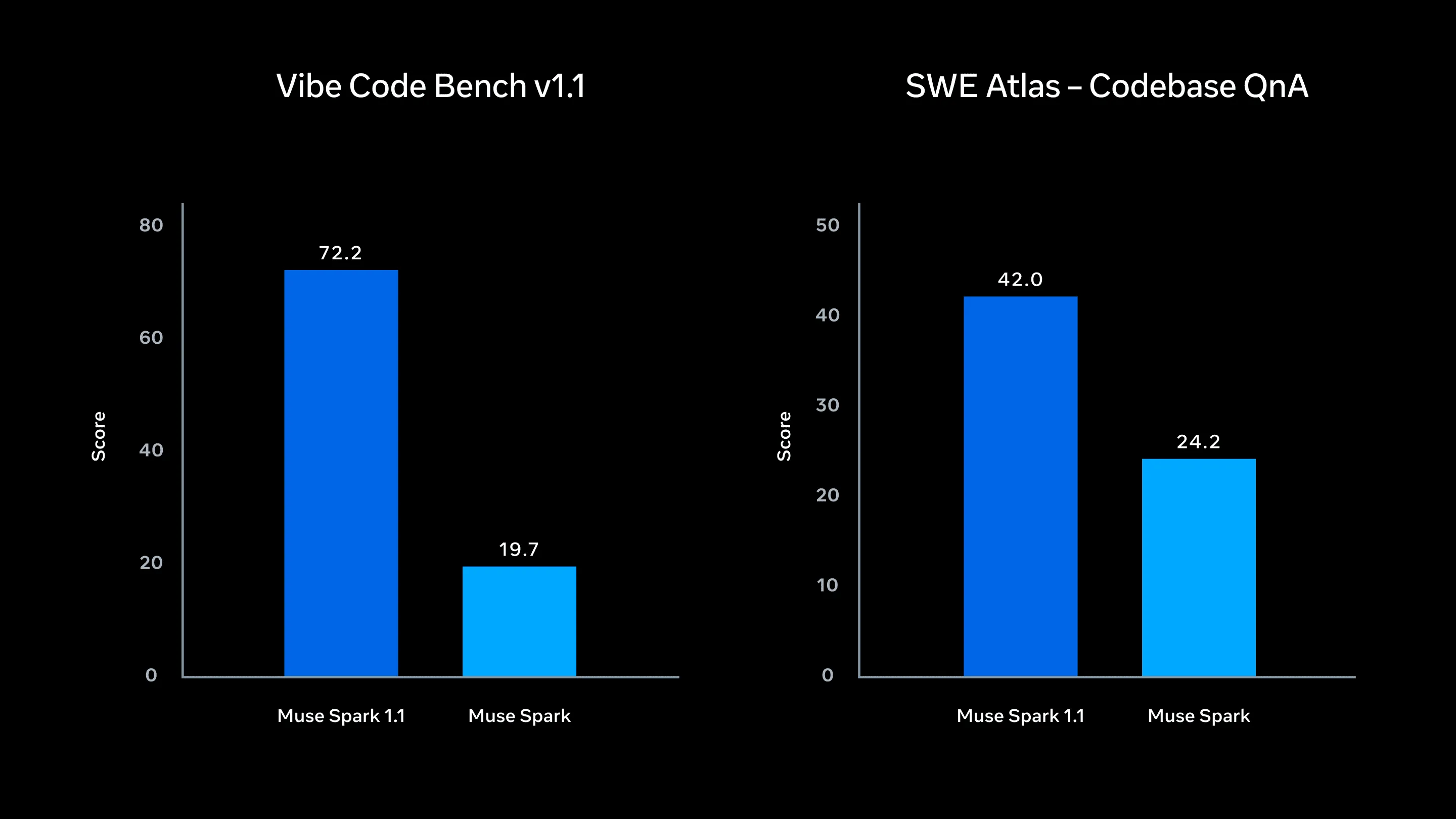
According to Meta's measurements, Vibe Code Bench v1.1, which evaluates web app generation, rose from 19.7 for the original model to 72.2. SWE Atlas Codebase QnA, which tests answering questions by reading a codebase, went from 24.2 to 42.0. These are substantial gains. It appears that the coding shortfalls exposed in the original model were addressed through post-training and an execution environment built for agents.
On JobBench, a general-purpose agent benchmark, Muse Spark 1.1 scored 54.7, Claude Opus 4.8 at its max setting scored 48.4, and GPT-5.5 at its xhigh setting scored 38.3. The original Muse Spark scored 17.0, and Gemini 3.1 Pro at its high setting scored 15.9. At least under Meta's test conditions, 1.1 has advanced to a level that could be called a generation apart from its predecessor.
However, these are self-reported figures measured in an environment chosen by Meta. According to the appendix of the evaluation report, Muse Spark 1.1 was run at high, GPT-5.5 at xhigh, Claude Opus 4.8 at max, and Gemini 3.1 Pro at high. Even with identical setting names, the amount of reasoning computation each company uses doesn't necessarily match, and some figures for external models were cited from each company's own published numbers. The comparison isn't confined to the models alone—tools and prompts change the procedure, and retries and context compression affect both success rates and cost. Until this is reproduced independently under identical conditions, one cannot claim it's "the strongest at every task."
How $1.25 and $4.25 Are Reshaping the Price War
What Meta pushed hardest on was pricing. The Meta Model API charges $1.25 per million input tokens and $4.25 per million output tokens. New accounts receive $20 in trial credits. Compared to each company's standard pricing as of July 10, 2026, this is low among top-tier models.
| Model | Input per 1M tokens | Output per 1M tokens | Key conditions |
|---|---|---|---|
| Muse Spark 1.1 | $1.25 | $4.25 | Reasoning tokens billed as output |
| Grok 4.5 | $2.00 | $6.00 | 500K token context |
| Gemini 3.1 Pro Preview | $2.00 | $12.00 | Up to 200K tokens; output includes thinking tokens |
| Claude Opus 4.8 | $5.00 | $25.00 | 1M token context available at standard pricing |
| GPT-5.5 | $5.00 | $30.00 | Long-context pricing applies above 272K tokens |
Under a simple calculation using 1 million tokens each for input and output, the total would come to $5.50 for Muse Spark 1.1, $8 for Grok 4.5, $14 for Gemini 3.1 Pro, $30 for Claude Opus 4.8, and $35 for GPT-5.5. The final bill depends on both per-token pricing and total token volume. In Meta's API, reasoning tokens are also billed as output, so the difference widens based on how many times tools are invoked, how many times the agent backtracks from failures, and how many tokens it takes to complete the same task. If a cheaper model keeps thinking for longer, its per-task cost advantage shrinks.
Even so, this pricing clearly reflects Meta's intent. In its April earnings report, the company raised its 2026 capital expenditure outlook from a previous range of $115–135 billion to $125–145 billion, driven mainly by component prices and future data center capacity. API revenue won't immediately recoup such massive investment, but a strategy that prioritizes adoption over high margins, embedding itself in developers' execution infrastructure, makes sense—not only through indirect returns via improved advertising, but also by making model usage itself a billable product.
Compatible APIs Lower Migration Costs
Just as impactful as pricing for practical use is the fact that existing tools can be connected without major rewrites. The Meta Model API accepts both the OpenAI SDK's Chat Completions and Responses formats, and it's also compatible with Anthropic's Messages format. All that's needed is to change the endpoint to api.meta.ai/v1 and set the model name to muse-spark-1.1. OpenCode now includes Meta connectivity, and other OpenAI-compatible CLIs can add it as a custom provider.
What compatibility mainly reduces is the cost of switching API formats. With Llama, developers could obtain the weights and run them on their own infrastructure or any cloud they chose. Muse Spark 1.1, however, is accessed through Meta's endpoint, meaning Meta controls where it runs, how pricing changes, and which regions it's available in. Even if the request format looks similar, the operational choices are not the same as with Llama.
The Responses API lets you use previous_response_id to maintain multi-turn state on the server side. Specifying web_search as a tool returns search results with citations. Because images, video, and PDFs can all be passed to the same model, workflows like finding a UI bug from a screenshot and fixing the corresponding code can be consolidated into a single loop.
In Meta's multi-agent example, a product manager role handles only planning and coordination and cannot operate the terminal directly. Backend and frontend roles are given implementation tools. A technical writer role reads records from a shared Kanban board and compiles deliverables. Meta has even distributed a reference implementation that separates permissions by role and allows replaying who decided what.
The rollout is still a public preview limited to developers in the United States. This differs from a general release with guaranteed performance, regional expansion, and finalized enterprise operating terms. Even with access to 1 million tokens, completion rates for long-running tasks still need separate verification. Precisely because migration is easy, developers need to measure success rates, speed, and total billing using their own codebases and tools.
Safety Controls Increased Alongside Performance Gains
The 112-page evaluation report goes into more depth than the brief announcement suggests. Without safety mitigations applied, Muse Spark 1.1 reached Meta's "high risk" capability threshold in the chemical and biological domains, and the company could not rule out the possibility that it also reaches high risk in cybersecurity. Cybench's pass@1 rose from 65.4 for the original model to 92.9, and CyberGym rose from 43.5 to 59.0. The improvements in coding and tool use have pushed up capabilities that can be used for both defense and offense.
Meta stated that by layering refusal controls, usage monitoring, and system-level safety measures, it has reduced the residual risk after deployment to "moderate or below." On AgentDojo, which measures prompt injection, the attack success rate dropped from 11.9 for the original model to 0.7. At the same time, Meta acknowledges that in certain scenarios—such as file-based injection—it has not reached best-in-class performance. For external developers, Meta recommends strictly limiting which tools are permitted, isolating the working environment, and combining safety measures tailored to specific use cases.
This is where the boundaries of API access come into play. With Meta AI, Meta itself can manage the entire operating environment, but with the external API, it's up to the adopting company to decide which files the model can read, which commands it can execute, and where it can write. A model's standalone defense rate does not guarantee safety in actual production use. Once three things are in place—the timing of availability outside the U.S., independently verified per-task cost and success rates, and operational terms that companies can audit—low pricing will shift from being a mere incentive to trial the product into grounds for sustained adoption.