

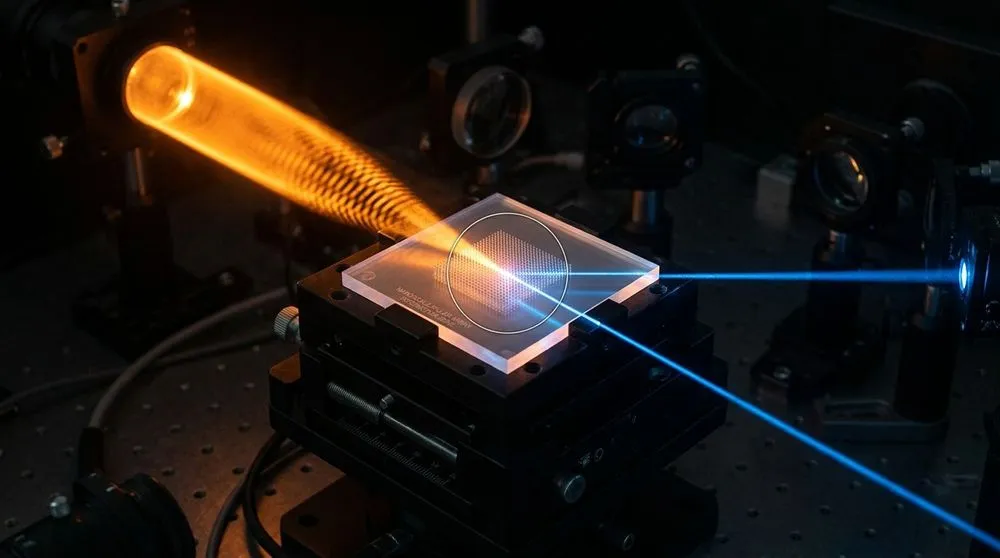
Light traveling through vacuum across the width of a single human hair (roughly 80 micrometers in diameter) takes about 270 femtoseconds. A single metasurface fabricated by Harry Atwater's lab at Caltech bent an incoming laser beam's direction by up to ±13 degrees in just 74 femtoseconds—about a quarter of that time. No mirrors move. No lenses shift. No electrical signal is involved. Light itself redirects other light.
Published in Nature Nanotechnology on June 22, 2026 (DOI: 10.1038/s41565-026-02199-w), this achievement pushes the speed record for optical control by orders of magnitude beyond existing technology. Lead author Claudio Hail is now an assistant professor in the Department of Mechanical Engineering at UC Berkeley, while co-author Lior Michaeli leads his own research group as an assistant professor in the Department of Electrical and Computer Engineering at Tel Aviv University. The research itself was carried out while both were postdoctoral researchers at Caltech, under Professor Atwater.
The Ceiling on Beam Steering Set by Liquid Crystals and Micromirrors
Technology for freely redirecting light underpins communications, imaging, LiDAR, and quantum optics. Today, this role is handled primarily by two types of devices.
One is the liquid crystal spatial light modulator (LC-SLM). By using voltage to change the alignment of liquid crystal molecules, it controls the phase and amplitude of light pixel by pixel. While it offers resolutions exceeding one million pixels, its response time—tied to the physical rotation of liquid crystal molecules—is slow, on the order of 10 to 100 milliseconds, limiting frame rates to a few hertz up to a few hundred hertz. Widely used in astronomical adaptive optics and holographic displays, it fundamentally cannot keep pace with optical communication routing or ultrafast signal processing.
The other is the digital micromirror device (DMD), developed by Texas Instruments. It tilts millions of tiny mirrors tens of thousands of times per second to modulate light amplitude in binary fashion. Though far faster than liquid crystal devices, it still operates in the tens-of-kilohertz range and cannot achieve continuous phase control. Widely used as a light source in projectors and spectrometers, it is unsuited for applications requiring continuous beam deflection angles on femtosecond timescales.
The fundamental constraint shared by both devices is their dependence on the physical motion of matter—molecular rotation or mechanical mirror movement. As long as mechanical inertia sets the speed limit, reaching the femtosecond regime is fundamentally out of reach.
What about using electronic transitions in semiconductors instead? Indeed, prior work has demonstrated illuminating direct-bandgap semiconductor metasurfaces—such as gallium arsenide (GaAs)—with intense lasers to generate free carriers and change the refractive index. However, because the relaxation time for generated carriers to return to the ground state takes on the order of picoseconds ($10^{-12}$ seconds), response speed has been blocked by this picosecond wall. The lifetime of real, physical particles created and destroyed—carrier generation and recombination—sets the speed ceiling.
| Technology | Response Speed | Deflection Angle | Reconfigurability |
|---|---|---|---|
| Liquid crystal SLM | 10–100 ms | Arbitrary (phase control) | Electrically possible |
| DMD | Tens of μs (~tens of kHz) | Binary only | Electrically possible |
| Semiconductor carrier-transition metasurface | ~ps | <1.5° | Limited |
| This study (optical Kerr effect + high-Q metasurface) | 74 fs (pulse-limited) | ±13° | Freely reconfigurable via pattern |
What this table reveals is that no prior approach has simultaneously satisfied speed, deflection angle, and reconfigurability.
Resonantly Amplifying the "Instantaneous Distortion" of the Optical Kerr Effect
The physical phenomenon the research team chose was the optical Kerr effect. It is the optical-frequency counterpart of the electro-optic effect discovered by John Kerr in 1875, later formulated theoretically by Buckingham in 1956. It occurs when the electric field of intense light distorts the electron cloud within a material, causing a slight change in refractive index. Because this involves no transition of electrons to excited states—merely an instantaneous distortion of the electron distribution within orbitals—the response occurs on sub-femtosecond timescales and reverts immediately once the light pulse disappears. There is no need to wait for carrier relaxation. This is the physical basis for circumventing the picosecond wall.
The problem is that this effect is extremely weak. Amorphous silicon's Kerr nonlinear refractive index is small, far too weak to deflect a beam in bulk form. Under ordinary conditions, the resulting refractive index change is barely detectable, let alone usable.
The Atwater team's innovation was to amplify this minute refractive index change using the metasurface's structural resonance. They fabricated an amorphous silicon thin film into an array of nanoscale pillar structures (nanopillars) smaller than the pump light's wavelength. By precisely engineering the pillars' diameter and spacing, they created conditions under which incoming light recirculates inside the metasurface, lingering longer than it otherwise would. This is known as a high-Q (high quality factor) resonance state; the extended interaction time between light and matter allows the minute refractive index change to accumulate into a substantial effect.
The specific operating mechanism works as follows. First, a spatially patterned, intense pump beam illuminates the metasurface. Wherever the pump light strikes, the silicon's refractive index changes slightly via the Kerr effect. Immediately afterward, a weak probe beam passing through the same metasurface diffracts at the boundary between regions with altered and unaltered refractive index, deflecting the probe beam's direction. The magnitude and direction of this deflection can be freely programmed via the pump beam's spatial pattern.
Hail explains the design philosophy: "The goal wasn't to build a metasurface whose optical response is fixed once fabricated, but rather a device where you can reconfigure how light is manipulated simply by changing the illumination pattern."
74 Femtoseconds Is Not a Material Limit
An important caveat accompanies the 74-femtosecond figure achieved in the experiment. This value does not represent the metasurface's own intrinsic response speed—it matches the pulse duration of the pump laser used to drive it. The paper describes this as "pulse-limited," suggesting that the Kerr effect's own response is sub-femtosecond—that is, even faster than 74 femtoseconds. Using shorter pulses could push the apparent response speed even higher.
The ±13-degree deflection angle represents roughly a ninefold improvement over the sub-1.5-degree angles of prior work. Beyond beam steering, the research team also observed two-dimensional spatial light modulation with arbitrary patterns (rewriting spatial light-dark patterns), linear frequency conversion, and self-diffraction of the pump light itself. Demonstrating such a diverse range of light manipulation from a single physical mechanism underscores the device's versatility.
Michaeli states: "The ultrafast effect we wanted to harness is inherently very weak. We had to design the metasurface to amplify it—not just to a level where it could be measured, but to a level where it could actually be used to manipulate light." This strategy of amplifying weak physical phenomena through structural design sits at the intersection of nonlinear optics and metasurface engineering, and connects to the concept of "Q-boosting," which has been rapidly advancing in the field in recent years.
Three Hurdles Remaining on the Path to All-Optical Processing
The primary application this achievement points toward is all-optical computing—processing optical signals end-to-end without converting them to electrical signals. In current optical communication systems, signals transmitted via optical fiber must first be converted to electrical signals at routers and switches, processed, and then converted back to light. This optical-electrical-optical conversion is the bottleneck limiting both speed and power consumption. If light's path can be switched in 74 femtoseconds, routing without conversion may become possible.
However, several unresolved challenges remain before practical deployment. First, the current design's reliance on high-Q resonance limits its operating bandwidth. The higher the resonance's Q factor, the longer light lingers—but this also narrows the usable wavelength range. Achieving broadband operation will require structures with dynamically controllable Q values, or optimization across different wavelength ranges. Second, free-carrier generation from two-photon absorption in silicon persists as background noise, degrading the purity of high-speed operation. The paper cites selecting different operating wavelengths and spectral mode engineering as future avenues for reducing this. Third, integrating this from a laboratory optical setup into actual communication chips or processors faces a mountain of engineering challenges, including miniaturizing the pump light source and scaling up the metasurface to larger areas.
The research team itself acknowledges that this achievement remains at a fundamental stage. The Atwater lab is now also exploring connections to broader time-domain photonics concepts, such as time crystals and synthetic time-varying optical materials. The figure of 74 femtoseconds is not a destination—it marks the threshold of an era in which light controls light.