

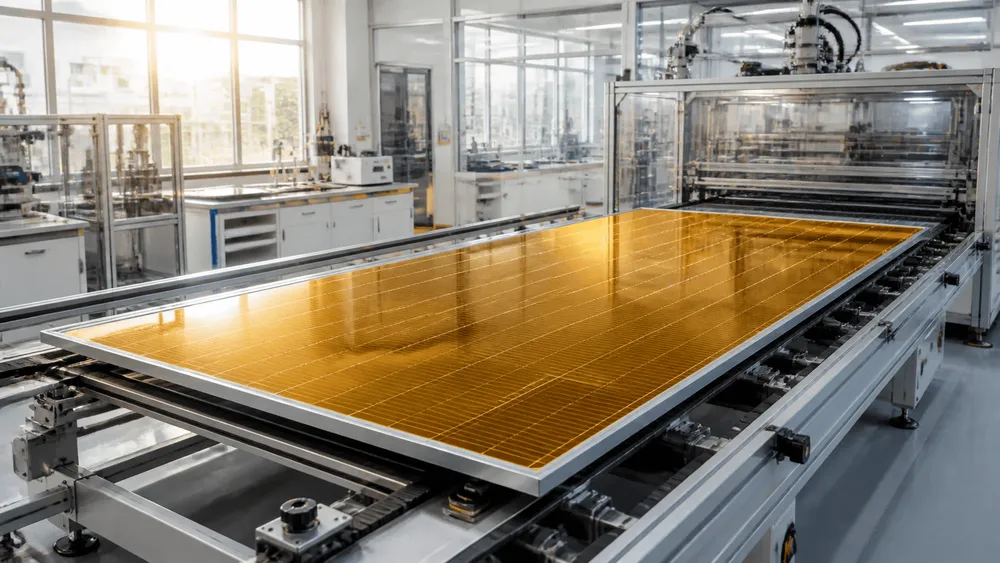
Nanjing University and Renshine Solar (Renshine Solar) have reported a third-party certified conversion efficiency of 22.0% for a single-junction perovskite solar module measuring 1.2m × 0.6m with a total area of 0.72 square meters. This comes from a paper by Dongdong Xu, Ke Xiao, Ye Liu and colleagues, along with Hairen Tan and others, titled "Lead carboxylates passivation for meter-scale perovskite solar modules" (DOI: 10.1038/s41586-026-10994-7), published online on August 12, 2026.
The starting point of the research was whether uniformity in the crystalline film and surface treatment could be maintained even as the module was scaled up to 0.72 square meters. The 22.0% figure reported this time shows how much efficiency loss associated with scaling up was suppressed. However, this is a value for the best certified sample, not an indication of factory average values or yield rates. It's necessary to read separately what the manufacturing, accelerated testing, and three-month outdoor comparison each confirmed.
The New 0.72-Square-Meter Benchmark Set by 22.0%
For the same 0.72-square-meter area, a 2025 paper in Science reported a total-area certified efficiency of 17.2%. The 22.0% reported this time represents an increase of 4.8 percentage points from that figure, corresponding to a relative improvement of approximately 27.9%. The stabilized power output was 158.4W, with the best module recording a reverse-scan value of 22.0% and a forward-scan value of 21.13%.
Mixing up area definitions can lead to mistaken comparisons. The best module with an aperture area of 810cm² recorded 24.0% in reverse scan and 23.30% in forward scan, but this is not the total-area value for the 0.72-square-meter module. The active area of the 0.72-square-meter product is 94.3% of the total area, and the authors convert the total-area 22.0% to an active-area figure of 23.3%, analyzing that the difference from the 810cm² product's 24.0% is mainly attributable to geometric losses such as dead areas at the edges.
The 22.0% certified value is for a single best sample. Meanwhile, the conditional comparisons for the 810cm² module were conducted with parallel data of five samples per condition, and the main Figure 3 comparison is stated as n=10 per group. From this sample size, it's not possible to judge the variability across the entire 150MW pilot line or mass-production yield rates.
Manufacturing was carried out on a 150MW pilot line. Slot-die coating was performed in air with a gap of 50µm and coating speed of 15mm/s, and the resulting film was dried for 35 seconds under less than 10Pa, then annealed at 130°C for 20 minutes. This was followed by a combination of vapor deposition, atomic layer deposition (ALD), sputtering, laser scribing, and encapsulation—after sealing with butyl rubber, POE, and glass, lamination was performed at 130°C for 10 minutes. While it's important that the figures were obtained through a process close to mass-production dimensions, sale price and manufacturing cost are not included in the paper's core evaluation.
Refining the Surface with Solvents, Treating Defects with Lead Carboxylates
This manufacturing method takes the approach of first forming the surface of the perovskite layer, then treating it with lead carboxylates. A mixture of 2-methoxyethanol (2-Me), 1,3-dioxolane (DOL), and DMSO in a 6:3:1 volume ratio was used to form an FAI-rich surface through vacuum-assisted crystallization. Lead carboxylate (LCP), represented by lead oleate Pb(OA)2, was then applied to this surface.
The aim is to maintain uniformity in surface treatment even with large-area scaling. Conventional ammonium halide passivators (AHP) are effective at small areas but are sensitive to humidity, require inert atmospheres, and tend to produce non-uniformity due to coffee-ring effects when coated over large areas. LCP, as a chemically stable material, was aimed at improving uniform coating and charge transport at the interface.
The paper investigated this treatment by combining dissolution and precipitation observations with FTIR and 1H NMR spectroscopic measurements, along with surface analysis using XPS and TOF-SIMS. Crystal structure was confirmed with GIWAXS, and SEM, PL mapping, and electrical characteristics were also measured. XPS supports enrichment of FA+ and I− at the surface. However, the response to peer review explicitly states that XPS alone cannot determine the precise atomic stoichiometry of the surface.
There are also calculations supplementing the mechanism. Ab initio molecular dynamics (AIMD) targeting a mixed system of 2-Me, DOL, and Cs+ shows spontaneous formation of Cs-containing complexes, and calculations of bond energies between FAI and solvent, as well as bonding between I− and OA− at defect sites, are also presented. None of these are measured efficiency or outdoor power generation figures, but rather theoretical results supporting the proposed reactions and bonding mechanisms. It cannot be concluded from these calculations alone that LCP treatment directly produced the outdoor performance.
What Did the 1,300-Hour Damp Heat Test Confirm?
In damp heat testing using five sealed 810cm² modules per condition, relative efficiency was compared at 85±2°C and 85±5% RH after 1,300±48 hours. Taking initial efficiency as 100, the AHP product dropped to 61, a decline of 39%. The LCP product maintained 98, with a decline of only 2%. This is a result measuring the difference in degradation under damp heat as a comparison with matched treatment conditions.
In thermal cycling tests repeating -40°C to 85°C 300 times, the LCP product showed almost no measurable efficiency loss. In a separate maximum power point tracking (MPPT) test, it maintained 96 against an initial efficiency of 100 after 2,200 hours. Both are accelerated/indoor tests on sealed 810cm² modules, and are not tests that directly demonstrate outdoor lifespan over decades.
The paper reports passing the full series of IEC 61215 and IEC 61730 tests. IEC conformity means passing tests related to design, safety, and durability, but does not prove commercial viability or long-term actual power generation.
The Three-Month Outdoor Comparison Doesn't Prove Temperature Effects
At the same large-scale ground-mounted power plant, the research team compared a 1MW perovskite system with a 3.5MW crystalline silicon TOPCon system from March to May 2026. Since the installed capacities differ, what was compared was not total power generation but monthly specific yield per unit of installed capacity. Using a definition where the silicon-side value is subtracted from the perovskite-side value and divided by the silicon-side value, the differences reported in the paper were 3.42% in March, 3.79% in April, and 5.81% in May.
Reading the bar graph in the supplementary figure, the monthly specific yields were approximately 126 vs. 122 in March, 151 vs. 146 in April, and 159 vs. 150 kWh/kWp-month in May, with the former being the perovskite system and the latter the silicon system in each case. However, these are approximate figures read from the graph's scale, and the published Supplementary Data does not include machine-readable raw data for Fig. 73. The exact differences should be based on the percentages stated in the paper. There is also missing data from May 23-24 due to power plant maintenance.
It can be observed that as spring temperatures rose, the gap widened from 3.42% to 5.81%. However, this is a comparison of one perovskite system and one TOPCon system observed at the same site over three months, not a randomized intervention trial. The effects of capacity and module ratings, wiring, and inverters have not been separated out. The same applies to the effects of tilt, temperature coefficient, and soiling, so it cannot be definitively concluded that temperature caused the difference.
The 22.0% reported this time has been third-party certified, and there are also controlled comparisons in the manufacturing method and reliability testing. On the other hand, independent replication of the outdoor advantage and reproducibility across multiple sites have not yet been reported. Once year-round specific yield across multiple climates, mass-production yield rates, lead leakage and recovery, and lifecycle costs are established, it will be possible to judge whether this advance in efficiency achieved by expanding module area will lead to technology adoptable at power plants.