

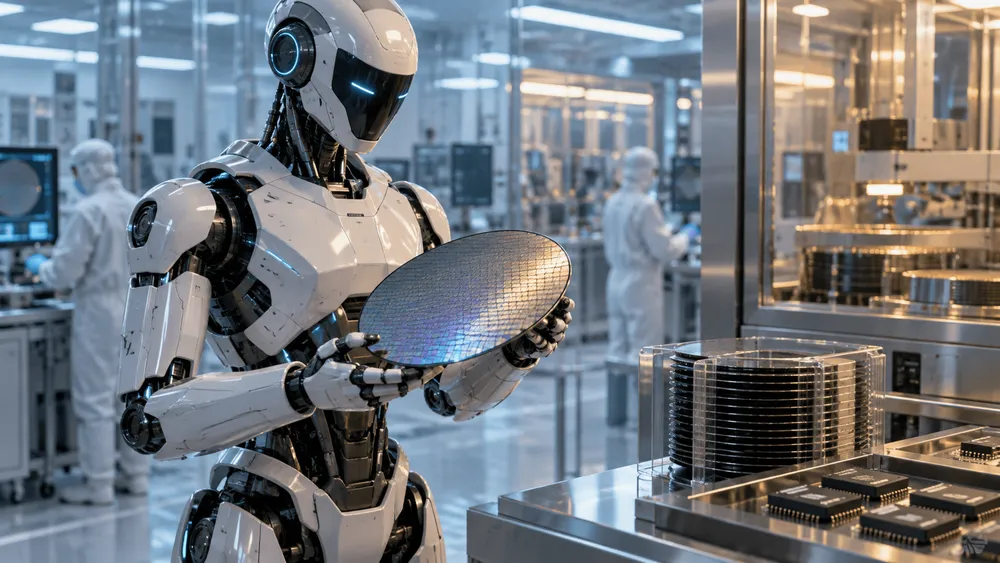
On September 30 (US time), in its fiscal fourth-quarter 2026 earnings remarks, Micron said it sees humanoid robots becoming a major source of high-capacity memory demand, comparable to autonomous vehicles. The benchmark is more than 200GB of memory and several terabytes of storage. However, this is not a confirmed robot specification. It is a forward-looking projection benchmarked on advanced autonomous vehicles. With the memory shortage continuing, when and how will the arrival of robots and new fab capacity affect supply and demand?
The Basis for the 200GB+ Projection
The 200GB-plus figure that Chairman and CEO Sanjay Mehrotra cited in the prepared remarks refers to the memory capacity typically installed in Level 4 and higher autonomous vehicles. Level 4 is the stage at which the system handles driving under defined conditions. Storage also reaches several terabytes, and the required amount is more than 10 times that of today's Level 2+ and Level 3 cars. Micron expects humanoid robots to need a similar amount of memory and storage.
The expectations for robots are not new this time. In its previous remarks on June 24, the company also projected that a humanoid robot's memory capacity would be 10 times that of an average Level 2+ car and discussed demand growth from the late 2020s. This time, by citing the capacity of advanced autonomous vehicles, it painted a more concrete picture of robot demand. Multiple customers are evaluating samples of next-generation products, but Micron has not disclosed whether they will be adopted for mass production or what shipment volumes to expect.
Meanwhile, the compute platforms for robots available today come in different capacities. In NVIDIA's technical overview of Jetson Thor, published in August 2025, the top-end T5000 module carries 128GB of LPDDR5X, and the developer kit includes 1TB of NVMe storage.
| Subject | Memory / Storage | What the figure covers |
|---|---|---|
| Level 4+ autonomous vehicles | Typically 200GB+ / several TB | Vehicle capacity cited by Micron |
| Future humanoid robots | Similar to autonomous vehicles (expected) | Micron's future outlook |
| Jetson T5000 | 128GB LPDDR5X | Spec of a current compute module |
| Jetson Thor developer kit | 1TB NVMe | Storage spec of the developer kit |
Sources: Micron's prepared remarks of September 30, 2026; NVIDIA's technical overview of August 25, 2025.
This gap involves differences in generation and system scope. The future robots as a whole that Micron discusses are not the same thing as a current compute module. The existence of a 128GB product alone neither refutes a 200GB-class projection nor means the projection is the required capacity for every robot today. The necessary amount varies with the AI models installed and how much sensor processing is done on the device.
A Robot's "Thinking" and "Moving"
To judge its surroundings, a robot must run AI models while processing data arriving from its sensors. DRAM provides the workspace for that. More capacity allows larger models and more in-process data to be held. But capacity alone does not determine processing speed.
The T5000's memory bandwidth is 273GB/s. Bandwidth indicates how much data can move between memory and compute circuits in a given time. Even if a large model fits, its capability cannot be fully used if the data needed for computation cannot be delivered fast enough. Beyond capacity, how to limit data movement and power consumption is a design challenge when running AI on a device.
NVIDIA describes robot processing in layers. High-speed motion control demands strict response times, whereas environment perception, action planning and high-level reasoning each allow different time margins. The speed at which a large AI model reasons and the speed at which joints must move safely cannot be lumped together. Rather than demanding the same low latency for every task, compute resources must be allocated according to role.
Storage plays a different role. According to Micron's humanoid robot explainer, NAND stores AI models and firmware, and also holds maps, operation logs and update data. If DRAM is the workspace for in-process data, NAND is where information is kept even when power is off. The several-terabyte figure relates not only to inference but also to the information a continuously operating machine accumulates.
Given this configuration, the spread of humanoid robots will not necessarily translate directly into higher HBM demand. The LPDDR5X used by the T5000 is low-power DRAM, a different standard from the HBM used for AI computing in data centers. To assess robot demand, one must look not only at capacity per unit but also at which types of memory are adopted.
Funding for Expansion Is Ready, but Supply Won't Rise Right Away
Micron sees physical AI as potentially an important source of demand by the end of the 2020s. So how will supply to meet it grow? Listing this round's fab plans, limited to front-end wafer manufacturing, reveals the time lag between investment and shipments.
| Fab / expansion plan | Target | Planned initial production |
|---|---|---|
| Idaho, US: ID1 | DRAM | Mid-2027 |
| Idaho, US: ID2 | DRAM | End of 2028 |
| Expansion in Japan | DRAM | End of 2028 |
| New fab in Singapore | NAND | Second half of 2028 |
| First fab in New York, US | DRAM | 2030 |
Sources: Micron's prepared remarks of September 30, 2026 (pp. 2–3) and presentation slides (pp. 8–9). All are plans. The expansion in Japan also supports a transition in manufacturing technology, and net additions to production capacity have not been disclosed.
Initial production at Micron's new fabs is spread across 2027 to 2030, and ramping output will take several more quarters.
The scale of funding is large. Capital expenditures in the first half of fiscal 2027 will be about $25 billion, net of expected government incentives, and will increase further in the second half. But more than half of the increase is for construction, pulling forward cleanroom space that will mainly be usable from the end of 2028 onward. The money being spent now will not immediately put more memory on store shelves. Manufacturing equipment installation will be adjusted to demand and market conditions.
Micron said previously that industry supply would improve gradually in 2028 but that it could not see when supply would catch up with demand. This time, it expects the supply-demand balance in calendar 2027 and 2028 to be significantly tighter than in 2026. More supply is not the same as an end to the shortage. Indeed, it projects industry bit shipment growth in both years of the low-20% range for DRAM and the mid-20% range for NAND. Even so, its judgment is that demand cannot be met.
The current figures also show the difference between shipment volume and price growth. In the fourth quarter, DRAM bit shipments rose by a mid-single-digit percentage from the previous quarter, while the average selling price rose in the high-teens percent. NAND shipments grew about 10%, while the price rose about 30%. Data center SSD revenue reached nearly $10 billion, accounting for more than two-thirds of the company's NAND revenue. The big demand driving current results already lies in this market.
However, these are Micron's shipment volumes, selling prices and revenue mix, not figures that directly indicate retail prices of PC memory or the allocation of production capacity. There is also no basis for reading that robots, which are at the sample-evaluation stage, are already taking large amounts of PC memory. Robots are positioned less as an explanation for today's shortage than as demand awaiting the expanded supply.
What Long-Term Contracts Protect, and How to Read Robot Demand
While adding capacity, Micron is also trying to secure future revenue through customer contracts. Multi-year agreements rose from 16 last time to 26. They use a "take-or-pay" structure, in which customers are obligated to buy agreed volumes or pay for them, and account for more than 35% of the company's projected revenue through 2030.
Three-quarters of the projected revenue under these contracts has a pricing framework, and more than half of that has price floors and ceilings. The remaining quarter is renegotiated periodically based on market prices. The pricing terms apply to contracted revenue, not to three-quarters of total company revenue or to the memory market as a whole.
Purchase and payment obligations are a way to reduce the risk of falling demand for Micron, which bears the construction costs. But a price floor with a specific customer does not fix the market price of PC memory. This explanation offers no guarantee that prices will not fall if AI investment slows.
Furthermore, robot adoption forecasts differ in timing and units. Morgan Stanley's outlook, published in May 2025, projects about 930 million humanoid robots in use in industrial and commercial applications in 2050. That is not annual shipments but the number in use at that point. It also assumes adoption will be relatively slow until the mid-2030s and accelerate from the latter half of that decade into the 2040s.
To consider new annual memory demand, one must multiply the number of units manufactured that year by the amount installed per unit. Multiplying a future total installed base by 200GB yields only the total amount in machines at a given time. Directly linking the demand Micron expects at the end of the 2020s to the 2050 adoption forecast would misjudge how fast demand arises.
Humanoid robots point to the possibility that memory-hungry devices will spread beyond the data center. To gauge the scale, one needs to watch whether sample evaluations progress to mass-production adoption and how much new fabs can increase shipments from initial production. Investment in robots is itself not unrelated to AI investment. A capacity projection of the 200GB class alone cannot determine prices after AI demand falls.