

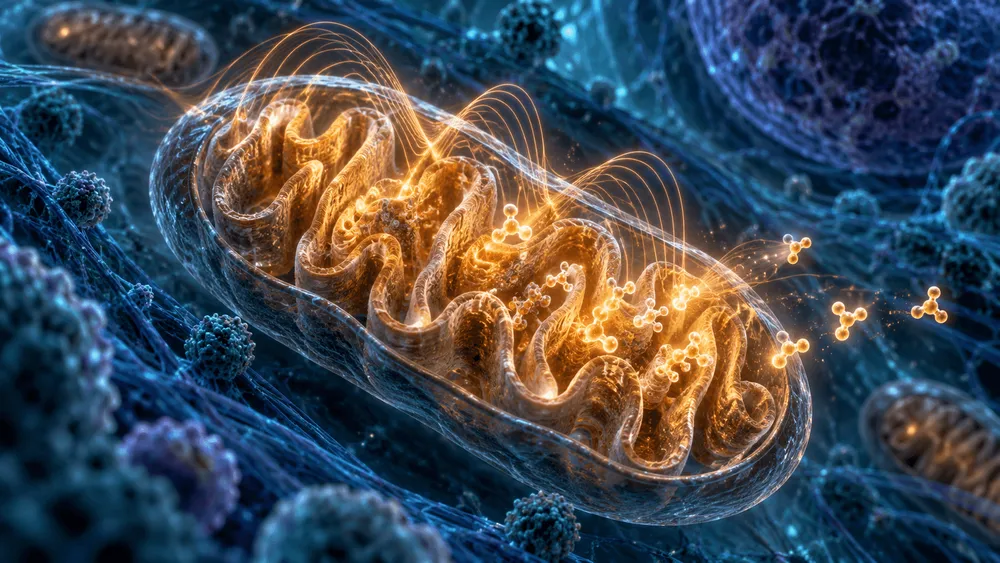
Mitochondria, working ceaselessly inside human cells, use nutrients derived from food to synthesize adenosine triphosphate (ATP), supplying the chemical energy needed for nearly all life processes. They are often called the "powerhouses of the cell." Biochemistry textbooks describe in detail how oxidative phosphorylation works: a proton concentration gradient across the inner membrane drives ATP synthase, a giant rotary enzyme. Yet the microscopic physical processes underlying this highly efficient energy conversion remain incompletely understood.
A new study attempts to address this question by examining microscopic physical phenomena occurring within biological membranes. A collaborative research group led by Bo Song at the School of Optical-Electrical and Computer Engineering, University of Shanghai for Science and Technology, detected a signal in structurally intact mitochondria that is difficult to explain using known molecular vibrations, and proposed that a quantum mechanically coupled state of light and matter might underlie it.
However, this study has not been published in a peer-reviewed journal as a confirmed result. It is an unreviewed paper posted on the preprint server bioRxiv in September 2026 (DOI: 10.64898/2026.09.10.750628, first author Yang et al.).
The research team's claim is that a quantum state affecting energy production forms inside mitochondria—but this is the authors' interpretation, linking spectroscopic data with a mathematical model, not an established fact. It is necessary to distinguish carefully between what was actually observed in the experiments, what is inferred from the mathematical model, and what remains missing to substantiate the hypothesis.
A 71-Terahertz Spectroscopic Signal That Appeared Only in Structurally Intact Samples
The first thing the research team examined was how cells and mitochondria respond, in terms of frequency, to infrared light. The experiments used Fourier-transform infrared spectroscopy (FTIR).
Infrared spectroscopy is a fundamental analytical technique that exploits the fact that bonds between atoms in a molecule stretch and bend at characteristic frequencies, allowing researchers to probe a substance's composition and structural state.
The samples analyzed included a cultured human cell line, as well as tissue taken from mouse kidney, liver, heart, and skeletal muscle, and mitochondria isolated by centrifugation.
When the research team measured the infrared absorption spectra of these samples, they detected a distinctive signal near 71 terahertz (THz) that is difficult to explain by the vibrations of known biomolecules. 71 THz corresponds to a frequency of 71 trillion oscillations per second.
| Sample type | Treatment | 71 THz signal |
|---|---|---|
| Cultured human cells (HEK-293T line) | Living cells | Detected |
| Excised mouse tissue (kidney, liver, heart, skeletal muscle) | Fresh tissue | Detected |
| Isolated mitochondria | Membrane structure preserved | Detected |
| Various biological samples | Dried and ground | Disappeared |
What stands out is that this 71 THz signal depended strongly on the structural state of the samples. It was confirmed in living cells, freshly excised tissue, and structurally intact isolated mitochondria, but disappeared when samples were dried and ground up, destroying higher-order structures such as biological membranes.
Bo Song told ScienceAlert, in essence, that "a quantum state in mitochondria offers one possible explanation for this unknown frequency."
However, observing the 71 THz signal is not the same as proving that a quantum state exists there. The fact that the signal disappears when the structure is destroyed suggests it may arise from a collective physical phenomenon originating in organized biological structure, but this does not directly demonstrate quantum coherence or a quantum mechanically coupled state.
A Polariton Model Coupling Light and Molecular Vibration
So what exactly does the research team mean by "quantum state"?
What the group proposes is a model applying the concept of a "polariton"—a state in which light and a material excitation are strongly coupled, widely studied in condensed matter physics and nano-optics—to the interior of mitochondria.
The focus is on a structure called the "crista," formed by the intricate folding of the mitochondrial inner membrane. The lipid bilayer of the cristae contains numerous groups made of carbon and hydrogen. This bond has a molecular vibrational mode near about 87 THz.
In the team's model, it is assumed that an electromagnetic field localized inside the mitochondria couples strongly with the collective molecular vibration of regularly arranged bonds, forming a polariton state possessing properties of both light and matter.
When a photon and a collective excitation on the material side couple strongly, the original energy level splits into two. Calculations based on this model predicted that the roughly 87 THz vibrational mode would split into two levels: a lower-energy level near 71 THz and a higher-energy level near 103 THz.
Of these, the lower-energy 71 THz level nearly matched the unknown absorption signal detected in the experiments.
Meanwhile, the higher-energy level near 103 THz overlaps with the strong infrared absorption bands of water molecules (), present in large quantities in living organisms, and of various biological macromolecules—so the research team explains that it is likely obscured by background signal in ordinary spectroscopic measurements, making it difficult to identify.
The authors further noted that the typical dimensions of an actively metabolizing mitochondrion may correspond to the wavelength scale of the electromagnetic field near 87 THz. Their hypothesis is that the structure of the mitochondrial inner membrane itself may act as a microscopic resonant environment, strengthening the interaction between the electromagnetic field and molecular vibrations.
This kind of coupling model between light and biomolecular vibration is not something Bo Song is proposing for the first time here. Song has previously proposed a hypothesis of "cellular vibron-polaritons"—coupling between light and lipid vibrations inside the myelin sheath surrounding nerve fibers—in preprints such as arXiv:1906.03795.
The present study can be seen as an extension of that theoretical framework to mitochondria, which handle the cell's energy metabolism.
However, the fact that the calculated model matched the measured frequency does not directly prove the existence of a polariton state. At present, the situation is that the model and the observed results are consistent with one another.
Infrared Irradiation Associated with About a 10% Increase in ATP
Does this hypothetical 71 THz state merely represent a spectroscopic phenomenon, or does it actually affect cellular metabolism?
To investigate this, the research group irradiated living cells with mid-infrared light at specific frequencies and measured how the amount of ATP inside the cells changed.
The experiments used HEK-293T, a cultured cell line derived from human embryonic kidney cells. The research team irradiated cells with weak mid-infrared light for 10 minutes and then measured ATP production.
Three frequency conditions were set: 71 THz, corresponding to the observed unknown signal; 87 THz, corresponding to the vibration used as the model's reference; and 53.7 THz, a control frequency not directly related to the hypothesis. Each group had a sample size of 8 ($n=8$).
データを表で見る
| ATP change rate (%) | |
|---|---|
| 71 THz (detected signal) | 10.3 |
| 87 THz (CH2 vibration) | 10.1 |
| 53.7 THz (control group) | 0 |
In cells irradiated with 71 THz light, ATP production increased by 10.3% compared with the non-irradiated group. The group irradiated at 87 THz, corresponding to the vibration, also showed a reported increase of 10.1%.
On the other hand, the group irradiated with the control frequency of 53.7 THz showed no statistically significant change in ATP production. Notably, the publicly available materials do not report the absolute ATP values for either the non-irradiated or irradiated groups.
| Irradiation frequency | Position in the model | Change in ATP production | Experimental conditions |
|---|---|---|---|
| 71 THz | The observed unusual signal; the model's lower-energy level | +10.3% | HEK-293T, 10-minute irradiation, $n=8$ per group |
| 87 THz | Vibrational mode of the bond | +10.1% | HEK-293T, 10-minute irradiation, $n=8$ per group |
| 53.7 THz | Control frequency | No significant change | HEK-293T, 10-minute irradiation, $n=8$ per group |
This result requires careful interpretation. The authors interpret the increase in ATP at specific frequencies as a result suggesting that infrared irradiation may have excited a polariton resonance in their model, affecting energy metabolism.
If ATP had increased uniformly regardless of frequency, this could be explained by simple heating effects. On the other hand, since no significant change was observed at 53.7 THz, a frequency-dependent response may indeed exist.
However, the possibility of a heating effect has not been completely ruled out.
The mid-infrared irradiation used was weak, and the absence of ATP change at 53.7 THz suggests that a simple thermal effect alone is difficult to invoke as an explanation. However, the paper does not present data from a physical temperature probe directly measuring local temperature changes around the cells.
Additional experiments are needed to completely rule out the possibility that differences in absorption rates across frequencies produced small local temperature differences, which in turn affected enzymatic reaction rates or other factors.
A Hypothesis Linking the TCA Cycle and Carbon Dioxide
The research team further presents a hypothesis about which biochemical reaction inside the cell this physical phenomenon might connect to.
The focus is on the citric acid cycle (TCA cycle), which proceeds within the mitochondrial matrix and supplies electrons to oxidative phosphorylation.
One element Song and colleagues focused on is the relationship with the vibrational modes of carbon dioxide () molecules. In the TCA cycle, is generated through decarboxylation reactions accompanying nutrient metabolism. The authors consider it possible that vibrational energy related to this process interacts with the electromagnetic field near 71 THz.
This idea is also connected to theoretical research Song and colleagues published previously.
In a 2023 paper (DOI: 10.1007/s12264-023-01044-7), they proposed, based on theoretical calculations, that when nicotinamide adenine dinucleotide () is reduced to NADH within the TCA cycle, a weak photon corresponding to 87 THz might be emitted.
Song told ScienceAlert that a quantum state within mitochondria could potentially enhance the efficiency of the TCA cycle and affect ATP production.
In the model the research team envisions, electromagnetic excitations generated alongside metabolic reactions interact with the polariton state of the inner membrane, potentially affecting metabolic reactions and energy transfer as a result.
However, this entire chain of processes is not an experimentally established mechanism but a model combining multiple hypotheses.
The team has not directly measured, in real time, whether 87 THz photons are actually being emitted inside cells, nor have they identified which specific enzymatic reaction within the TCA cycle is altered by excitation of the polariton state.
There is currently insufficient evidence to directly conclude, from the finding that ATP levels changed at specific irradiation frequencies, that a resonance mechanism within the TCA cycle is responsible.
Challenges Remaining to Verify the Hypothesis
What is important in evaluating this study is to clearly distinguish between facts confirmed by experiment and the hypotheses derived from them.
First, detection of a distinctive spectroscopic signal alone cannot prove the existence of a quantum state.
The finding that a 71 THz absorption signal appeared in structurally intact mitochondria and disappeared when the tissue was destroyed is intriguing. However, the interpretation that a hybrid light-matter state called a polariton has formed is based on the fact that a frequency predicted by the mathematical model matched the measured signal.
Other explanations besides a quantum polariton—such as classical electromagnetic resonance or multiple reflection within biological membranes, or collective vibrations of lipids and proteins—have not all been ruled out.
Second, the ATP experiments are limited in both scale and scope.
The roughly 10% increase in ATP was confirmed only in HEK-293T, a single cell line that has been cultured in laboratories for many years, and the sample size for each group was limited to 8.
Whether the response observed in cultured cells occurs in the same way across multiple cell types and tissues, in animals with homeostatic regulatory mechanisms, and much less in the human body, remains unknown.
Therefore, there is currently no basis for claims linking this to health promotion or therapeutic effects, such as the idea that irradiating the body with a specific infrared frequency could boost human metabolism.
Song himself acknowledges an important limitation of the study. In the interview with ScienceAlert, he cited as a main limitation of the research the fact that "the dynamics of energy transfer associated with 87 THz light are not understood."
If the proposed model is correct, it would be necessary to directly measure, using techniques such as ultrafast spectroscopy, how energy is exchanged between photons and molecular vibrations, and how long such a state is maintained. However, no such time-resolved measurement data have yet been presented.
To determine whether this hypothesis will gain support going forward, independent replication by other research groups will be essential.
In addition to reproducing the 71 THz signal using different laboratories and measurement instruments, it will be necessary to demonstrate that the signal cannot be explained by classical vibrations or thermal effects. Furthermore, to verify polariton formation itself, experiments are needed that directly measure phenomena characteristic of strong coupling, such as level splitting and the time evolution of energy transfer.
The extent to which quantum mechanical phenomena contribute to biological function in an environment like a living organism—rich in water and subject to large thermal fluctuations—remains an important research theme in quantum biology. The role of quantum effects has long been studied in phenomena such as avian magnetoreception and the initial stages of photosynthesis.
Whether the 71 THz signal reported here leads to a new physical mechanism underlying mitochondrial energy metabolism, or is ultimately explained by some other biophysical phenomenon, remains unknown at this stage.
To evaluate the hypothesis presented in this unreviewed preprint, it will first be necessary to confirm the reproducibility and origin of the signal, and then to directly verify the causal relationship between energy transfer and ATP production.