


When a power bank swells up or becomes too hot to touch, what is actually happening inside? On August 31, 2026, Japan's Ministry of Economy, Trade and Industry (METI) presented a proposal requiring, in addition to manufacturers' self-inspection, mandatory testing by government-registered third-party organizations. The technical standards would also add quality-control measures to prevent foreign-object contamination and misaligned electrode winding. By tracing the path from normal charge-discharge flow to ignition, we can distinguish the failures that external inspection targets from the dangers that remain in users' hands regardless.
Three jobs packed into a small box
A power bank consists of a battery cell that stores electricity, a voltage-conversion circuit that regulates input and output, and a control/protection circuit that cuts off current in abnormal situations. The USB port visible from outside is merely the gateway connecting these three components. When charging a smartphone, the chemical energy stored in the cell is converted back into electricity, and the voltage-conversion circuit adjusts it to the voltage the USB device requires before sending it out.
Conversely, when charging the power bank itself, the charging circuit passes power received from the USB port to the cell. It monitors the cell's voltage and temperature, throttling the current as it approaches full charge and stopping once the upper limit is reached. The displayed remaining-charge level is also an estimate based on the charge and voltage flowing in and out of the cell—not a direct measurement of electricity simply packed into the box.
Separating these three jobs makes it easier to interpret heat generation. Both the voltage-conversion circuit and the cell have electrical resistance, so heat is generated even during normal charging and discharging. However, heat within the designed range can escape from the case to the surroundings. If the case is covered with cloth or similar material, heat dissipation becomes harder, and internal temperature tends to rise even at the same output. Heat too intense to keep touching, swelling, and a burnt smell are signs that this range may have been exceeded.
A battery cell is also not simply a tank storing surplus electrons in a container. When a charger sends electrons from outside into the negative electrode side, lithium ions inside the cell also move toward the negative side to cancel out the resulting charge imbalance. This increases the chemical energy difference between the positive and negative electrode combination. Discharging is the process of using this difference to send electrons through an external circuit. Because the stored energy remains even after the power is unplugged, a product with disconnected terminals can still generate heat if a short circuit occurs inside the cell.
Ions travel on the inside, electrons on the outside
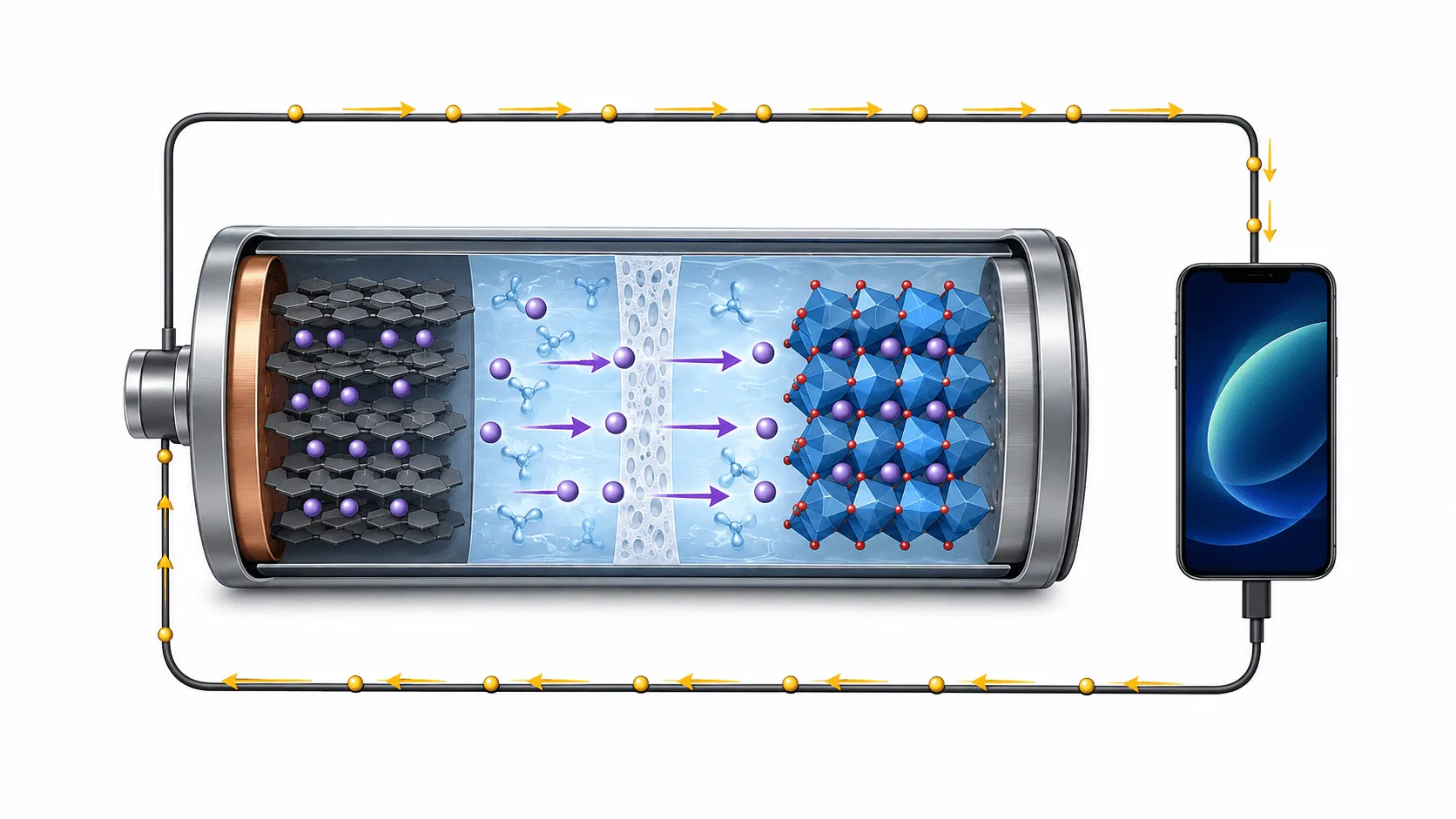
A lithium-ion battery cell contains a positive electrode, a negative electrode, an electrolyte filling the space between them, and a separator preventing the two electrodes from touching. During discharge, lithium ions move from the negative to the positive electrode through the electrolyte. Electrons, however, cannot pass through the separator, so they travel from the negative side to the positive side through the external circuit—connected to a smartphone or similar device. This flow of electrons is the usable current. During charging, external power is applied to reverse the direction of both ions and electrons.
Imagine the cell as a facility divided into two by a partition wall with fine holes. Lithium ions can pass through the holes in the wall, but electrons must travel around an outer perimeter road to reach the other side. Placing a smartphone on that outer road lets it draw work from the electrons as they pass through. A state in which the separator tears and the two electrodes touch is similar to a large hole opening in the partition wall, letting a shortcut form on the inside instead of going around the outer road.
This analogy has limits. In actual charging and discharging, ions do change location as if cargo were moving between two warehouses, but at the same time, the positive and negative electrode materials themselves undergo chemical state changes. Repeated charge-discharge cycles leave portions of these reactions incompletely reversed, and degradation accumulates in the materials and interfaces. The drop in capacity and rise in internal resistance—and resulting heat generation—seen in aged cells are chemical changes that cannot be explained by simple pathway congestion.
The electrolyte and separator bear the contradictory roles of moving ions while preventing electrons from taking shortcuts. The separator needs fine pores for ion passage, but as the membrane becomes thinner, it becomes easier to pack more material into the same volume—while also becoming more susceptible to contamination and deformation. In product safety, membrane uniformity, treatment of electrode edges, and alignment during assembly must be managed just as carefully as capacity and thinness. The reason foreign-object contamination and misaligned electrode winding were cited in this review of technical standards is that this interface boundary is responsible for insulation inside the cell.
Failures the protection circuit can stop, and those it cannot
When the voltage flowing in from the terminal is too high, the control/protection circuit can cut off the charging path. Excessive output current, over-deep discharge, and temperature rises detected by sensors are handled the same way. The circuit measures voltage, current, and temperature, and stops the flow of electricity when a set safe range is exceeded.
However, internal short circuits—where the positive and negative sides connect at a narrow point inside the cell—are a different matter. Metal contaminants entering during manufacturing, misalignment of electrodes or the separator, or deformation of the cell from dropping or crushing can all damage the separator. Because short-circuit current flows only within the cell, disconnecting the external terminals may not stop localized heating that has already begun.
Fast charging, too, should not be treated simplistically as a cause of fire, or the actual entry points of failure get overlooked. Compatible devices negotiate the voltage and current the charging circuit can accept and adjust the charge amount according to the cell's condition. Even under normal design and heat-dissipation conditions, greater power tends to increase heat generation in both the circuit and the cell. When other conditions overlap—a hot car interior, a bedding surface, a damaged cell—the margin for temperature drops, so the rated charging speed and the actual usage environment need to be considered separately.
METI's own failure analyses likewise show different entry points—contamination, misaligned electrode winding, external force, overcharging, protection-circuit malfunction—all leading to internal short circuits and fire inside the cell. In other words, the protection circuit is part of the safety design, but it does not substitute for the quality of cell manufacturing. Correctly measuring voltage from outside a finished product and confirming there are no contaminants inside that could later damage the separator are two separate things that must be verified independently.
The chain from internal short circuit to flame
Not every cell ignites when an internal short circuit occurs. Depending on the size of the shorted area and the state of charge, as well as the materials, case structure, and conditions for dissipating heat to the surroundings, the result can range from a mere voltage drop to a progression into thermal runaway. NASA's safety guidelines likewise distinguish that not all internal short circuits lead to thermal runaway.
When thermal runaway does occur, the following causal chain accumulates:
- Localized heating: A large current concentrates at the damaged point, generating heat through electrical resistance.
- Expansion of the short circuit: As temperature rises, the resin separator shrinks and melts, widening the area where the positive and negative sides touch.
- Exothermic reaction: The heated electrode materials and electrolyte react, releasing further chemical energy as heat.
- Gas and pressure rise: The electrolyte and electrode materials decompose, generating gas containing flammable components and raising pressure inside the cell.
- Venting and ignition: Hot gas and contents are expelled through the case's safety valve or a damaged section, and if surrounding air and an ignition source align, flames result.
The defining feature of this chain is that rising temperature accelerates the reaction, and the reaction's heat further raises temperature—this is thermal runaway. Even if the protection circuit stops current flowing to the outside, the chemical energy remaining inside the cell continues converting to heat in a short time, making it difficult to bring the situation under control simply by stopping normal charging once smoke has begun.
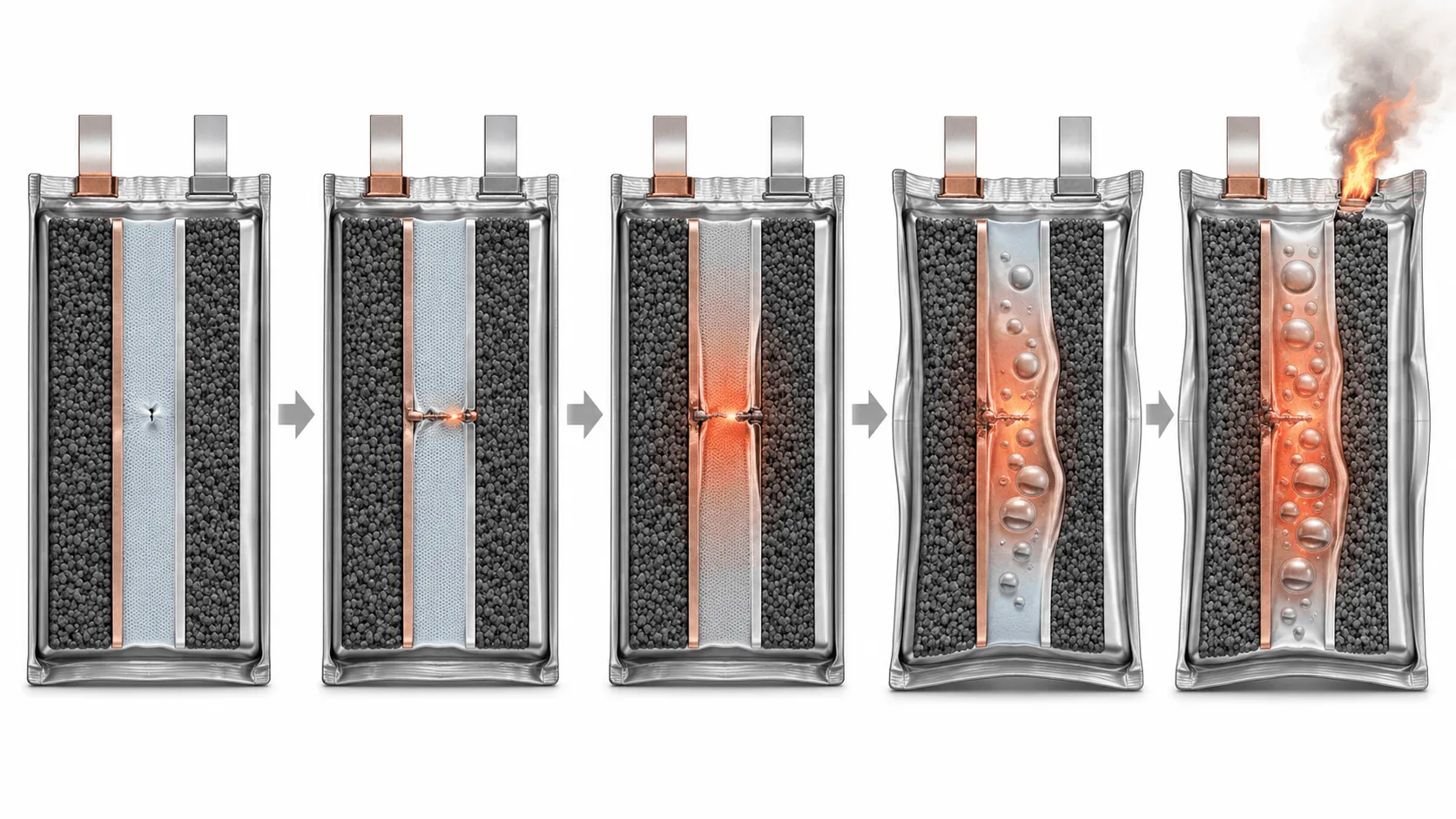
Swelling can appear even before this chain begins. When gas generated by degradation or an abnormal reaction accumulates inside the cell, pressure rises, and in pouch-type cells with a flexible outer casing, the surface bulges outward. Pushing the swollen casing back does not reverse the reaction that produced the gas or the internal damage—applying pressure may instead further deform the electrodes and separator. Swelling should not be treated merely as a sign of increased charge or a cosmetic casing issue; it is evidence that internal conditions have changed and use should be discontinued.
The explanation that "it burns because it contains lithium metal" is also not accurate. Ordinary lithium-ion batteries do not move lumps of metallic lithium in and out during normal use. The main danger lies in storing high energy in a small cell, using a flammable organic electrolyte, and the possibility that an internal short circuit can trigger a self-accelerating exothermic reaction between the electrodes and electrolyte.
Accidents third-party inspection can reduce, and risks that remain in users' hands
According to Nikkei, incidents such as power bank fires reported to NITE numbered 192 in 2025, roughly four times the number in 2021. On August 31, 2026, METI presented a proposal to designate power banks as "Specified Electrical Appliances and Materials," which require inspection by a third-party organization. The ministry plans to revise the relevant cabinet and ministerial orders under the Electrical Appliance and Material Safety Act within fiscal year 2026, with enforcement expected as early as March 2027.
Currently, manufacturers can inspect their own products for compliance with technical standards and display the PSE mark. Under the revised system, inspection by a government-registered third-party organization would be added. The technical standards would also be revised to require quality-control measures preventing foreign-object contamination and misaligned electrode winding. The aim is to have third parties also verify whether products meet the standards, and to require, through the technical standards, procedures that reduce latent defects during manufacturing.
Defects inside a cell are hard to detect through inspections that simply charge a finished product once and check its operation. This is because a tiny contaminant may not cause an immediate short circuit but may reach the separator only after repeated expansion and contraction from charging and discharging cycles. Preventing contaminants from entering during manufacturing, ensuring electrodes and the separator are wound in the correct position, and inspecting finished products for compliance with safety standards are each separate stages of responsibility. The proposal to add third-party organizations pushes toward strengthening pre-shipment compliance verification and manufacturing-stage quality control, rather than relying on post-accident recalls.
Even so, the PSE mark is not a guarantee that a product "will not catch fire." Even a cell with no problems at the time of shipment can be damaged after purchase by being dropped onto a hard floor, crushed under luggage or a seat, left in a hot car, or exposed to water. Third-party inspection mainly reduces oversights at the manufacturing and design stage; heat and physical force applied during use must be avoided separately by the user.
Japan's Consumer Affairs Agency advises that if a power bank shows signs such as abnormal heat, swelling, deformation, a burnt smell, smoke, or unusual noise, use should be stopped immediately and the manufacturer or retailer contacted. At purchase, check for the PSE mark, the seller's identity, and recall information; during use, watch the condition and temperature of the case. Even after the system is strengthened, this two-stage check—at purchase and during use—reduces the entry points leading to internal short circuits.