

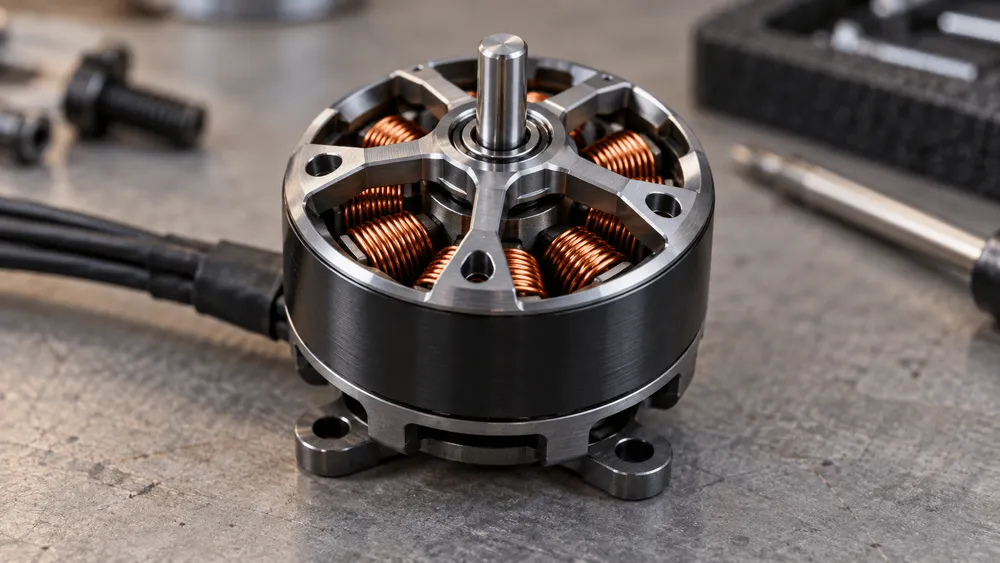
Modal Motors, a U.S. startup, wants to cut electric motors off from China's rare-earth magnet supply chain. In a TechCrunch interview on September 23, founder Michael Van Steenburg argued that even motors manufactured in the U.S. remain exposed to supply risk as long as their magnets depend on China. The company has already started taking orders for drone motors.
But it is important to separate several things: a design that uses no rare earths versus one that uses U.S.-sourced rare earths, and starting to take orders versus achieving mass production.
The distinction matters for evaluating the technology. Modal Motors' product page shows two magnet configurations, but the commercial-scale plant of the company named as a materials supplier is scheduled to begin operating in 2027. As for the company's claims of superior performance, the public materials do not include figures that can be compared under identical conditions. Going through the process step by step, from parts sourcing to performance verification, shows which parts of "decoupling from China" have already been achieved and which still need to be confirmed.
Orders are open for a small drone motor
What Modal Motors announced on June 3 was the opening of orders for the OR3627-900kV, a motor for drones. First deliveries are planned for the fourth quarter of 2026, and the start of volume supply for the first quarter of 2027.
These are the company's plans. They do not show that deliveries had actually begun as of September, nor do they indicate a confirmed number of orders. For land, marine, and industrial applications beyond drones, the company accepts inquiries for custom configurations tailored to each use.
The published specifications are a mass of 130 g, a diameter under 42 mm, peak output of up to 360 W, and a speed of 9,000 rpm. It is a brushless DC motor designed for Group 2 unmanned aircraft. These are figures published by the developer, and the company notes that specifications may change without notice.
It also cannot be assumed that "up to 360 W" and "9,000 rpm" can be achieved simultaneously under the same load conditions. These numbers alone are not enough to judge flight time or performance differences relative to competing motors.
The product page also lists another product, the Hybrid Enigma Drive. The concept combines input from an internal combustion engine or other source with electric drive through a magnetic gear, and it is presented as a design that fits easily into spaces with limited height.
However, this product has not been given the same ordering and delivery schedule as the OR3627-900kV. In describing the company's current stage, the two cannot be lumped together as products that are "already shipping."
A rare-earth-free version and a version using U.S.-sourced rare earths
Modal Motors' product page shows two versions: BLUELINE, which uses no rare earths, and REDLINE, which uses rare earths sourced in the U.S. The former uses iron nitride (FeN) magnets from Niron Magnetics, while the latter uses samarium iron nitrogen (SmFeN)-based materials procured from partners in the U.S. and allied countries.
That means not every Modal Motors product is "rare-earth-free." In addition to a configuration that uses no rare earths at all, the company offers one that still uses rare earths but shifts sourcing away from China.
The motor architecture the company highlights is a patent-pending transverse flux motor. The structure routes magnetic flux transversely to the direction of rotation, and the company envisions uses where weight reduction matters, such as drones, pumps, fans, and blowers.
But a design that can accommodate different magnet materials is not the same as one that delivers the same weight, efficiency, and price in every configuration. Comparing BLUELINE and REDLINE in real applications would require checking the specifications and test conditions for each.
The search for alternative magnet materials is not unique to Modal Motors. In July, Niron announced a supply agreement with ASPINA, a company based in Nagano Prefecture, saying it would advance development of brushless motors and other products using iron nitride magnets.
This is one example of growing demand for rare-earth-free motors, but it is not evidence of supply volumes for Modal Motors or of the performance of its products.
Where in the supply chain is dependence on China concentrated?
According to an analysis by the International Energy Agency (IEA), China accounted for 60% of magnet rare-earth mining, 91% of refining, and 94% of sintered permanent magnet production in 2024. Concentration in China rises further as ore is processed into magnets.
However, these figures each use a different market as the denominator, and they do not represent China's share of electric motors as a whole.
The IEA also reports that after China introduced export controls in April 2025 covering seven heavy rare-earth elements and other items, exports of the covered goods fell sharply in April and May, disrupting procurement by automakers. Export volumes subsequently recovered.
The concentration of the supply chain in one country did become a real production risk, but it would not be accurate to say exports are still fully halted.
If BLUELINE can be mass-produced as intended, it could reduce reliance on the stages of rare-earth mining, refining, and magnet manufacturing, where concentration in China is highest. REDLINE, by contrast, keeps using rare earths but aims to move their sourcing to the U.S. and allied countries.
Modal Motors says it sources motor components in the U.S. and performs automated assembly domestically, but the public materials do not include part-by-part certificates of origin or third-party tracing of the supply chain. It is not possible to conclude that dependence on China has been eliminated entirely, once electronic components and manufacturing equipment are considered alongside magnets.
Motor delivery plans and magnet mass production are out of step
What stands out when considering materials supply is the difference between the timelines Modal Motors and Niron have given.
Modal Motors plans first deliveries of the OR3627-900kV in the fourth quarter of 2026 and volume supply in the first quarter of 2027. Niron, in an announcement in August, said it plans to start operating its first commercial-scale iron nitride magnet plant in 2027. The plant is planned to have annual production capacity of up to 1,500 tons.
This timing difference alone does not show that Modal Motors' first deliveries are impossible. It may be able to supply magnets for initial lots using existing facilities or small-scale production lines.
However, the public materials reviewed do not specify the quantity of iron nitride magnets to be supplied to Modal Motors, when supply will begin, or where the magnets for the first lot will come from.
The U.S. government support of up to $150 million for Niron is also a conditional commitment and does not show that commercial-scale production has already started.
For customers deciding whether to adopt the motors for drone applications, it will be necessary to check not just that they are "available to order," but also lead times for each configuration, quantities that can be supplied continuously, and magnet traceability.
BLUELINE and REDLINE in particular use different materials. Once deliveries actually begin, an important point to check will be how many units of each configuration were supplied.
Performance figures worth checking
On its product page, Modal Motors claims its motors outperform Chinese rare-earth motors in torque density, efficiency, and mass. Its June announcement likewise says the motors outperform competing products.
The company touts third-party performance verification, but the published product page and announcement do not name the products used for comparison, the test conditions, or link to a test report.
Because voltage, speed, load, and the conditions for continuous versus peak output are unknown, these two documents alone do not allow the company's claims to be recalculated under the same conditions, or allow anyone to verify in which applications and by how much the motors are superior. This does not mean the tests were not conducted.
For drone use, it would be useful to see not only the 130 g mass of the motor itself but also thrust, power consumption, temperature during continuous operation, and flight time when using the same propeller and power source.
Fans and pumps require evaluating different load conditions, and the Hybrid Enigma Drive, which uses a magnetic gear, needs a separate efficiency assessment. The peak performance figures published so far are not enough to conclude that the motors are superior in every application.
Modal Motors' effort aims to rethink both magnet materials and motor architecture in response to a rare-earth magnet supply chain that is heavily dependent on China.
The key things to watch are not only whether first deliveries happen on schedule. It will also matter whether the parts sourcing history for each configuration is made clear for units actually delivered, and whether test results comparing the motors with competing products under the same conditions are published.
Once that information is available, it will be possible to judge more concretely how far the goal of a "motor that doesn't rely on China" has been achieved in both sourcing and performance.