

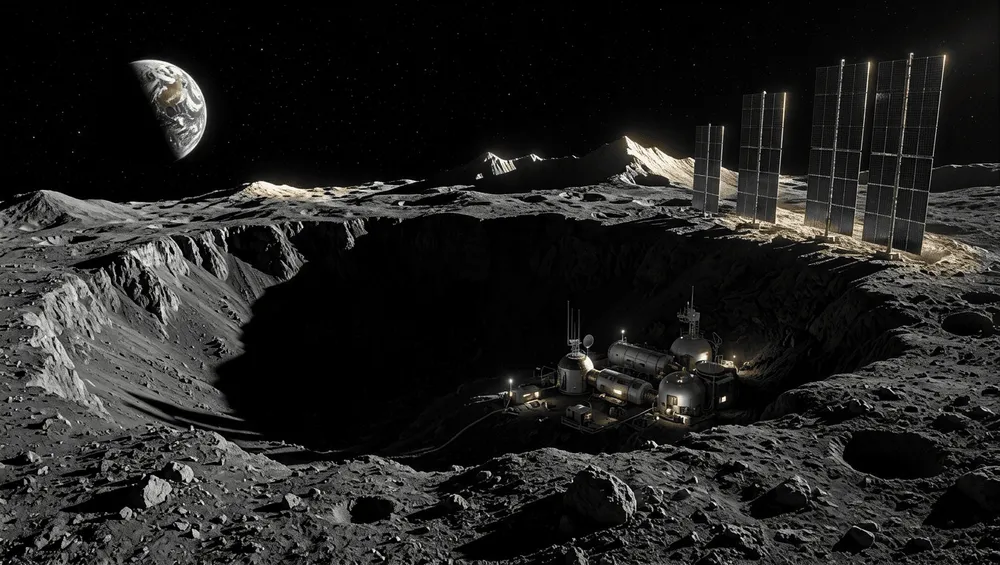
Science fiction often imagines humanity's expansion into space beginning with the construction of lunar cities. During the Apollo era, the Moon was thought to be a completely dry, barren world. But following experiments like NASA's 2009 LCROSS impact mission, it became clear that water ice exists in permanently shadowed craters at the Moon's poles. The Moon has often been called "the eighth continent," and governments and private companies alike have begun talking about building lunar bases that could eventually grow into cities of a million people, complete with heavy industry.
But how long could such a city actually survive? If water can be sourced locally, the enormous cost of hauling heavy liquid from Earth disappears. Still, a fundamental question remains: is there really enough water to sustain human life and industry on the Moon?
In September 2023, Martin Elvis and colleagues at the Smithsonian Astrophysical Observatory in the United States offered an answer. Even under the most optimistic conditions imaginable, the Moon cannot sustain a city of 1 million people. Their findings were published in the journal Frontiers in Space Technologies.
The Billion Tons of Water Locked in Lunar Cold Traps
The Moon has no atmosphere, so there's no erosion from wind or rain. Because its axial tilt is only about 1.5 degrees—compared to Earth's roughly 23.4 degrees—the floors of certain polar craters have gone untouched by sunlight for roughly 4 billion years. In these cold traps, where temperatures drop below 110 K, water delivered by comet impacts and asteroids has been preserved as ice. Even in the vacuum of the lunar surface, this ice sublimates at a rate of just 1 millimeter per billion years—an extraordinarily stable reservoir.
For their calculations, Elvis and his team adopted an extremely optimistic estimate: 1 billion tons of water on the Moon. That's equivalent to 400,000 Olympic-sized swimming pools, or roughly seven minutes' worth of water flowing over Niagara Falls. NASA's Artemis program and China's Chang'e missions have both selected landing sites specifically to target this polar ice. China's Chang'e 7 mission, planned for 2026 or later, will carry a small flying probe designed to descend into a crater and directly detect water ice. As exploration efforts from multiple countries progress, the actual distribution of these resources—long inferred only through radar observations—is finally coming into focus.
For any settlement to sustain itself without constant resupply from Earth, locally sourced water becomes the foundation for everything. Beyond drinking water and sanitation, humans need water to generate breathable oxygen and to grow food through agriculture. According to the calculations, each person consumes about 125 tons of water annually for drinking and hygiene (roughly 340 liters per day), plus 2 tons per year for oxygen production. Agricultural water demands are even steeper, consuming about 500 tons per person annually for plant growth and soil maintenance.
The burden grows heavier still if a lunar base serves as a waypoint for missions to Mars or beyond, since producing rocket propellant by electrolyzing water dramatically increases consumption. SpaceX's Starship, for example, requires 1,200 tons of propellant for a single launch. Producing propellant on the Moon makes economic sense, since it avoids the enormous cost of launching everything out of Earth's deep gravity well. But water burned as fuel is lost to space—unlike household water, it can't be recovered and recycled within a habitat. In-situ propellant production is the single fastest way to deplete the Moon's limited water reserves.
Even at 98% Recycling Efficiency, Water Runs Out in a Century
In a closed environment like space, how efficiently water is recovered and reused becomes a matter of survival. The research team built their model around the latest water recycling technology demonstrated aboard the International Space Station (ISS) in 2023. After years of refinements to its urine processing and water recovery systems, the ISS now recovers used water and atmospheric moisture at 98% efficiency.
That 98% figure isn't achieved through simple filtration. Moisture from astronauts' sweat and breath is captured by dehumidifiers, while urine is vacuum-distilled to extract pure water. A dedicated assembly was even added to wring additional moisture out of the remaining brine—only then was this efficiency level reached. It's a hard-won achievement, forged through struggles with the unpredictable behavior of liquids in microgravity, calcium buildup clogging pipes from urine, and the gradual degradation of specialized filters needed to maintain water quality. The research team applied this high recycling rate to a hypothetical lunar city of 1 million people to calculate how quickly the water supply would decline.
The results were sobering. Even 1 billion tons of water would be completely exhausted in just over 100 years.
データを表で見る
| Time to depletion (years) | |
|---|---|
| 94% recycling (1B tons water) | 40 |
| 98% recycling (1B tons water) | 100 |
| 98% recycling (34M tons water) | 4 |
As the chart shows, if the recycling rate dropped to the ISS's earlier benchmark of 94%, the water supply would run out in just 40 years. Unlike the ISS's compact modules, a lunar settlement would face far more pathways for water loss—moisture absorbed into vast agricultural soil beds, condensation on the walls of enormous habitat structures, and more. Simply maintaining the ISS's 98% recycling rate across a city-scale environment is already an extraordinarily difficult precondition to meet.
What tightens the constraint even further is the 1-billion-ton assumption itself. More recent and detailed orbital observation data suggest the Moon's actual water reserves may amount to only 34 million tons—roughly one-thirtieth of the earlier estimate. Applying this more realistic figure, the water supply for a million-person city would run dry in just a few years. Far from sustaining a city, the resource would be exhausted during the earliest stages of construction.
Power Is Abundant, But Water Is the Real Constraint
When considering habitation in space, energy supply is often discussed alongside water. Supporting a major city on Earth requires enormous amounts of electricity, and proposals for small nuclear reactors on the Moon have been debated. However, Elvis and his team's calculations show that power is not the limiting factor on the lunar surface.
As mentioned earlier, the Moon's axial tilt is a mere 1.5 degrees. This means that at elevated locations along the rims of polar craters, the Sun skims along the horizon almost continuously, creating regions known as "Peaks of Eternal Light" that receive near-constant sunlight. With gravity just one-sixth of Earth's and no destructive winds to worry about, building massive solar power towers over a kilometer tall is entirely feasible. According to the research team's estimates, such towers could reliably supply about 3 gigawatts (GW) of electricity.
Three gigawatts is comparable to the output of several nuclear power plants on Earth—more than enough to power a settlement of 1 million people along with energy-intensive data centers and industrial facilities, with power left to spare. Silicon, the raw material for solar cells, is abundant in the regolith covering the Moon's surface. Aluminum and iron, used for electrodes, can also be extracted locally, opening the possibility of self-replicating solar panel production on-site rather than shipping heavy panels from Earth.
Electricity can be generated in abundance. Water cannot. While it's physically possible to combine hydrogen and oxygen to make water, this simply raises the question of where the hydrogen would come from. Within the framework of In-Situ Resource Utilization (ISRU) on the Moon, there exists an unbridgeable asymmetry between electricity and water.
From a City of a Million to a Village of a Thousand
What the Elvis team's calculations reveal is a hard truth: given the limits on water, any plan to build a massive city all at once is doomed to fail. Entrepreneurs pushing for lunar development often speak of relocating heavy industry off-world or building self-replicating cities, but the resource budget underlying such visions simply doesn't add up.
Even so, scaling back initial ambitions makes settlement possible. A village of 1,000 or a town of 10,000 could remain sustainable for centuries under current water estimates. Achieving lasting settlement, however, will require a fundamental rethinking of traditional, water-intensive agriculture.
One promising technological approach under active research is food production that uses minimal or nearly closed-loop water systems. Rather than hydroponics, which floods a growing medium with water, researchers are developing vertical farming systems based on aeroponics, where plant roots are exposed to air and misted with just the minimal nutrients needed. If cultivation facilities based on artificial photosynthesis—using microorganisms to synthesize protein directly from carbon dioxide—can be introduced as well, agricultural water consumption could be reduced by a factor of several dozen.
With these technological breakthroughs, if the overall water recycling rate for a habitat can be pushed above 99.5%, the lifespan of a lunar settlement would extend considerably further. Without such advances, humanity would need to rely on another technically challenging solution: capturing ice-bearing asteroids into lunar orbit and importing resources from beyond the Moon itself.
The next crucial piece of the puzzle is pinpointing the exact distribution and total reserves of lunar water. Is the ice buried deep and thick within the regolith, or scattered thinly near the surface like frost? Once direct sampling by spacecraft and confirmation of total reserves are complete, we'll finally be able to draw a clear line indicating how many people the Moon can support—and for how long.