


NAED Energy Holding announced on November 12, 2026 that its PV-1 tandem solar cell manufacturing line has reached a rated throughput of 16,000 wafers per hour per line, equivalent to roughly 4.6 GW of annual output across six lines. The rating applies to G12 half-cut wafers, and the line is designed to advance 400 wafers to the next process step every 90 seconds. On November 16, the company released results from a short operating test and presented a new estimate putting annual capacity at about 4.7 GW.
However, the 4.6 GW and 4.7 GW figures are not the generating capacity of solar cells actually produced. They are annual production capacities calculated under assumed conditions. Wafer throughput matters, but so do cell conversion efficiency, equipment utilization, and yield. The November 12 and November 16 announcements used different calculation conditions for annual capacity, so the two need to be evaluated separately.
400 wafers every 90 seconds, with the PVD step setting the line's pace
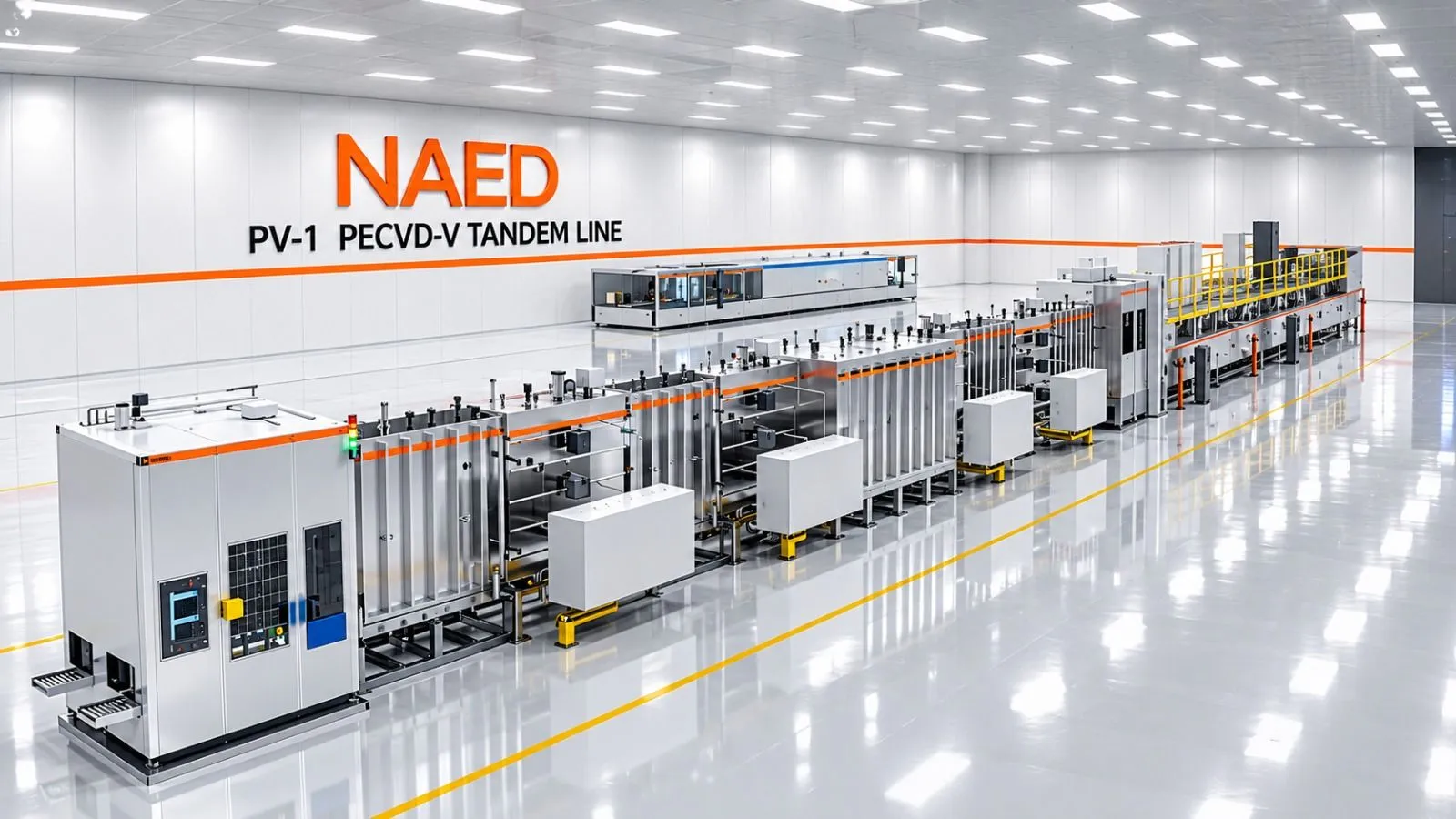
PV-1's rated throughput of 16,000 wafers per hour is derived from a design that sends out 400 wafers every 90 seconds. The formula is 400 wafers × 3,600 seconds ÷ 90 seconds = 16,000 wafers. The 90-second transfer cycle is set by the in-line physical vapor deposition (PVD) tool, "ITO-1." PVD forms thin films on a substrate surface by physically vaporizing and scattering material.
By contrast, the four plasma-enhanced chemical vapor deposition (PECVD) modules, which use plasma to promote chemical reactions and form thin films, are designed for a 76-second cycle. Processing 400 wafers every 76 seconds would give a calculated capacity of about 18,950 wafers per hour. But because the downstream PVD step takes 90 seconds, the throughput of the whole line is limited by PVD. The November 12 announcement also states explicitly that the PVD step determines the line's processing speed.
Another feature of PV-1 is its transport method, which holds wafers vertically and moves them through each process in batches of 400. The fixture that holds and carries the wafers together is called a "carrier." In PV-1, the entire carrier is rotated 180 degrees in vacuum so that the opposite side of the wafers can be processed. In its November 11 announcement, NAED explained that, compared with flipping wafers one at a time, this approach allows the holder to be shared across steps and reduces the chances of directly touching the wafers between processes.
The process flow disclosed on November 16 begins with cleaning and loading, followed by double-sided PECVD in vacuum, PVD, rear-side printing, and curing. According to the company's acceptance test report, the carrier rotation was completed in 41 seconds, within the design time window of 57 seconds. The actual transfer cycle was reported as 86.5 seconds against the 90-second design value. The design completes carrier rotation within the transfer cycle, enabling continuous processing in 400-wafer units.
Tandem structure combining perovskite and silicon, with a 30% target efficiency
What NAED envisions for "T2X" is a two-terminal perovskite/silicon heterojunction tandem solar cell. The upper perovskite cell absorbs high-energy light and transmits red and infrared light to the lower silicon heterojunction (HJT) cell, so that different wavelength ranges are put to use. The November 16 announcement gives the bandgaps, which govern the energy of the light absorbed, as about 1.7 eV for the upper cell and about 1.1 eV for the lower cell.
Because the two subcells are connected in series, their voltages add. The current, however, is shared, so the two cells' currents must be properly balanced. Both the optical design that uses different wavelengths efficiently and the electrical current matching determine a tandem cell's conversion efficiency.
The 34.4% conversion efficiency NAED published is a model-based figure, whereas the 30% used in the annual capacity estimate is a target efficiency. The 34.4% model assumes a cell area of 217.2 cm², and the per-cell output is listed as 7.47 W in the November 12 announcement and 7.48 W in the November 16 announcement. The annual capacity calculation, on the other hand, assumes an area of 220.5 cm², 30% efficiency, and irradiance of 1,000 W/m², giving about 6.61 W per cell. The two differ not only in efficiency but also in the cell area used.
The outputs shown are direct current (DC) rated power for a single cell under standard test conditions. Once assembled into modules, output changes because of wiring, optical losses, and other factors. The line's throughput determines the number of cells produced and cell efficiency determines the output of each, so calculating annual capacity in gigawatts also requires accounting for equipment utilization and yield.
From 4.6 GW to 4.7 GW: a difference in calculation conditions
The roughly 4.6 GW annual output NAED presented on November 12 and the roughly 4.7 GW presented on November 16 treat equipment utilization and yield differently. It would not be appropriate to interpret the difference as the result of improved line throughput.
In its November 16 follow-up announcement, NAED reported three 24-hour continuous runs under fully automated load conditions, conducted November 10–12. The good wafers processed across the three tests totaled 1,152,500, with an average throughput of 16,007 wafers per hour. The company said this was +0.04% from the design value, with test-to-test variation of 0.18%. Under its TDS-001 standard, the pass conditions include staying within ±3% of the design throughput of 16,000 wafers per hour and having no major stoppages, and the company says all three runs met the standard.
At the same time, NAED published a new estimate putting the annual capacity of the six lines at 4,728.5 MW DC (about 4.7 GW). The main reason the figure rose from about 4.6 GW on November 12 is that the definition of the 85% factor used for annualization changed.
The table below compares the November 12 announcement with the November 16 follow-up.
| Item | Nov. 12 announcement | Nov. 16 announcement |
|---|---|---|
| Rated throughput | 16,000 wafers/hour per line; 96,000/hour for six lines | Same rated throughput used |
| Operating test | Rated value presented | Three 24-hour runs, average 16,007 wafers/hour reported |
| Annual hours | 8,760 hours | 8,760 hours |
| Utilization and yield | 85% availability × 97.5% yield | 85% overall equipment effectiveness (OEE), including yield |
| Cell conditions for annual conversion | 30% target efficiency, 220.5 cm² area | 30% efficiency, 220.5 cm² area |
| Annual good cells, six lines | About 697 million | About 714.8 million |
| Annual output in DC, six lines | About 4.6 GW | 4,728.5 MW |
| Role of 34.4% efficiency | Model value for 217.2 cm² area | Model value for 217.2 cm² area |
Note: The annual production count published on November 16 is based on the rated throughput of 16,000 wafers per hour, which differs by about 0.04% from the 16,007 average in the short operating test. Output figures include rounding.
The November 12 calculation treats 85% of the 8,760 hours in a year as available time and assumes 97.5% of the wafers processed in that time are good. The annual number of good cells from six lines is as follows.
[ 16{,}000 \times 8{,}760 \times 0.85 \times 0.975 \times 6 = 696{,}945{,}600 ]
The November 16 calculation, by contrast, sets overall equipment effectiveness (OEE), which already includes yield, at 85%, so it does not separately multiply by 97.5%. Using the same rated throughput and annual operating hours, the annual number of good cells is as follows.
[ 16{,}000 \times 8{,}760 \times 0.85 \times 6 = 714{,}816{,}000 ]
With the cell area of 220.5 cm², 30% efficiency, and irradiance of 1,000 W/m² held the same, the factor applied to annual production changes from 0.82875 to 0.85. The difference between these factors works out to about 2.56%, as shown below.
[ \left(\frac{0.85}{0.82875}-1\right)\times100 \approx 2.56% ]
By our calculation, annual capacity rises from about 4.6103 GW to about 4.7285 GW. This differs from the increase one would get by simply comparing the rounded published figures of 4.6 GW and 4.7 GW. The change in annual capacity can therefore be explained mainly by a change in the assumptions behind the annualization, not by a major improvement in line throughput.
The 72-hour operating test shows the short-term throughput NAED reported. The 4.7 GW annual output, meanwhile, is an estimate that assumes the same throughput can be maintained while operating at 85% OEE throughout the year.
Short-term operating test and reliability evaluation: conditions for judging mass-production capability
The November 16 announcement includes accelerated reliability tests on mini-modules in addition to the line's operating test. According to NAED, a 1,000-hour damp-heat test at 85°C and 85% relative humidity showed output retention of 96.4%, and 97.0% after 200 thermal cycles. The company cites the IEC 61215-2, IEC TS 62804, and ISOS test procedures and reports passing 12 test sequences.
However, connecting these results to the performance of commercial modules also requires considering sample area, quantity, and outdoor durability. A U.S. Department of Energy summary of responses to its request for information (RFI) on perovskite PV research, development, and demonstration, updated May 9, 2022, gives examples of revised targets such as modules with an area of at least 500 cm² containing four or more cells, and outdoor testing using 20 or more modules. This is a summary of proposals on development evaluation gathered from 11 organizations at the time, and it reflects an approach that emphasizes product area and durability as well as conversion efficiency.
For PV-1, it is also necessary to confirm how the equipment used in the operating test relates to the completion status of the actual production line. In its November 11 announcement, NAED said that six of 13 tools were complete and the remaining seven were under manufacture. The 72-hour operating test disclosed on November 16, meanwhile, was reportedly conducted earlier, on November 10–12. The published materials alone do not make clear how the tools described as under manufacture relate to the equipment used in the test.
The published text also does not confirm who certified the tests, whether third-party certificates exist, what the raw measurement data show, or the number, area, and selection method of the samples used in the reliability tests. No independent measured results have been presented for the conversion efficiency of finished cells, and yield and OEE in long-term commercial operation have not been evaluated.
To evaluate PV-1's annual production capacity as real supply capability, it would be necessary to confirm that throughput and yield can be maintained under the same manufacturing conditions, and that finished cells and modules achieve the specified output and durability. Beyond the short-term operating test results reported here, the operating status of the whole production line and a track record of good cells from long-term operation will be the basis for judgment.