


NEC halted development of physical quantum computers at the end of March 2026. This was reported by Nikkei and Diamond Online in quick succession in September 2026 — it was not an announcement made by NEC itself. The company holds a unique place in this field: in 1999, Yasunobu Nakamura and colleagues at NEC's Fundamental Research Laboratories reported in Nature the first operational demonstration of a superconducting qubit in a solid-state device, laying the groundwork for what is now the dominant approach worldwide. The two news outlets attribute the decision, 27 years later, to the difficulty of recovering investment and to researchers leaving the company. But NEC itself, in a document submitted to a Cabinet Office meeting in December 2022, laid out in concrete numbers just how far it intended to go. Laid alongside what it actually achieved, the outline of this withdrawal becomes sharper than the summary in the news reports suggests.
The end-of-March halt revealed by reporting, and the only explanation NEC has offered
On September 5, 2026, Nikkei reported that NEC had halted development of physical quantum computers, and that the decision appeared to reflect a judgment that commercialization would take too long and that returns commensurate with the investment would be hard to achieve. This rationale is Nikkei's own inference, not something NEC stated itself. The day before, on September 4, Diamond Online reported — as an exclusive — both the end-of-March withdrawal and the fact that researchers who had worked on the development had moved to Fujitsu.
When Diamond's editorial team asked NEC's public relations department to comment, the company declined to address the withdrawal directly — "we will refrain from commenting" — but added: "Regarding the use of quantum computers, we are advancing technical assessment toward practical application as well as efforts toward industrialization. We are participating in a consortium with a variety of user companies to create use cases and conduct proof-of-concept work, and are assessing areas for future business development." Neither the word "withdrawal" nor "discontinuation of development" appears in this response. As of now, this statement is the only confirmed position NEC has offered.
In other words, what readers have in hand is a combination of news reports stating a date and a conclusion, and a corporate comment that neither confirms nor denies it. To gauge the substance of the withdrawal from outside the reporting, one has to go back to documents NEC itself made public in the past. Fortunately, one such document remains on the Cabinet Office's website.
Twenty-seven years after the 1999 world first: the gap between NEC's own roadmap and reality
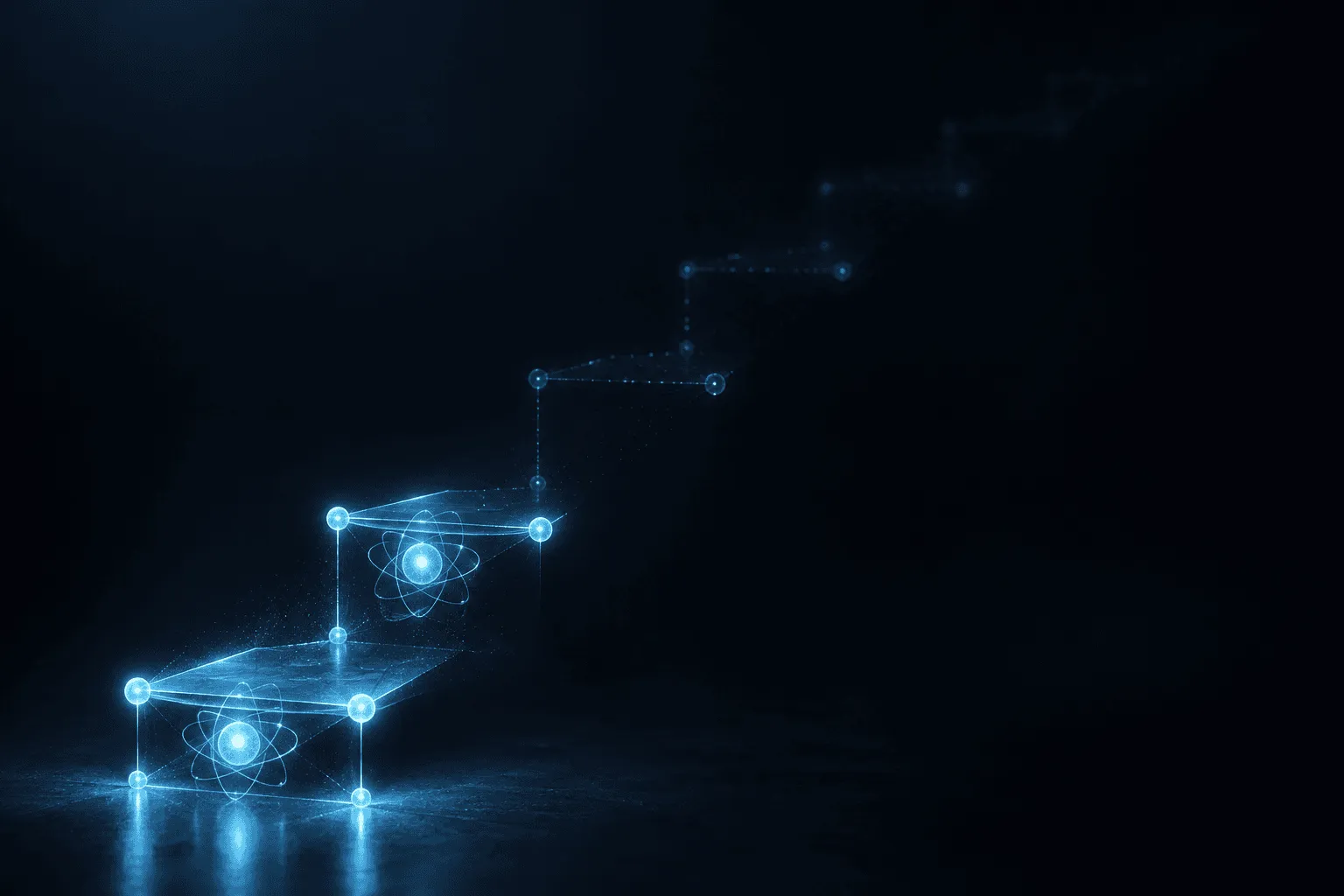
On December 6, 2022, NEC submitted a document to the third meeting of the Cabinet Office's "Working Group for Promoting the Practical Application of Quantum Technology," under the name of Motoo Nishihara, then Director, Executive Vice President and CTO. The document charts the progress of quantum processor development as a staircase: from a basic 4-qubit unit, to 100 qubits, and on to "over 1,000 qubits." In the same document, NEC stated it was aiming to deliver problem-solving models based on quantum annealing and gate-based approaches by 2030, with fault-tolerant approaches envisioned from 2040 onward. No year was attached to the "over 1,000 qubits" milestone itself.
The stance NEC presented at that meeting was the opposite of that of a company preparing to withdraw. It positioned annealing as "currently the approach closest to commercialization in the quantum field," stated explicitly that "NEC will continue development with quantum annealers, which also leverage quantum's core strengths, as a central pillar," and proposed continued government support for the investment needed to get through the development phase. A company that was, at the time, asking the government for support stopped developing physical hardware three years and three months later.
Lining up only the dated, verifiable milestones in NEC's quantum development gives the following:
| Timing | Event |
|---|---|
| April 1999 | Yasunobu Nakamura and colleagues report the first operational demonstration of a superconducting qubit in a solid-state device, in Nature (Nature 398, 786) |
| 2003 | Demonstration of a 2-qubit logic gate operation (Nature 425, 941) |
| 2014 | Realization of a parametron using a superconducting circuit (Nature Commun. 5, 4480) |
| November 2021 | Launch of the NEC Vector Annealing service |
| March 17, 2022 | Announcement of demonstrated annealing operation using a 4-qubit basic unit based on superconducting parametrons |
| December 6, 2022 | Explains, at a Cabinet Office working group, a roadmap progressing from 4 qubits to 100 qubits and on to over 1,000 qubits |
| June 28, 2023 | Announces the start of joint research with Tohoku University using an 8-qubit quantum annealing machine developed with AIST |
| September 9, 2025 | Publishes, jointly with AIST, RIKEN, and Fujitsu, a supply chain technology report |
| End of March 2026 | Halts development of physical quantum computers (reported by Nikkei and Diamond Online) |
The 4-qubit basic unit that marked the starting point of the roadmap reached the demonstration stage in March 2022. Beyond that, no announcement of a physical machine corresponding to the 100-qubit milestone can be confirmed. The last publicly announced physical machine was the 8-qubit system from June 2023, meaning the reach achieved after the roadmap's announcement went only from 4 qubits to 8 qubits. The gap between that and the halt of development was two years and nine months. The 100-qubit milestone was supposed to be only an intermediate goal, yet no record exists of ever reaching it.
That 8-qubit machine was, in its own right, progress for NEC at the time. Developed jointly with AIST and made available for joint research with Tohoku University, it was described as the first domestically built quantum annealing machine usable remotely over the internet by outside researchers. That is, NEC had advanced far enough to turn a laboratory experimental device into a computing resource accessible to outside researchers. Yet the machine that opened this door for external use turned out to be the last physical machine NEC ever announced.
Conditions that read as a failure to see a return on investment
The explanation about a failure to recover investment is hard to understand in isolation from the stagnation in qubit count. The quantum annealing approach that NEC judged in 2022 to be "closest to commercialization" is a specialized method for solving combinatorial optimization problems; it cannot perform general-purpose computation. Being a special-purpose machine, its revenue potential is tightly bound to the scale of problems it can solve. The optimization problems solvable on an 8-qubit machine remain within a scale that existing computers can already handle adequately. Value that customers would actually pay for only emerges once the scale exceeds what existing methods can solve in a realistic amount of time.
What matters here is the alternative path NEC already had in parallel. The company had launched the NEC Vector Annealing service, running pseudo-quantum-annealing on its own vector processors, in November 2021, and had also begun offering D-Wave's Leap Quantum Cloud Service that same year. Looking purely at the business of solving optimization problems for revenue, two viable paths already existed without any proprietary superconducting hardware at all. Developing a physical machine was, in effect, an internal investment competing against those two other paths.
The upkeep cost of a physical superconducting machine is also not trivial. Superconducting qubits only operate inside dilution refrigerators cooled close to absolute zero, and the control wiring and readout circuitry scale up with the number of qubits. Multiplying the qubit count by 100 is not simply a matter of fabricating 100 times more devices — it requires redesigning, simultaneously, the volume of wiring and heat load inside the refrigerator and the scale of the control electronics.
The supply chain technology report that AIST, RIKEN, and NEC compiled jointly with Fujitsu in September 2025 addressed exactly this domain — the outlook for components and materials. Read the other way, this also means the elements needed for scaling up were, as of that point, still being sorted out domestically.
In the same 2022 document, NEC also wrote that annealing processor development was maturing, and that practical application and productization were already underway. As technical milestones, it listed: long-duration retention of quantum superposition states on an annealing machine by 2023; delivery of problem-solving models combining quantum annealing and gate-based approaches by 2030; and realization of a fault-tolerant approach from 2040 onward. These are milestones for the technical track, not a direct indication of when the investment would turn profitable.
If that is the case, what the halt at the end of March 2026 signals is a reversal: a technology NEC itself had positioned in 2022 as "nearly ready for practical use" became, three years and three months later, a candidate for discontinued development. Even if technical maturity had risen, the judgment could still change once the premise of continuing to pour funds into refrigerator and control-system upgrades collapsed. The proposal urging the government to keep providing support was itself an admission that a single company could not shoulder this investment alone.
The judgment Nikkei reported — that "commercialization would take too long" — can be read as the gap between that and the near-term commercialization outlook NEC itself had painted in 2022. To repeat, though, this is not an explanation NEC gave itself. What the company actually said concerned technical assessment and efforts toward industrialization; which specific figures were judged unprofitable internally, and when, has not been disclosed.
Eight qubits versus 256: the gap that opened between domestic superconducting efforts
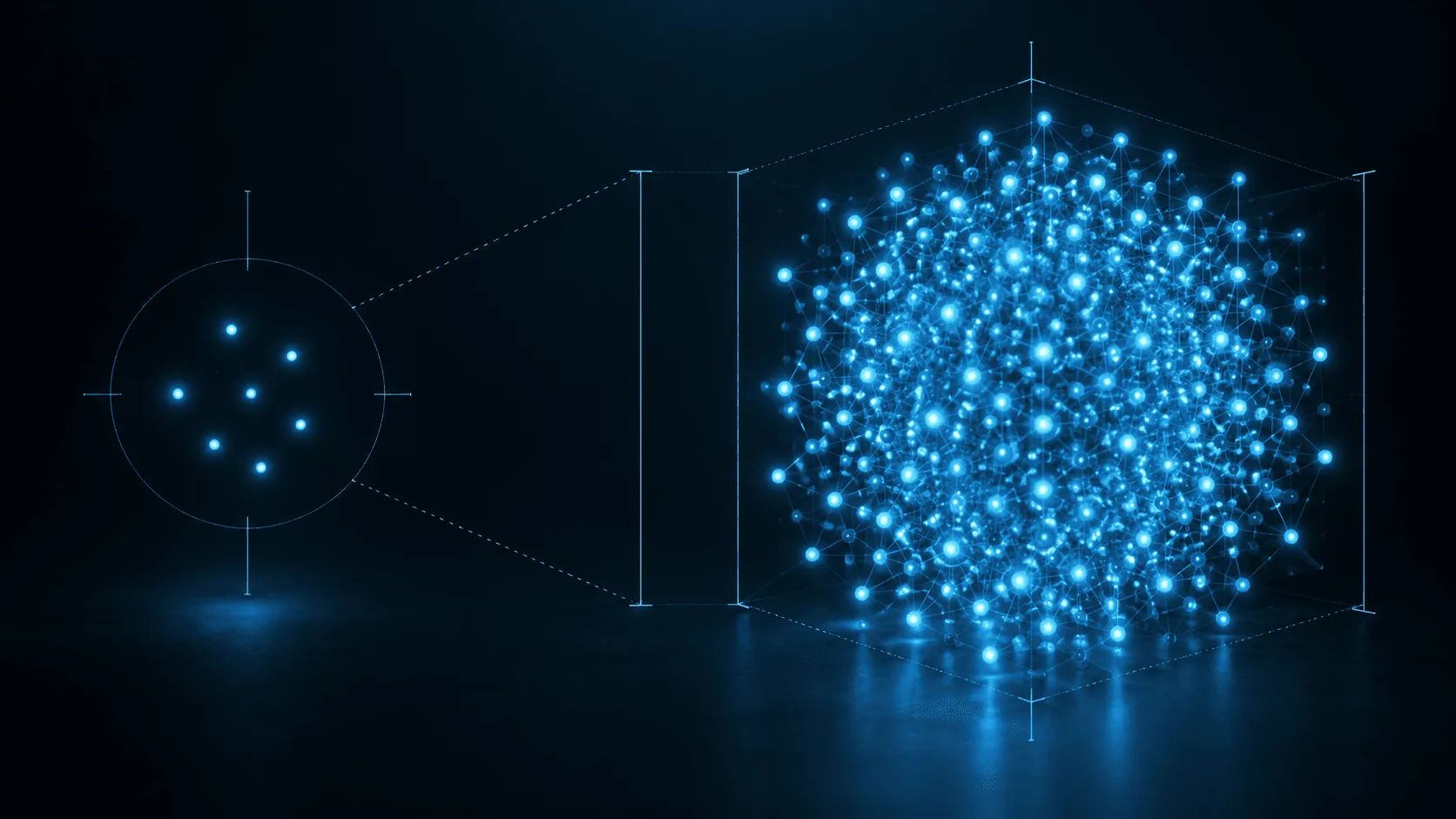
As of the end of March 2026, when NEC halted development of physical hardware, comparing the largest domestically developed superconducting quantum machines that had been publicly announced and made available for outside use reveals a 32-fold gap.
データを表で見る
| Announced physical qubit count (Physical qubits) | |
|---|---|
| NEC and AIST (quantum annealing, announced June 2023) | 8 |
| Fujitsu and RIKEN (quantum gate model, announced April 2025) | 256 |
256 divided by 8 equals 32, but reading this number as a difference in capability would be a mistake. NEC's 8-qubit machine uses quantum annealing, solving a specific class of problem — combinatorial optimization. Fujitsu and RIKEN's 256-qubit machine uses the gate-model approach, which in principle can run general-purpose quantum algorithms. Lining up qubit counts across machines that solve different kinds of problems does not settle which is superior.
Still, the comparison is meaningful because both projects were pursuing scale in the same country, in the same superconducting materials system, over the same period. Superconducting qubits share the same wiring and cooling constraints regardless of the approach used, so qubit count serves as a rough proxy — regardless of which method is chosen — for how far a given organization has pushed the engineering of scaling up. NEC's chosen combination of superconducting parametron devices and the ParityQC architecture was designed to be noise-resistant and to sustain quantum states for longer periods — something qubit count alone cannot fully capture. But absent any announcement of progress beyond the 8-qubit machine of June 2023, there is likewise no evidence that the scaling process was ever carried through.
On the Fujitsu-RIKEN side, scale progressed to 64 qubits in October 2023 and 256 qubits in April 2025, with plans to install and publicly unveil a 1,000-qubit machine at Fujitsu's quantum building (in Kawasaki, Kanagawa Prefecture) during fiscal 2026. Fujitsu also announced, on August 1, 2025, the start of research and development on a superconducting quantum computer exceeding 10,000 qubits, targeting completion in fiscal 2030 with 250 logical qubits. At the same time NEC was sketching "over 1,000 qubits" as a concept diagram, another organization nearby had already put the same number into a concrete schedule.
Where the people went, and what remains of NEC's quantum work
Diamond Online reported that researchers who had worked on the development moved to Fujitsu. The number is not stated in the article, and no official confirmation has come from either NEC or Fujitsu. Still, the fact that the destination was Fujitsu changes the meaning of the withdrawal. The knowledge needed to scale up superconducting qubits lives more in hardware and procedures than in papers. When people move, that knowledge moves with them — so the portable portion of NEC's 27 years of accumulated expertise may not have been lost from Japan so much as concentrated on the Fujitsu-RIKEN side.
What remains on NEC's side cannot be pinned down from public information. Its public relations office says it continues efforts toward industrialization, but no report clarifies whether that scope includes quantum annealing hardware, or whether it is limited to the pseudo-quantum-annealing service and cloud access mediated through D-Wave. Because the only physical machine NEC ever publicly announced was a quantum annealing machine, "halting development of physical hardware" and "continuing the annealing business" cannot be confirmed as overlapping, at least not as things stand.
A business model in which a company does not own physical hardware but continues an optimization business is already not unusual in the quantum industry — using another company's quantum machine via the cloud while the company itself focuses on formulating problems and applying them to business operations. The two parallel paths NEC had already set up since 2021 — the Vector Annealing service and cloud access via D-Wave — fit exactly this shape. Given NEC's public relations statement that it "continues efforts toward industrialization," it can be read that what was withdrawn was the physical hardware, not the work of using quantum technology itself. Still, how much hardware that ongoing work actually includes remains something public information cannot pin down.
A name that remained at the edge of national policy, and the next date to watch

About six and a half months before halting development of physical hardware, on September 9, 2025, NEC — together with AIST and RIKEN, jointly with Fujitsu — published a supply chain technology report for large-scale superconducting quantum computer systems. This was part of the third phase of the Cabinet Office's Strategic Innovation Promotion Program (SIP), a document meant to organize who would support the broader base of Japan's superconducting quantum development. A company about to stop developing its own physical hardware had, until half a year earlier, still had its name listed within this national framework. This sequence suggests that NEC's withdrawal was not a departure from quantum technology itself, but a relinquishing of the role of building the hardware in-house.
One participant has dropped out of domestic superconducting hardware development, but that does not mean domestic development has narrowed to a single Fujitsu-RIKEN track. RIKEN, together with Osaka University, announced on March 26, 2026 the start of operations of a new 144-qubit machine called "Rei-II," separate from the Fujitsu-RIKEN line, showing that a RIKEN-Osaka University line of development also continues. Fujitsu, one of the remaining players, is also extending its collaborations abroad. On August 4, 2026, Fujitsu announced a partnership with Monash University and Australia's CSIRO for quantum research, education, and practical applications.
The next verifiable date falls within fiscal 2026, when whether Fujitsu's 1,000-qubit machine is installed and unveiled at its quantum building as planned will provide the first piece of evidence. It will confirm whether a different organization can operate, as an actual machine, the same scale that NEC once sketched on a diagram but never reached. Beyond that lies Fujitsu's 2030 target of over 10,000 qubits and 250 logical qubits — a process that includes error correction, meaning achievement or failure will only be determined over a much longer stretch of time.
What to watch on NEC's side comes down to whether new announcements about quantum annealing appear going forward. If announcements involving physical hardware dry up, leaving only pseudo-quantum-annealing and brokering access to other companies' machines, then the substance of the "efforts toward industrialization" its public relations office described would turn out to lie on the software and business-application side. Conversely, if there is a follow-up on joint development with AIST or an announcement of a new annealing machine, it would suggest the scope of the halt covered a different, possibly narrower, range that excluded some aspects related to the gate-model approach. Which of these turns out to be true will become clear from whatever NEC announces next.