

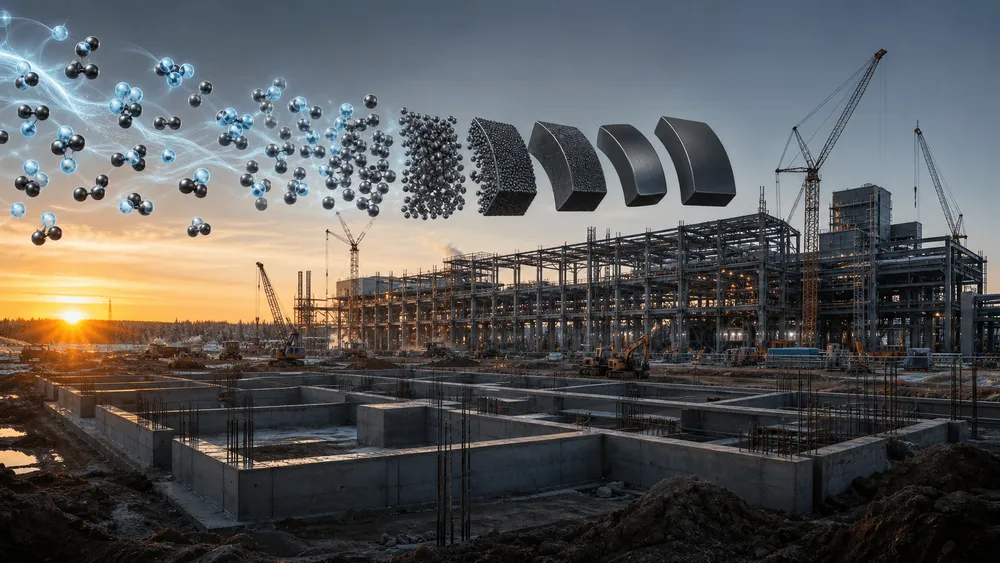
Niron Magnetics has poured the first concrete at its rare-earth-free permanent magnet plant under construction in Sartell, Minnesota. The plant is scheduled to begin operations in 2027, with plans to produce up to 1,500 tons of iron nitride magnets annually. Following the groundbreaking in September 2025, construction has now progressed to the structural phase. The project has entered the stage where it will be tested whether this new material, made from iron and nitrogen, can move beyond the lab and pilot plant into full-scale mass production.
First Concrete Poured at 287,000-Square-Foot Plant
The plant floor area Niron announced in summer 2026 is 287,000 square feet. The facility will house everything from raw material processing to finished magnets under one roof, with operations starting in 2027 and annual production capacity reaching up to 1,500 tons. The word "up to" used by the company refers to a production capacity target. It is not a commitment that shipment volumes or equipment utilization rates will reach 1,500 tons in 2027.
Plans for the plant had already been in motion. Niron broke ground in September 2025, and in its announcement that November, the Phase 1 facility was described as 190,000 square feet. The company has not publicly explained the relationship between that figure and the current 287,000 square feet. It cannot be confirmed whether the construction scope expanded or whether the counting method changed to include ancillary areas. Therefore, the increase in floor area should not be directly interpreted as an increase in production capacity.
Still, pouring concrete differs in nature from securing land or raising funds—it demonstrates that construction work has extended to the structural phase. Niron currently manufactures magnets at its commercial pilot plant in Minneapolis, supplying samples to customers. The Sartell plant will be the first full-scale site to test whether this process can be repeated at a scale of 1,500 tons annually.
Supply Chain Concentration: From 58% in Mining to 92% in Manufacturing
According to a U.S. Department of Energy (DOE) supply chain assessment, China accounted for 58% of rare earth mining and 92% of magnet manufacturing in 2020. The U.S. share of magnet manufacturing was less than 1%. Supply risk is not limited to where mines are located—concentration intensifies further downstream, through separation, refining, and alloy and magnet production.
Niron aims to shorten this downstream process by replacing rare earths with iron and nitrogen. According to the company's congressional testimony, its vision is to produce permanent magnets—from iron ore and atmospheric nitrogen all the way to the finished product—within a single integrated plant. Compared to approaches that mine neodymium and dysprosium domestically to recreate the same supply chain, this method bypasses rare earth separation and metal refining. The significance of the Sartell plant lies not simply in locating a magnet plant within the United States, but in shortening the pathway from raw materials to finished products.
However, abundant raw materials do not automatically make mass production easy. The transition to 1,500 tons of annual production requires reproducing the manufacturing conditions established at the pilot plant at a significantly higher throughput. Alongside production volume, yield, lot-to-lot performance variation, and processing costs will become factors in customer decisions.
1,500 Tons Now, 10,000 Tons Next
In its 2025 congressional testimony, Niron stated that U.S. industry consumes approximately 50,000 tons of rare earth permanent magnets annually. Using this company-provided figure as the denominator, Sartell's annual capacity of 1,500 tons represents 3%. Moreover, it has not been confirmed that iron nitride can replace existing magnets in all applications. The 3% figure represents a scale comparison between plant capacity and demand—it is not an achievable market share.
Public support has also backed the transition to mass production. ARPA-E, under the DOE, allocated $19,999,372 for pilot production aimed at commercial samples. The Sartell plant has been approved for a federal advanced energy project tax credit of $52.2 million, with the state of Minnesota also providing a $10 million grant. Tax credits and grants differ in nature, but both share the characteristic that public funding has supported part of the mass-production risk, from R&D through plant construction.
Separately, the DOE selected $2,699,810 in funding for the design, prototyping, and testing of variable flux motors using iron nitride. Niron, partnering with the Illinois Institute of Technology and Oak Ridge National Laboratory, has set a goal of improving overall drive-cycle efficiency by 2%. However, even the DOE describes this outcome as a target contingent on "success." Even if magnets can be mass-produced, the process of proving benefits at the system level—including motor design and control—remains ahead.
Furthermore, Niron is searching for a site within the United States for a second plant with capacity of up to 10,000 tons annually. The concept presented in March 2026 calls for a 1.6 million-square-foot facility, with capital investment of up to $1.8 billion and employment exceeding 700 people. Construction is projected to begin in early 2028, but the project is currently at the site-selection stage and does not represent confirmed production capacity. Whether Niron can demonstrate quality and profitability at Sartell first will serve as the bridge to this second plant.
After Speaker Adoption, What Performance Remains to Be Verified?
Iron nitride magnets have already begun appearing in products. In June 2026, YG Acoustics unveiled the "Carmel 3" speaker using Niron-made magnets at a Vienna audio exhibition. An adoption case where even the product name is disclosed represents evidence one step beyond sample evaluation. On the other hand, adoption in speakers does not mean the same performance has been certified for drive motors or defense equipment exposed to high temperatures.
A permanent magnet is not complete simply by having high magnetic flux density. It must satisfy application-specific requirements for coercivity—the ability to retain magnetism against external fields and heat—usable magnetic energy, and demagnetization characteristics at various temperatures. The DOE explains that while speakers do not operate at high temperatures, vehicle drive motors require high-coercivity grades that resist losing magnetism even at elevated temperatures. Even with the same material, passing criteria differ by product.
An independent study published in 2024 reported that iron nitride magnets consolidated using a method different from Niron's achieved a saturation magnetization of 1.07 tesla and coercivity of 0.20 megaampere per meter. However, the study concluded that the magnetic properties of the samples fell short of neodymium magnets. This result cannot be directly applied to Niron's proprietary product. Still, it illustrates the difficulty of maintaining material properties achieved in powder form within a shaped, mass-produced magnet.
In its congressional testimony, Niron claims that third-party and customer testing has confirmed thermal stability and magnetic flux density. However, publicly available materials do not disclose grade-specific demagnetization curves or mass-production yield data. Beyond completing the facility, it will be necessary to confirm actual 2027 production volumes, lot quality, and customer qualification accompanied by application-specific data. Once these are in place, Sartell will become the first full-scale site to elevate rare-earth-free permanent magnets to an industrial material produced at a scale of 1,500 tons annually.