

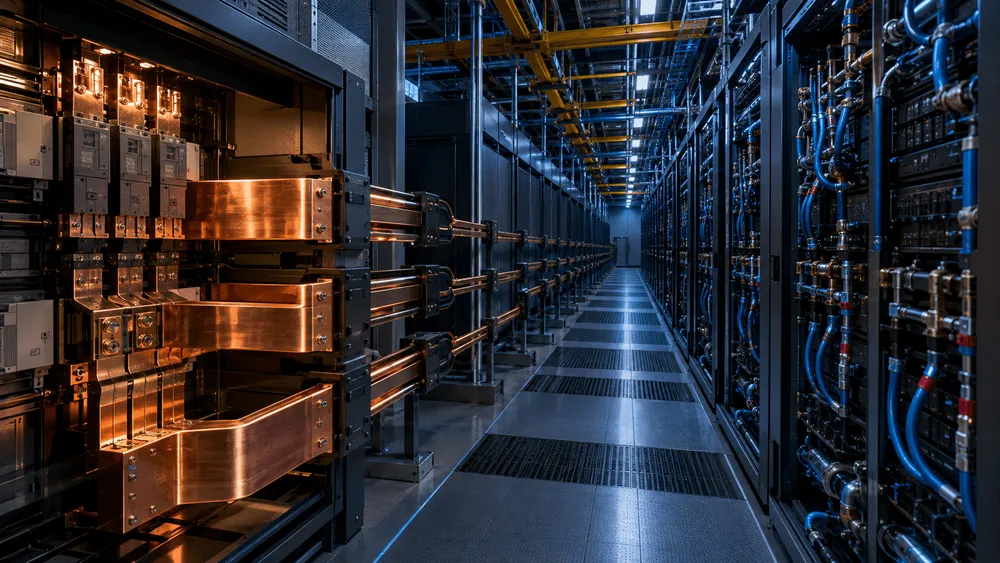
NVIDIA has outlined a path for converting AI data center power to 800V DC (800VDC), moving in stages from retrofitting existing facilities to full facility-wide DC conversion. The first step is a dedicated power rack that takes the current AC distribution and converts it to 800VDC. This allows facilities to adopt the new approach without a full overhaul of building electrical systems, while also freeing compute racks from having to house power converters. Even if operators procure GPUs, those GPUs cannot run unless enough power can be delivered to feed a 1MW-class rack. Power infrastructure has become the determining factor for compute capacity.
The Cost of Delivering 1MW at 54V
Delivering 1MW at 54V requires, by simple calculation, roughly 18,500A of current. At 800V, that drops to about 1,250A. Real-world systems must account for redundancy and conversion losses, but the underlying relationship holds: raising voltage dramatically reduces the current needed to carry the same power. Since heat generation in cables and copper busbars scales with the square of current, a design that keeps voltage at 54V while scaling up rack power quickly becomes heavier and bulkier.
NVIDIA's white paper estimates that, comparing conductors of the same cross-sectional area carrying 48A, 415V AC can deliver 0.6kW per square millimeter, while 800VDC can deliver 1.7kW—a 157% increase. In a separate design estimate NVIDIA published in 2025, 800VDC was said to improve end-to-end efficiency by up to 5% compared to conventional approaches, while cutting copper usage by 45%. Both figures are design estimates dependent on facility conditions, not measured values uniformly obtained across operating data centers.
The purpose of raising voltage extends beyond thinning cables—it also moves the AC-to-DC conversion step outside the compute rack. In current AI racks, 415V or 480V AC is converted to 54V DC at a power shelf, then stepped down further near the compute tray to 12V or the GPU's operating voltage. Each additional converter adds loss and potential failure points, while consuming rack space that could otherwise house GPUs.
If 800VDC can be delivered close to the compute node, the final step-down to 12V can happen directly. NVIDIA explains that a scheme using a 64-to-1 LLC converter with a matrix transformer improves efficiency by one point compared to a multi-stage approach that converts 400V to 50V and then to 12V, while reducing the implementation footprint near the GPU by 26%. The shift to 800V is thus both a facility-level power distribution change and a design change that returns rack-internal space to compute hardware.
A Phased Migration That Preserves Existing Infrastructure
NVIDIA's proposed migration path unfolds in three stages, each moving power conversion progressively further upstream.
| Stage | Power Flow | Advantages | Remaining Challenges |
|---|---|---|---|
| Power Rack | Converts 415/480V AC to 800VDC near the rack row | Uses existing AC distribution and building infrastructure | Conversion stage remains, and power racks consume floor space |
| Facility-Level Rectifier | Converts low-voltage AC to 800VDC in roughly 1.5MVA units | Powers multiple racks together, freeing up compute room space | Requires low-voltage transformers and DC protection equipment |
| Medium-Voltage Rectifier / SST | Converts 35kV-class AC directly to 800VDC | Eliminates the low-voltage AC layer, enabling full facility-wide DC conversion | Multi-MW-class reliability, thermal management, protection, and certification remain immature |
The initial power rack functions as a conversion adapter for existing data centers. NVIDIA itself acknowledges that, because an additional conversion stage remains, this is not the optimal solution at the facility level. Even so, the benefit of being able to deploy high-density compute racks while continuing to use already-built utility feeds and AC distribution is significant. For operators who have already secured land, buildings, and grid capacity, this avoids the need to rebuild the facility from scratch.
According to NVIDIA's plan as reported by the Economic Daily News on August 17, MGX-compatible 800VDC power racks will launch in the second half of 2026, paired with existing AC infrastructure. In 2027, the approach will advance to consolidating power at the rack-row level, supporting up to 2MW per row. For newly built facilities, the plan envisions going further with DC power blocks that convert medium-voltage AC directly to 800VDC in a single step.
The white paper assumes facility-level rectifiers receiving low-voltage AC at roughly 1.5MVA per unit with about 99% efficiency. Medium-voltage rectifiers and solid-state transformers (SSTs) are targeted at up to 7.5MVA per unit with efficiency above 98.5%. A conceptual design for a 17.5MW system receiving 35kV AC is also presented, powering four 1.1MW compute racks plus cooling equipment. However, this diagram is not a product specification—it is a design example NVIDIA is presenting to partners.
Why Energy Storage Must Change Too
In large-scale AI processing, many GPUs compute simultaneously and then enter communication-wait states simultaneously. According to NVIDIA's white paper, rack power consumption can swing from roughly 30% at idle to 100% within a very short time. While 800VDC makes it easier to carry large amounts of power, it does not eliminate this violent load fluctuation. Without countermeasures, everything from rack-level power equipment to facility-level utility infrastructure would need to be oversized to accommodate peak current.
NVIDIA differentiates energy storage approaches by the duration of the fluctuation. For sub-100-millisecond events, electrolytic capacitors are suitable; for the 100-millisecond-to-10-second range, a combination of methods including supercapacitors is used; and beyond 10 seconds, batteries offer better volumetric efficiency. The design places capacitors near the rack to absorb short-duration power fluctuations, while facility-level batteries smooth out the starting and stopping of entire jobs.
When storage alone cannot absorb the fluctuation, the GPU's own power-smoothing function either consumes power to fill in the troughs of load or throttles processing performance to reduce peaks. The former wastes energy; the latter slows computation. This means the economics of 800VDC are not determined by rectifier conversion efficiency alone. How storage capacity and control software are allocated—and whether GPUs can be kept at high utilization without oversizing utility infrastructure—determines the overall cost of the data center.
A shared DC bus makes it easier to connect batteries and capacitors with fewer conversion stages than an AC system would require. This is why NVIDIA bundles 800VDC and energy storage into a single concept. AI data centers have become synchronized, rapidly fluctuating electronic loads rather than steady bulk loads. If short-duration fluctuations cannot be suppressed within the facility, the burden on utility infrastructure increases, which in turn affects grid interconnection review.
How Far Have Delta Electronics and LITEON Progressed?
Taiwan's major power supply makers are moving beyond supplying individual power units to taking on businesses that bundle power and cooling for entire rack rows. Delta Electronics has already unveiled a 1.1MW row-based power system that converts 400–480V AC to 800VDC. In addition to a 90kW DC/DC power shelf that steps 800VDC down to 50V or 48V, the company has also developed distribution boards that convert to 50V or 12V on the chip side, with the latter's conversion efficiency reaching up to 98.5%.
According to the Economic Daily News, Delta Electronics plans to begin mass production of 800VDC and ±400VDC products in Q3 2026, with small-volume shipments starting in Q4. In 2026, ±400VDC is expected to lead, with 800VDC volumes increasing in 2027. Products compatible with NVIDIA's approach are beginning to emerge, but multiple DC schemes will coexist initially.
At its Q1 2026 earnings call, LITEON explained that its 50VDC power racks have entered mass production, while its 800VDC power racks will move into customer validation in the second half of the year. Its 110kW power shelf has begun shipping, and the company projects that AI-related products will account for roughly 30% of its 2026 revenue. At COMPUTEX 2026, LITEON showcased a working 800VDC liquid-cooled power rack that integrates power shelves and backup batteries, using cold plates to cool high-heat components.
On August 6, Wolfspeed and LITEON jointly announced that Wolfspeed's silicon carbide (SiC) MOSFETs had completed the certifications needed for adoption in LITEON's 800VDC sidecar and compute rack power units. SiC, which enables fast conversion of high voltages, is a leading material for reducing rectifier losses and component count. Wolfspeed also emphasized its supply capacity backed by 200mm SiC manufacturing infrastructure.
However, what the announcement confirms is only the completion of SiC technology certification. The names of hyperscaler customers, order values, and supply volumes have not been disclosed. It also remains unclear when customer certification for LITEON's power racks as a whole will be completed. Between component selection and the start of large-scale mass adoption in data centers lie system validation and safety certification.
Standards, Safety, and the Hurdle of Customer Certification
800VDC is not a closed, NVIDIA-only proprietary scheme. Google, Meta, and Microsoft jointly created the "Mt Diablo" power sidecar specification within the Open Compute Project (OCP), covering the transition from 48VDC to ±400VDC or 800VDC. NVIDIA has also contributed its MGX rack design to OCP. When multiple companies use the same voltage range and mechanical interfaces, data center operators gain the flexibility to source power equipment, compute racks, and cooling systems from separate vendors.
Meanwhile, a low-voltage DC white paper compiled by OCP in March 2026 laid out multiple candidate approaches side by side, including a 700V unipolar scheme and a 350/700V bipolar scheme. Grounding, neutral point, and circuit breaker configurations each carry their own trade-offs, and facility-level DC distribution has not yet converged on a single approach. 1500VDC remains a future candidate, but NVIDIA is proceeding with 800VDC as its near-term design.
Safety design, too, cannot simply be an extension of AC practices. NVIDIA uses touch-safe connectors in areas accessible to people and incorporates mechanical interlocks that prevent disconnection under load. Because DC current has no zero-crossing point, arcs are harder to interrupt. Protection devices and grounding schemes must be redesigned, and maintenance procedures and worker training must also be adapted to 800VDC. The facility designs shown in the white paper are not finalized specifications but design examples meant to be refined together with partners.
What matters in the customer validation LITEON plans for the second half of 2026 is not peak efficiency but effective efficiency under sudden load changes, fault-section isolation, and redundancy. As customer certification progresses and OCP finalizes protection and interconnection specifications, 800VDC will move from a power rack on the exhibition floor to a procurement standard for data centers. Whether a 1MW-class rack can actually be deployed will depend less on the GPU model number than on whether power and energy storage can be treated as a single, unified design.