

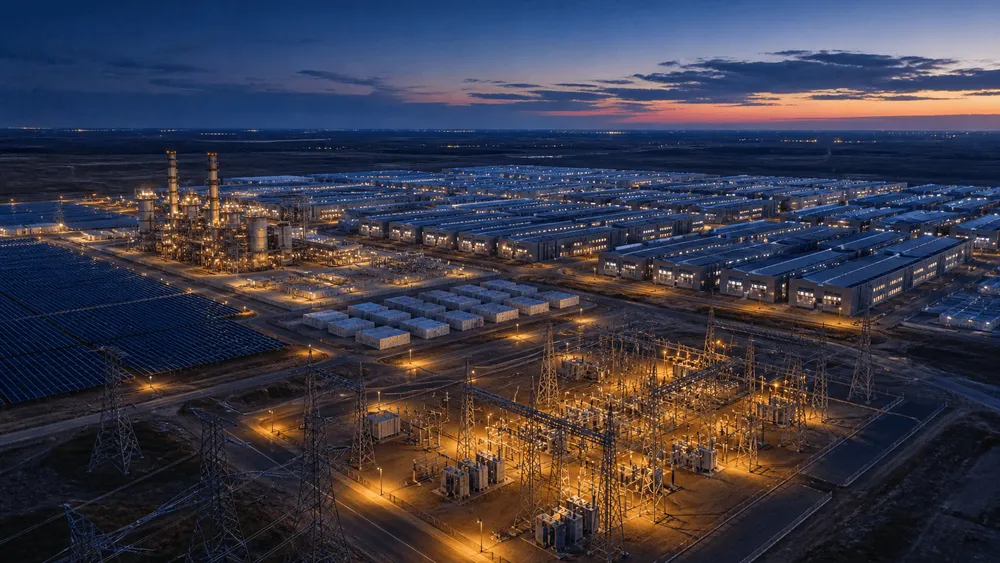
The race to expand AI infrastructure has moved beyond securing semiconductors to securing electricity itself. On August 7, 2026, The Information reported that NVIDIA would invest up to $3 billion in Lancium, a Texas-based power infrastructure development company. The following day, August 8, the New York Times reported that Amazon had acquired the GW Ranch site in Pecos County in the same state and would fund a gas-fired power plant to supply electricity to a data center. While these are separate deals, both reflect a reality in which lining up GPUs means nothing as computing capacity unless land, grid interconnection, and generation capacity are secured first.
Lancium's Grid Interconnection Decides the Additional $1 Billion
According to The Information, NVIDIA would first invest $2 billion to acquire roughly 20% of Lancium, which is backed by Blackstone. If certain conditions—including grid interconnection—are met, NVIDIA would add another $1 billion. The report put Lancium's enterprise value, including debt, at approximately $10 billion. NVIDIA and Lancium have not officially announced the deal, so at this stage it cannot be treated as a completed investment.
Even so, the fact that grid interconnection is a condition for the additional investment reveals the deal's underlying logic well. What Lancium provides is not data center buildings. The company acquires land, arranges substation equipment and interconnection rights to the grid, and controls on-site power sources and energy storage. Land that has been brought to a state where power can actually be used has become a scarce asset for AI companies.
Lancium already holds a 1.2GW grid interconnection approved by the Electric Reliability Council of Texas (ERCOT) at its Abilene campus, which serves as the site for OpenAI's first Stargate location. In October 2025, the company completed $600 million in debt financing anchored by that site. In July 2026, Lancium announced it would build another 1.0GW campus in Childress County together with Crusoe—a division of labor in which Lancium handles the 270 acres of land and power infrastructure while Crusoe builds and operates the data center.
Looking at this division of labor, it becomes clear that NVIDIA is not trying to buy an entire power company outright. What is reportedly being targeted is a minority stake in a developer that has gotten ahead of the multi-year grid review and land acquisition process. GPU makers, once on the side of waiting for customers' capital spending, are increasingly moving to the side of using their own capital to secure future sites for GPU deployment.
A 7.65GW Permit, but 5,000MW Nameplate Capacity
According to the New York Times, the numbers surrounding GW Ranch, which Amazon has acquired, need to be read with care to distinguish their meanings. In January 2026, developer Pacifico Energy announced it had obtained an air permit from the Texas Commission on Environmental Quality (TCEQ) for up to 7.65GW of gas-fired power generation. The plan also includes 1.8GW of battery storage and 750MWac of solar, to be developed in phases across a site of more than 8,000 acres. Pacifico stated at the time that the first power supply would begin in the first half of 2027.
Meanwhile, TCEQ's technical summary lists the plant's nameplate capacity as 5,000MW. The facility consists of 35 simple-cycle gas turbines and is designed to supply power to an on-site AI data center. It is also designed so that electricity cannot be bought or sold with the local distribution grid. In other words, the 7.65GW figure represents the total gas generation capacity covered by the permit—it does not represent the load that will continuously reach the data center or the initial operating capacity.
This private power network has a clear advantage: it partly bypasses the wait for public grid interconnection and limits the direct impact of a massive load on ERCOT's supply-demand balance. However, the constraints that determine construction speed do not disappear. The developer itself must take on procurement of gas turbines, fuel supply, permitting, and construction. Pacifico's stated total capacity for Phase 1 is 1GW—the plan is not for all 7.65GW to come online at once.
The Gap Between the Emissions Cap and the 2040 Target
The annual emissions cap approved by TCEQ reaches approximately 33.2 million short tons of CO2 equivalent. The breakdown includes approximately 33.16 million short tons of carbon dioxide, 2,830.17 short tons of nitrogen oxides, and 5,955.13 short tons of carbon monoxide, among others. TCEQ's calculation derives the maximum annual emissions rate using the condition that each turbine operates 8,760 hours per year.
The approximately 33.2 million short tons figure is not an amount that will necessarily be emitted every year once the facility is complete. The permitted cap and actual emissions can diverge depending on the number of turbines actually built, the capacity factor, and the use of solar and battery storage. The actual load demanded by the data center will also affect fuel consumption. Still, because Amazon has confirmed its involvement in the project to the New York Times, it is now possible to track the company's AI expansion and the emissions from gas-fired power generation as part of the same business decision.
Amazon maintains a goal of achieving net-zero carbon emissions across its business by 2040 and supports more than 700 carbon-free energy projects worldwide totaling over 40GW. But procuring renewable energy in a different region and the emissions actually released on-site by a power plant in Pecos County are not the same metric. Evaluating GW Ranch requires not simply treating the permitted cap as the actual output, but verifying the capacity actually built, the annual capacity factor, and the on-site power generation mix.
Before Semiconductors, Power Now Determines Construction Speed
According to the International Energy Agency (IEA), global data center electricity consumption grew 17% in 2025, with AI-related facilities growing even faster. Capital expenditure by the five major tech companies exceeded $400 billion that year and is projected to grow a further 75% in 2026. The IEA cited grid interconnection and permitting, in addition to the supply of gas turbines and transformers, as physical constraints hindering expansion.
In Texas, this pressure is already showing up in electricity demand. The U.S. Energy Information Administration (EIA) projects that annual electricity load within ERCOT's territory will grow by an average of 10% per year from 2025 to 2027, citing data centers as one of the primary drivers. The reported NVIDIA investment in Lancium and Amazon's GW Ranch plan represent moves to invest capital directly in power access in order to secure connected capacity and dedicated generation capability.
However, pouring in capital does not immediately create electricity. The additional $1 billion for Lancium is contingent on achievement conditions such as grid interconnection, and GW Ranch must still proceed with actual construction toward its goal of first power delivery in the first half of 2027. While both plans signal a significant shift, their success will be determined not by the announced gigawatt figures, but by the connected capacity, the turbines actually operating, and the measured emissions.