

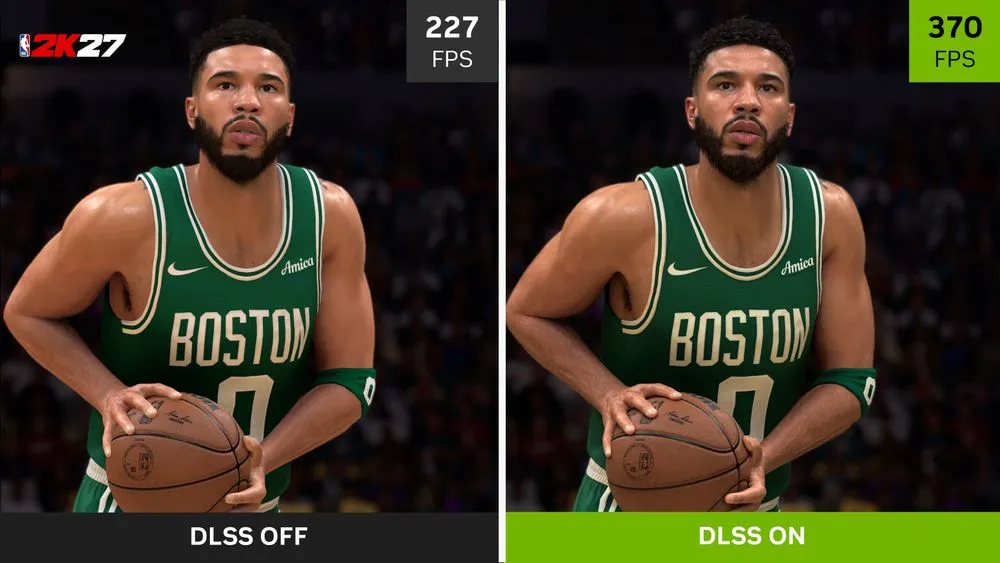
At 1pm Japan time on September 4, 2026, NVIDIA will roll out DLSS 5 with NBA 2K27. When it was first unveiled in March, the neural rendering technology required two GeForce RTX 5090 GPUs. Six months later, it has become a shipping feature that runs on every desktop and laptop GPU in the RTX 50 series. NVIDIA says it has made the model 5x faster at processing, and has published a measurement showing up to 797fps on the RTX 5090. However, these two numbers do not represent the same kind of performance gain.
The 5x figure refers to processing-speed improvement over the initial model, while 797fps is a displayed frame rate after stacking Super Resolution and 6x Multi Frame Generation on top. According to briefings given to press, DLSS 5's neural rendering alone can reduce frame rate by roughly 50–60%. To understand what it means for the feature to reach the full RTX 50 lineup, it's necessary to separate figures that include generated display frames from the actual frequency at which the game renders frames.
From a Two-GPU Setup in March to the Full RTX 50 Lineup
The Game Ready Driver that enables DLSS 5 is scheduled for release at 9pm Pacific time on September 3. Once released, players can turn on "DLSS Neural Rendering" from NBA 2K27's settings menu, and toggle it during gameplay or replays with the F9 key. The feature covers GeForce RTX 50 series desktops and laptops, as well as GeForce NOW Ultimate. On the cloud side, processing is handled by NVIDIA-operated environments equipped with RTX 5080 hardware.
At the time of the March announcement, NVIDIA showed a technology demo aiming for real-time operation at up to 4K, along with a promise to deliver the feature "this fall." Now, the company says it has cut the setup down from two RTX 5090s in the initial demo to a single GPU, while improving the model's processing performance by 5x over six months. This is the result of repeated pipeline optimization and neural model refinement—it does not mean that in-game frame rates are five times higher than they were in March.
At launch, NBA 2K27 is the only title with native support. NVIDIA says it will add support for more titles over the coming weeks and months, but has not disclosed specific release dates for any of them. The RTX 40 series and earlier generations are not officially supported. Unofficial experiments running leaked runtimes on older-generation GPUs or in other titles should be evaluated separately from the polished, developer-tuned shipping version.
Breaking Down the 797fps Figure: Dividing the Displayed Number by Six Reveals the Real Headroom
NVIDIA's own measurements run NBA 2K27 at Ultra settings with ray tracing enabled, combining DLSS 5 with 6X Multi Frame Generation. The test system uses a Ryzen 7 9800X3D CPU, 64GB of memory, and Windows 11 x64. At 1080p and 1440p, Super Resolution is set to Quality, while 4K uses Performance mode—meaning the image-quality settings are not consistent across resolutions.
| Resolution | GPU | NVIDIA's Displayed fps | Displayed fps ÷ 6 (estimate) |
|---|---|---|---|
| 1080p | RTX 5090 | 797 | ~133fps |
| 1080p | RTX 5080 | 602 | ~100fps |
| 1080p | RTX 5070 Ti | 530 | ~88fps |
| 1080p | RTX 5070 | 386 | ~64fps |
| 1080p | RTX 5060 Ti | 325 | ~54fps |
| 1080p | RTX 5060 | 258 | ~43fps |
| 1440p | RTX 5090 | 594 | ~99fps |
| 1440p | RTX 5080 | 413 | ~69fps |
| 1440p | RTX 5070 Ti | 353 | ~59fps |
| 1440p | RTX 5070 | 262 | ~44fps |
| 4K | RTX 5090 | 370 | ~62fps |
| 4K | RTX 5080 | 233 | ~39fps |
Dividing NVIDIA's displayed fps figures—which include output from 6x Multi Frame Generation—by six yields an estimate of the actual rendered frame frequency while MFG is active: roughly 43–133fps at 1080p, 44–99fps at 1440p, and 39–62fps at 4K. The headline figure of up to 797fps does not mean the game is rendering 797 frames per second.
This estimate is based on how 6X Multi Frame Generation works: for every one actually-rendered frame, it generates up to five additional frames, for a total of six displayed frames. For example, at 4K the RTX 5090's 370fps divided by six comes out to roughly 62fps, and the RTX 5080's 233fps divided by six comes to roughly 39fps. Because frame generation itself carries processing overhead, actual rendered fps with the feature disabled could turn out higher than this rough estimate. Still, the fact that the 4K table doesn't include the RTX 5070 Ti or lower-tier cards, and that the RTX 5080's estimate falls below 40fps, shows that full RTX 50 support does not automatically mean every resolution has comfortable rendering headroom.
Displayed fps also doesn't track directly with input responsiveness. Generated frames make motion look smoother, but they don't multiply by six the frequency at which the game actually renders new scenes in response to player input. NVIDIA's table is useful as an example of combined final output from DLSS 5, Super Resolution, and Multi Frame Generation together, but it can't be used to isolate the cost of neural rendering by itself.
Who Decides the Quality of the Generated Image?
What sets DLSS 5 apart from earlier versions of DLSS is that, beyond reconstructing low-resolution images and generating intermediate frames, it newly recreates how lighting and materials appear. 3D-Guided Neural Rendering treats the frame rendered by the game engine as a fixed reference point. It reads color, surface reflectance, lighting information, and normals to infer the relationships between characters, materials, and light sources. This is a fundamentally different starting point from video generation that creates entire scenes from text prompts.
For temporal consistency, the system uses motion vectors supplied by the game itself. According to NVIDIA, rather than generating multiple frames together in a batch, the system processes one frame in and one frame out, and is designed to return consistent output for the same input. This compensates for subsurface scattering on skin, light passing through hair, and shadows where objects meet. Whether flickering is avoided and character appearance remains stable during motion, however, is a claim that needs verification in the shipped product.
On the developer side, multiple models are available and can be selected on a per-scene basis. Structure Intensity adjusts reflections and fine shading, while Tone Intensity changes the response to broad lighting and color. Developers can also use semantic-classification-based masks to apply different effects to characters versus backgrounds, and engine-side masks to target specific objects such as glass, water droplets, or plants. Even though the basic control visible to players is just an on/off toggle, developers are the ones deciding where and how strongly the effect is applied behind the scenes.
In NBA 2K27, Visual Concepts aimed to preserve facial geometry captured from real players while refining how light falls on skin, hair, and uniforms. In a press demo, PCWorld noted that shadows falling on hands and contact points between skin and uniforms looked more natural, but that animation awkwardness became more noticeable once characters began moving. As photorealistic material rendering advances, it tends to expose weaknesses in other areas, such as skeletal animation and facial expression. Improved image quality does not automatically bring the rest of a game's realism up to the same level.
Can the 50–60% Overhead Be Measured Independently?
In a briefing attended by Wccftech and PCWorld, NVIDIA stated that DLSS 5 alone can reduce frame rate by roughly 50–60%, depending on the game, scene, and resolution. DLSS 5 can technically run independently of Super Resolution, Multi Frame Generation, and Ray Reconstruction, but in the actual product demos, the first two features were compensating for the reduced performance. Where traditional DLSS created an impression of "lightening the load and boosting fps," DLSS 5 is a feature that redirects GPU time toward generating image quality.
The nature of the added latency also needs to be considered separately. NVIDIA responded that because DLSS 5 doesn't wait for the next frame, it doesn't add the kind of systematic latency that something like Frame Generation does. That said, processing time for applying the neural model to the current frame still remains. The company says the core workload doesn't change based on the number of masks or which model is chosen, but the cost for the game to build the buffers used for masking can occur separately.
The performance tables published so far don't include values with Super Resolution and Multi Frame Generation turned off, isolating DLSS 5 on and off in the same scene. Verifying the claimed 50–60% figure will require measuring actual rendered fps, frame time, and system latency at the same resolution and same image quality settings, once the driver is released on September 4. Beyond static images, temporal stability also needs to be compared in scenes involving continuous camera movement and facial expression.
What's confirmed with this product launch is that DLSS 5 has moved from a research demo requiring two flagship GPUs to a feature that runs on a single card across the RTX 50 lineup. Whether the trade-off between image quality and performance overhead has been struck correctly is not something that can be settled by NVIDIA's own measurements alone. Only once identical on/off tests can be reproduced across multiple games and the full range of RTX 50 models will it be possible to judge how much of that 5x model improvement actually reaches players.