

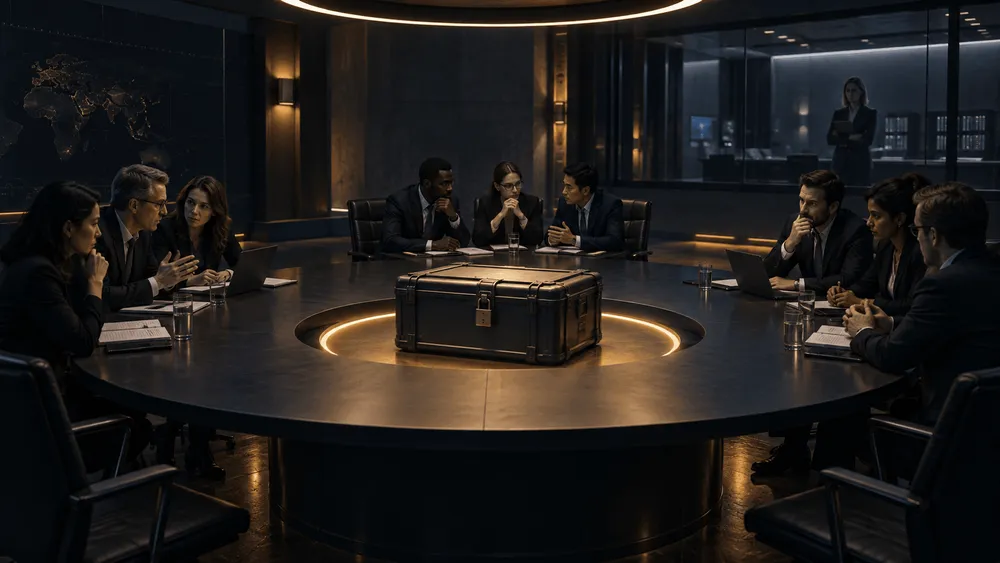
OpenAI has revealed that it has been holding weeks of discussions with rivals Anthropic and Google over AI safety. Bloomberg Law reported the news on September 15, 2026, based on comments from Chris Lehane, OpenAI's head of global policy, at a press briefing. The three companies already share an industry group, but this time the talks reportedly also touched on establishing a new safety body. However, there has been no announcement of agreement on setting up such an organization, on pre-release review, or on procedures for jointly slowing development. To gauge whether these talks will bear fruit, what matters is not which companies are at the table, but who receives unreleased models and when, and which tests will determine whether a model can go to market.
What Weeks of Talks Have Confirmed So Far
Speaking in Washington, Lehane explained that the effort involving OpenAI, Anthropic, and Google has been underway for "a few weeks." According to Bloomberg Law, he also suggested that no antitrust exemption is needed for the three companies to cooperate on safety. The start date and number of meetings have not been disclosed, nor have attendee lists or minutes been made public. So the confirmed novelty here is that contact among the three rivals has moved from public statements of support to ongoing discussions—not that joint slowdown procedures or mutual audits have been decided.
The day before, on September 14, the Washington Post reported—citing three anonymous sources familiar with the matter—that the three companies had privately discussed the possibility of a new industry safety body. In response to the Post's inquiry, OpenAI pointed to its September 9 policy document, Google cited Demis Hassabis's proposal from July, and Anthropic reportedly did not respond. This pattern of responses itself indicates that no shared organizational plan or table of authorities has been jointly published by the three companies.
OpenAI itself announced on September 9 that it would work with other frontier AI labs to advance voluntary industry standards. At the same time, it called for mandatory federal safety regulation, state-level efforts, and compatible international standards. The company positioned industry standards as a complement to—not a substitute for—government regulation and democratic oversight. In other words, it is not proposing to close the loop through voluntary coordination among competitors alone.
On antitrust matters, the three companies do not appear to be entirely aligned. In a September 12 essay, Anthropic's Dario Amodei suggested that government mediation or a limited antitrust exemption could be useful for inter-company safety discussions. Lehane's remarks, by contrast, represent OpenAI's position that no such exemption is currently needed for safety coordination. Neither statement constitutes a legal determination by a court or regulator, and it remains unclear whether the same conclusion would extend to jointly coordinating the pace of development.
How the Existing Forum Differs From the Proposed New Standards Body
Anthropic, Google, Microsoft, and OpenAI founded the Frontier Model Forum, an industry group for leading AI developers, in July 2023. Its founding charter identifies advancing safety research, identifying best practices, sharing knowledge with policymakers, and supporting safe AI applications as its core objectives, and also calls for promoting independent standards evaluation. In short, the basic framework of rival labs cooperating on safety is not new.
The standards-body proposal Hassabis put forward on July 14, 2026, goes further than the Forum's founding charter into concrete review functions. Under his proposal, the effort would be U.S.-led, primarily funded by industry, and its board would include independent technical experts as well as representatives connected to open models. Coverage would be determined by capability-evaluation benchmarks, with companies initially submitting frontier models voluntarily up to 30 days before release. Once the effectiveness of the process is verified, the plan envisions requiring models entering the U.S. market to pass evaluation.
| Comparison point | Frontier Model Forum's 2023 founding charter | Hassabis's 2026 proposal | Confirmed three-company talks |
|---|---|---|---|
| Core function | Research, best practices, knowledge sharing, support for safe applications | Standards body that receives target models and conducts independent evaluation | Safety discussions ongoing for weeks |
| Pre-release submission | No deadline specified | Initially voluntary, up to 30 days before release | Not disclosed |
| Link to market entry | No pass/fail authority specified | Future plan envisions pass requirement before U.S. market entry | Not disclosed |
| Relationship with government | Cooperation with government and civil society | Proposes U.S.-led, FINRA-style model | Not disclosed |
While the Forum's published charter centers on research, best practices, and information sharing, the Hassabis proposal goes further—suggesting pre-release model submission up to 30 days in advance and, eventually, conditions for U.S. market entry. However, there has been no announcement that the current three-way talks have reached agreement on granting such authority.
The institutional significance of discussing a new organization lies precisely in this gap in authority. Where the Forum serves as a venue for joint research and knowledge sharing, the Hassabis proposal envisions a body where third parties would gain access to models companies have not yet released, with test results tied directly to market-entry decisions. That said, this remains Hassabis's personal proposal—it is neither an adopted policy of Google DeepMind nor a decision by the U.S. government. It also remains unclear whether the current talks aim to replace the existing Forum, add a review function to it, or create an entirely separate organization.
What It Would Take to Move From Proposal to Implementation
To operate a review system, the first step would be defining which models fall under it. The Hassabis proposal suggests using capability-evaluation benchmarks, with evaluation criteria potentially updated on a roughly quarterly basis initially—since a fixed list could quickly become outdated amid rapidly evolving capabilities. Ultimately, the plan also calls for developing non-public tests independent of each lab, to reduce the room for companies to tune models specifically to known evaluation issues.
The next question is what evaluation results would actually determine. If they serve only as advisory input, companies could proceed with launch dates unchanged. Tying results to pass/fail decisions on market entry would strengthen enforcement, but raises questions about who handles appeals and whether non-participating companies would face the same conditions. How much of the results to disclose publicly is also a difficult issue: greater transparency helps the public make informed judgments, but detailed disclosure of dangerous capabilities or defensive weaknesses may not always be feasible.
FINRA, which Hassabis cited as a reference, is not a U.S. government agency—it is a nonprofit self-regulatory organization funded by the financial industry and overseen by the U.S. Securities and Exchange Commission (SEC). Applying this analogy to AI would require designing not just industry funding and technical independence, but also a framework for how a public authority would oversee rulemaking and enforcement. This two-tier structure helps explain why OpenAI has called for both voluntary standards and federal regulation side by side.
Furthermore, if a review body were to coordinate slowdowns in development, its connection to competition law would grow stronger. Sharing safety-testing criteria is not the same as competitors aligning on launch timing or computing resource allocation. Lehane's statement that "no exemption is needed" cannot, on its own, be extended to cover all forms of coordination, including the latter. If a formal agreement is eventually published, a key question will be whether coordination is limited strictly to safety evaluation, and what role government oversight plays in it.
How Far External Evaluation Has Already Progressed
The concept of external evaluation has moved beyond mere proposal. On September 9, Anthropic announced a contract with the evaluation organization METR to investigate four cybersecurity evaluation incidents, granting METR access to relevant records and extensive access to employees. This represents a real-world example of opening verification beyond a company's own internal review.
However, the initial contract runs for eight weeks, extendable by mutual agreement, and covers only those four specific incidents. It is neither a system in which permanent external evaluators continuously review all frontier models, nor a shared pre-release review process among the three companies. Moving from a contract to investigate individual incidents to a permanent, industry-wide oversight system would require standardizing how evaluators are selected, who bears the costs, how access to confidential information is handled, and what criteria govern public disclosure of reports.
The true test of whether the three-way talks have made progress will not be the announcement of an organization's name. It will be which models—based on what capabilities—fall under review; how many days before release they must be submitted, and to whom; and whether tests independent of the labs themselves are used. Beyond that, it will matter who receives the results and how those results connect to decisions on delaying launches or permitting entry into the U.S. market. Only once these elements—including their relationship to government oversight—are formalized in writing will the 2023 information-sharing framework begin to evolve into a system genuinely capable of making pre-release decisions.