


On January 7, 2026 (U.S. time), OpenAI officially announced a new dedicated space within its AI chatbot called "ChatGPT Health."
This move comes against the backdrop that 230 million users are already turning to ChatGPT for health-related consultations every week (Japanese), and marks the beginning of an extremely ambitious ecosystem strategy by OpenAI—one that seeks to integrate fragmented personal medical data (EHRs) and wearable device logs to enable advanced AI-driven health management.
In this article, we'll take a closer look at the details of the newly announced "ChatGPT Health" feature, its integration with Apple Health and other services, and—perhaps most importantly—the privacy protection mechanisms that address one of the biggest concerns surrounding it.
230 Million Weekly Users' "Hidden Demand" and the Necessity of a Dedicated Space
According to data released by OpenAI, more than 230 million people worldwide ask ChatGPT health and wellness-related questions every week. Until now, users have engaged in conversations within the general chat interface—asking things like "What could be causing my headache?" or "Create a marathon training plan for me."
However, this "general experience" came with significant challenges: lack of context and data security.
The newly launched "ChatGPT Health" functions as an independent space (sandbox) added to the sidebar. Conversations here are clearly isolated (siloed) from the regular chat history.
Why Is "Isolation" Necessary?
The author views this isolated structure as the very core of this feature.
- Preventing context contamination: It prevents past medical history from bleeding into context while a user is discussing coding or travel planning in a regular chat.
- Psychological safety: By recognizing this as "a dedicated medical consultation room," users are motivated to input more accurate and detailed symptoms and data.
- Data governance: As discussed below, this serves as the technical boundary that enforces the strict rule that data in this domain will not be used for AI training.
Additionally, the design includes a feature where, if health-related topics come up in a regular chat, the AI nudges users to move the conversation to the "Health" section.
"Deep Integration" with Apple Health and Electronic Health Records
The most noteworthy aspect of this announcement is the integration functionality with external data sources. This marks a shift from the previous "text-based consultation" phase to a new phase of "analysis based on one's own biometric data."
Key Platforms Available for Integration
OpenAI has announced API integrations with the following services and data sources.
- Apple Health: Activity data collected via iPhone and Apple Watch, including step counts, sleep, and heart rate.
- MyFitnessPal / Weight Watchers: Meal logs and calorie intake records.
- Function: Lab test result data (such as blood tests).
- Electronic Health Records (EHR): Through a partnership with U.S. medical data connectivity infrastructure company b.well, users can import medical records from many healthcare institutions in the United States (EHR integration is rolling out in the U.S. first).
Concrete Use Cases: Integrating Fragmented Information
By uploading blood test results received as a PDF or connecting Apple Watch sleep data, users can now have conversations like the following.
- "Based on last month's blood test results, create a meal plan for this week to help improve my cholesterol levels, taking into account my MyFitnessPal history."
- "My sleep quality has declined recently—is there any correlation with my activity levels?"
- "Create a summary of how my health has changed over the past six months, ahead of my doctor's appointment next week."
The AI now takes on the role of holistically interpreting "wearable data," "hospital test results," and "daily meals"—information that users previously had to piece together in their own heads.
"Not Used for Training Data": The Battle Over Privacy and Trustworthiness
When handling medical data, privacy and hallucination issues are unavoidable concerns. On this front, OpenAI has taken an extremely cautious approach.
1. Prohibition on Use for Training
OpenAI has explicitly stated: "Conversations and data within ChatGPT Health will not be used to train the foundation model."
This applies as the default setting. In regular chats, conversation data may be used for training unless users opt out—but in the health domain, the opposite approach is taken. This measure reflects awareness of regulations such as HIPAA (the U.S. Health Insurance Portability and Accountability Act), serving both as a legal risk hedge for the company and as an essential prerequisite for earning user trust.
2. The Limits of Medical Advice and "HealthBench"
Fidji Simo, OpenAI's Head of Applications, has emphasized that this feature is "not intended for diagnosis or treatment." The AI is positioned strictly as a tool that helps users "organize information" and "prepare"—nothing more.
However, inaccurate answers can directly lead to health harm. To address this, OpenAI refined the model through the following process.
- Collaboration with experts: Worked with over 260 physicians across 60 countries over a period of more than two years.
- HealthBench: Developed a proprietary evaluation framework. Beyond simply assessing the accuracy of medical knowledge, it incorporates clinical judgment criteria such as "when should the AI encourage the user to see a doctor" and "is the phrasing free of unnecessary alarm for the user" as evaluation metrics.
Concerns Regarding Integration with Apple's Health App
On the other hand, there's one point users should be cautious about when connecting Apple Health data to ChatGPT. When using ChatGPT via Apple's Siri, Apple anonymizes personal information before transmission. However, with this direct integration, users grant OpenAI direct data access permissions.
No matter how strongly OpenAI declares that it "won't use the data for training," there remains a structural risk in the fact that data is transferred to OpenAI's servers. Users will need to carefully weigh the trade-off between convenience and privacy.
What OpenAI's Vertical Integration into "Healthcare" Means
This move can be seen as a decisive step toward establishing OpenAI's position as a "personal agent," going beyond merely being an "alternative to search engines."
A Countermeasure Against Google and Apple
Google has already acquired Fitbit and is developing a medical-specialized model using Gemini (Med-Gemini). Apple is also rumored to be developing AI health coaching features under codenames such as "Quartz" and "Mulberry."
However, since OpenAI doesn't own a platform (OS), it has the advantage of being able to integrate neutrally with Apple Health and apps on Android. This positions OpenAI to claim, ahead of its competitors, the role of a "medical data hub" capable of aggregating data across OS boundaries.
From "Dr. Google" to "Dr. ChatGPT"
People once typed their symptoms into a search box (Dr. Google) and grew exhausted sifting through a flood of search results to find information relevant to their own case. ChatGPT Health, by contrast, generates pinpoint answers based on an individual's own medical data. This represents a revolutionary drop in the cost of information exploration—and could pose a threat to the advertising-based business model of search engines.
Future Rollout and Availability
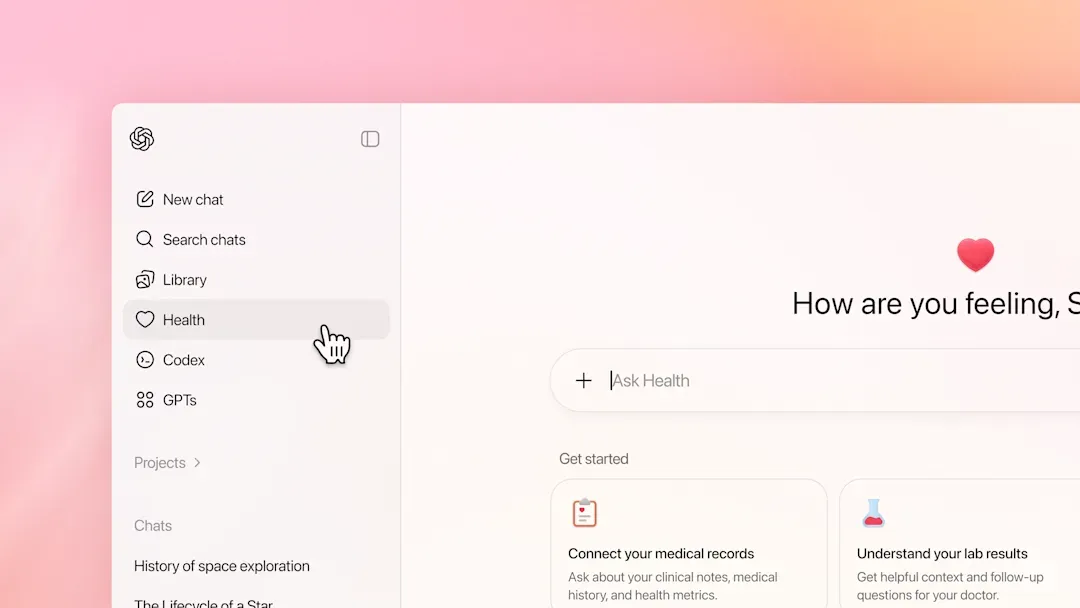
Rollout Plan
- Availability: Rolling out as a beta version, starting with users who signed up on the waitlist. Expected to expand to Plus, Pro, Team, and free users within a few weeks.
- Regional restrictions: Currently unavailable in the EEA (European Economic Area), the UK, and Switzerland. This is presumably because compliance with strict data protection regulations such as GDPR has not yet been completed.
- EHR integration: Electronic health record integration is centered on the U.S. market. EHR integration within Japan will likely take time, pending the development of APIs connecting to systems such as the My Number Portal (Mynaportal).
The Dawn of an Era Where AI Understands "Your Body"
OpenAI's announcement of "ChatGPT Health" symbolizes AI's evolution from a mere assistant for intellectual tasks into a partner deeply involved in human survival itself.
The attempt to integrate medical data—the "ultimate personal information"—on top of an overwhelming base of 230 million weekly users has the potential, if successful, to fundamentally transform healthcare accessibility and the practice of preventive medicine. At the same time, the risks of security incidents and erroneous advice have never been higher.
We now stand at a major crossroads: whether or not to entrust our own bodily information to Silicon Valley's algorithms.
Sources
- OpenAI: Introducing ChatGPT Health