

On August 4, 2026, Oak Ridge National Laboratory (ORNL) announced that it had verified at full scale a method for shortening the post-irradiation separation process in californium-252 (Cf-252) production by about one week. Research that began in 2015 reached the stage of testing with production-scale equipment during the 2025 production campaign. The lab says the process, which previously took about two weeks, can now be cut in half while maintaining the same product quality. Since ORNL is the only facility in the West producing Cf-252, this achievement represents a practical improvement toward increasing the supply of a rare neutron source.
However, what has shortened is not the entire manufacturing period—from reactor irradiation through to sealing the finished product. Rather, it is one chemical processing step in which the target nuclide is extracted after dissolving the highly radioactive target. Separating out what got faster from what constraints remain reveals the conditions under which this improvement actually translates into increased production volume.
A Neutral Ligand That Cut Roughly Two Weeks in Half
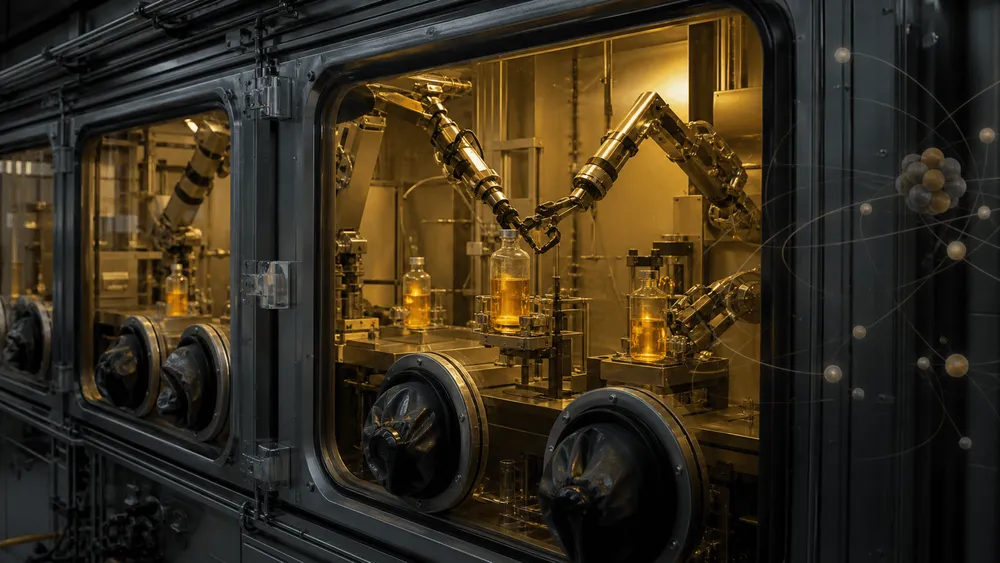
Cf-252 is produced at the High Flux Isotope Reactor (HFIR) by repeatedly bombarding curium isotopes with neutrons, building up the element through successive neutron captures and beta decays. Irradiated targets are then transferred to hot cells at the Radiochemical Engineering Development Center (REDC), where they are dissolved in concentrated nitric acid. From there, americium, curium, and lanthanides produced by fission are separated out, and Cf-252 is purified.
In the old process, bis-diethylhexyl phosphoric acid (HDEHP) was used to extract trivalent actinides and lanthanides. However, the solution used to fully dissolve the target has a high nitric acid concentration of 6 to 8 M. For HDEHP to work effectively, acidity had to be reduced to below 0.1 M, and adjusting this feed solution took about a week.
Lætitia Delmau and colleagues at ORNL chose a different route: using the neutral ligand tetraoctyl diglycolamide (TODGA) to transfer the target elements into the organic phase while the solution remains highly acidic. A 2017 technical report showed that a system of 0.2 M TODGA dissolved in Exxsol D60 could extract trivalent actinides nearly quantitatively from highly acidic solutions obtained from an actual Cf production campaign. It is this chemical difference that eliminates the need to wait while diluting the acid.
Development proceeded in stages, starting from small-scale tests. In 2015, droplets of waste solution with reduced radioactivity were handled in a glovebox; from 2017 onward, work moved to actual solutions inside hot cells. In the 2023 campaign, the scale was expanded using 6% of the material, and in 2025 it was tested at full scale. In a single cycle, 95% of americium, curium, cerium, and other elements in the Cf-252 solution were extracted, cutting processing time from about two weeks to about one week without changing product quality.
What Got Faster Is Not the Entire Manufacturing Process
ORNL's Cf-252 production proceeds through a long sequence: target irradiation, dissolution, separation of element groups, purification of individual nuclides, and fabrication into sealed sources. What the TODGA system replaces is the stage immediately following dissolution, where trivalent actinides and lanthanides are collectively recovered. Even the 2017 report noted remaining challenges: how thoroughly to exclude fission products such as zirconium and ruthenium, and how to optimize washing and back-extraction after extraction.
Therefore, it would be inaccurate to say that "manufacturing has become twice as fast." What ORNL has confirmed is that time was halved for a single separation step while achieving the same results as before. It has not disclosed annual production volume, how many percentage points the Cf-252 yield might increase, or how much hot cell costs could be reduced.
Even so, the time savings has direct value. At dedicated facilities where highly radioactive materials are handled remotely, even a single hour of occupancy carries significant cost. Shortening occupancy time by about a week reduces competition with other processes that require the same hot cells, raising overall processing capacity for the campaign. The new method will undergo further refinement and is scheduled for continued use starting with the next campaign in 2027.
The Two-Year Cycle: Cost, Facilities, and a 2.645-Year Half-Life
ORNL produces Cf-252 in batches every two years. Program manager Samantha Schrell said an annual campaign was also considered, but was ruled out due to cost, limited hot cell time, and Cf-252's short half-life of 2.645 years.
Cf-252 emits 2.31×10^12 neutrons per second per gram. While it is a powerful neutron source, the actual units sold are not grams. The DOE's National Isotope Development Center (NIDC) handles it in micrograms, using a system where customers enter a quantity on the product page to request a quote. No price list is published.
Under this transaction model, a conversion like "tens of millions of dollars per gram" cannot be treated as a market price. At the very least, there is no official data available to translate this process shortening into monetary terms. To gauge the significance for supply, one must look not at a hypothetical per-gram price but at the production volume of the next campaign and the number of micrograms that can be shipped to customers.
Across 78 campaigns from 1966 through May 2019, ORNL produced a cumulative total of 10.2 grams of Cf-252. Even summing more than half a century of production, the total remains at this level. The fact that NIDC currently lists it as "in stock" while still requiring a quote-based system reflects that this is a nuclear material managed and supplied in small quantities, tailored to each application.
Ten Planned Reactors and Cf-252 Supply Constraints
One application driving demand is reactor startup. Because Cf-252 continuously emits neutrons through spontaneous fission, it can be used as a startup source to initiate the fission chain reaction. Beyond this, it is used for inspecting unused fuel, well logging, and coal analysis. There is also demand for port security and instrument calibration, so demand is not determined by nuclear power generation alone.
Executive Order 14302 in the United States has directed the DOE to have 10 large reactors under construction with completed designs by 2030, and to increase output at existing reactors by a combined 5 GW. If small modular reactors and reactors for military facilities also move forward, Cf-252 will be needed for startup sources and fuel inspection. However, an increase in reactor plans does not directly translate into a fixed amount of Cf-252 demand, and ORNL has not disclosed specific demand forecasts.
Two measures are actually being pursued to increase production volume. In addition to the new separation method, ORNL is increasing the number of operating cycles for irradiating curium targets at HFIR. The former reduces time spent in hot cells; the latter increases the raw material that converts into Cf-252. Speeding up the separation process alone will not increase shipment volumes unless the amount of irradiated target also grows.
The number to watch in the 2027 campaign is not the number of days shortened itself, but how many additional micrograms could be supplied while maintaining recovery rates. Only when both irradiation volume and chemical processing improve together will this new solvent, a decade in the making, finally boost the West's Cf-252 supply capacity.