


The University of New South Wales (UNSW) in Australia and China's UtmoLight announced that they have achieved a stabilized conversion efficiency of 23.5% with a 30cm-square single-junction perovskite solar cell.
The figure itself was published by UtmoLight in September. On October 7, UNSW gave a detailed explanation of the technology, which forms the charge-extracting contact during manufacturing without using a nickel oxide layer, as well as its plans to scale up to commercial size.
The research aims not only to achieve high efficiency in small laboratory solar cells, but also to establish a manufacturing technology that maintains performance as the area grows. To evaluate progress toward commercialization, it is necessary to look beyond the efficiency figure itself and examine the measurement conditions, as well as whether the manufacturing method can reproduce the same performance at larger sizes.
What area was the 23.5% efficiency measured on?
The solar cell announced by UNSW measures 30cm × 30cm in outer dimensions, but the aperture area used to measure conversion efficiency was 676cm².
The 30cm-square outer area comes to 900cm², so the two figures differ. The aperture area is the region delimited for illumination during measurement, and efficiency based on it cannot be directly compared with efficiency based on the entire panel area.
In other words, it would not be accurate to interpret the 23.5% figure as the efficiency achieved over the full 30cm-square area.
As for the certifying bodies, UtmoLight's announcement names the National Center of Supervision and Inspection on Solar Photovoltaic Product Quality (国家光伏产业计量测试中心).
An excerpt of the test report released by the company also bears the name of the Fujian Metrology Institute (福建省计量科学研究院), and shows that the measurement was carried out under standard test conditions (STC) using maximum power point tracking (MPPT).
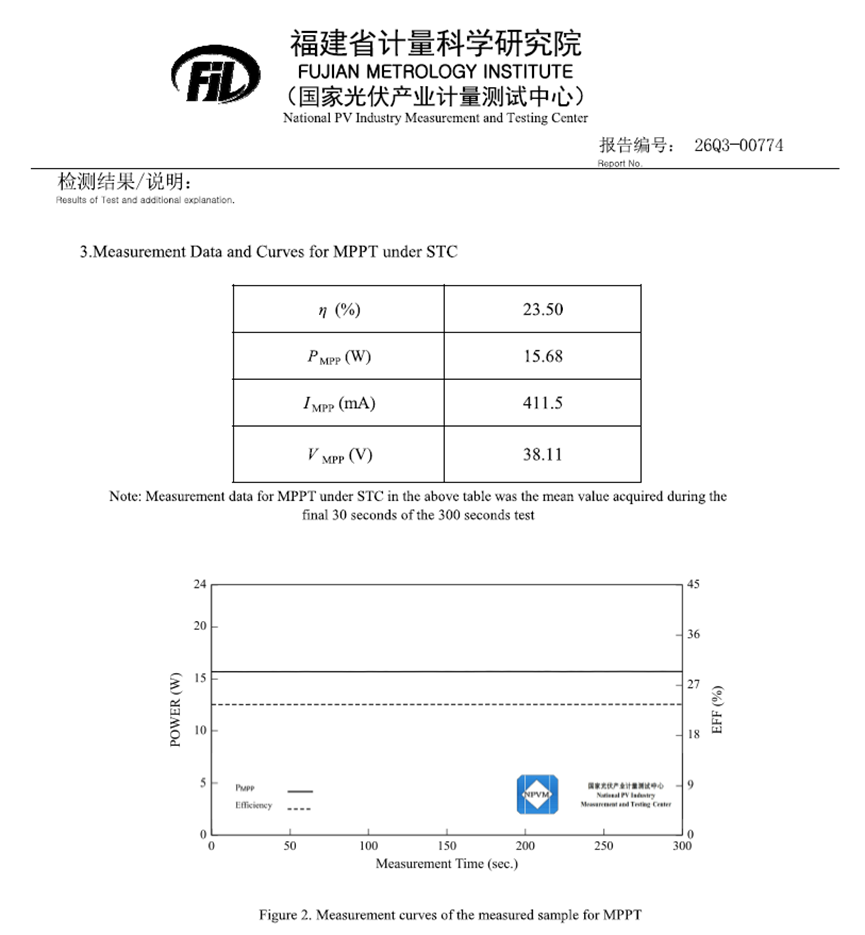
MPPT is a method of tracking the operating point at which output is maximized while a solar cell is generating power.
According to a note in the report, the 23.50% efficiency is the average of measurements taken during the last 30 seconds of a 300-second test.
Here, "stabilized" means the efficiency was evaluated once the output had settled during measurement. Stabilized efficiency obtained from a measurement lasting a few minutes should not be confused with the durability needed to maintain performance outdoors for years.
Indeed, UNSW itself cites degradation from moisture, heat and prolonged light exposure as challenges to be addressed.
Meanwhile, the published area and output figures call for further checking.
The output listed in the test report excerpt is 15.68W. Using the STC irradiance of 1000W/m² shown in ASTM's public materials, and converting the aperture area of 676cm² announced by UNSW to 0.0676m², the efficiency works out as follows:
15.68W ÷ (1000W/m² × 0.0676m²) × 100 ≈ 23.2%
To obtain an efficiency of 23.5% under the same conditions, an output of about 15.89W would be required.
In short, the figures currently available do not allow the relationship between the 23.5% efficiency and the 676cm² aperture area to be independently verified.
This calculation, however, assumes that the aperture area announced by UNSW and UtmoLight's test report refer to the same sample and the same measurement region.
The published report excerpt contains no information on area or measurement uncertainty, so it is not possible to conclude from this alone that the certified value is wrong.
If the full test report, including area information, is released and its correspondence with UNSW's announcement is clarified, the measurement results could be examined in more detail.
Dropping the nickel oxide layer and forming the charge-extracting contact during fabrication
What stands out in this solar cell is a design that omits the nickel oxide layer used in conventional devices.
According to UNSW, the nickel oxide layer plays a role in making a solar cell work properly, including preventing short circuits. However, it can also trigger unfavorable chemical reactions with the perovskite material and undermine stability. Forming the layer also requires its own manufacturing step.
Simply removing the nickel oxide layer would therefore not preserve the functions the solar cell needs. Another method must make up for its role.
When a solar cell absorbs light, electrons and holes are generated inside it. A hole is a vacancy left by a missing electron, treated as a carrier of positive charge; current flows when electrons and holes are extracted to different electrodes.
The research team explains that, rather than stacking layers one after another as in conventional approaches, it adopted a method that directly forms a "hole-selective contact," which preferentially extracts holes, within the manufacturing process.
A key point of the technology is how the formation of the light-absorbing perovskite layer is combined with the formation of the charge-extracting contact.
There is prior research on this type of manufacturing method.
In a 2023 paper in Nature Energy, Xiaopeng Zheng and colleagues reported a phenomenon in which phosphonic and carboxylic acids added to a perovskite precursor solution self-assemble on an indium tin oxide (ITO) substrate during film formation.
In this method, a self-assembled monolayer, in which molecules spontaneously arrange themselves in an ordered way, forms as the hole-selective contact while the perovskite crystallizes at the same time.
The researchers explain that this approach solves problems with solution wetting and can simplify the manufacturing process.
This does not mean, however, that the prior study uses the same materials or manufacturing conditions as the solar cell that achieved 23.5% this time.
UNSW's announcement does not disclose the type or formulation of the molecules used, or the detailed structure of the contact.
What can be read from the prior study is the aim of the manufacturing approach: building the interface for extracting holes at the same time as the perovskite layer is formed.
In large-area solar cells in particular, whether such a contact functions uniformly over a wide region is important.
If film thickness or crystallization state varies from place to place, defects may arise or losses during charge extraction may increase.
Finding a material that performs well in a small solar cell does not mean the same performance can be obtained simply by enlarging the coated area.
Professor Xiaojing Hao of UNSW explains that UtmoLight's experience in large-area processing and module manufacturing was essential in developing the materials and device design into a high-performance submodule.
Omitting the nickel oxide layer may reduce deposition steps and suppress problems caused by reactions between materials.
However, fewer manufacturing steps do not necessarily mean lower manufacturing costs.
Defect rates and material usage in the new process also need to be evaluated, and this announcement alone does not allow the improvement in manufacturing cost or yield to be quantified.
How does the "world record" 23.5% differ from other research?
UtmoLight says the 23.5% efficiency exceeds, by 0.6 percentage points, the benchmark listed in version 68 of the solar cell efficiency tables compiled by Martin Green and colleagues.
UNSW also positions it as a world record for large-area perovskite submodules.
When comparing perovskite solar cell efficiencies, however, the size of the samples and the measurement conditions need attention.
Small-area research cells, submodules combining multiple cells, and commercial-size modules differ both in what is being evaluated and in their manufacturing challenges.
In fact, a Nature paper published on August 12, 2026 by a team including Dongdong Xu reported certified efficiencies of 24.0% for a perovskite module with an aperture area of 810cm² and 22.0% for a large module with a total area of 0.72m².
That is a separate study that improved performance through surface treatment.
Compared with the UNSW–UtmoLight result, the picture is as follows:
| Announcement / study | Reported efficiency | Area and measurement conditions |
|---|---|---|
| UNSW–UtmoLight | 23.5% | 30cm-square outer dimensions; aperture area announced by UNSW of 676cm². Stabilized efficiency at maximum power point; according to the report excerpt, the average of the last 30 seconds of a 300-second test |
| Xu et al., Nature paper | 24.0% | Certified efficiency at an aperture area of 810cm². The public abstract gives no details of the measurement method |
| Large module in the same Nature paper | 22.0% | Certified efficiency at a total area of 0.72m². The area basis differs from that of the 810cm² sample |
This table is not a simple ranking of efficiency.
The 23.5% this time is a stabilized efficiency measured at the maximum power point, whereas the public abstract of the Nature paper used for comparison does not explain in detail how the 24.0% figure was measured.
Moreover, for the UNSW–UtmoLight result itself, points remain to be checked regarding how the announced aperture area corresponds to the figures in the certification report.
It would therefore be inappropriate to generalize 23.5% as "the highest efficiency among all large-area perovskite solar cells."
The record needs to be evaluated with clarity about which area it covers and under what conditions it was measured.
The result is also based on an announcement by a university and a company and on an excerpt of a published certification report.
UNSW's announcement page does not point to a peer-reviewed paper or DOI describing in detail the sample that achieved 23.5%.
The fact that the 2023 prior study and the August 2026 comparison study have been published as peer-reviewed papers does not mean that the same level of information is available on the materials composition and measurement conditions for this result.
Next goal: a 2.8m² commercial-size module with 18–19% efficiency
UNSW's stated next goal is to manufacture and test, within the next few months, a perovskite solar module equivalent to commercial size, with an area of 2.8m².
The target efficiency for this large module is 18–19%.
That is, the plan is not to achieve the 23.5% obtained with the current 30cm-square sample at commercial size as well.
The outer area of 30cm square is 0.09m², so scaling up to 2.8m² corresponds to roughly a 31-fold increase in outer area.
This comes from the calculation 2.8 ÷ 0.09 and is not a comparison based on the 676cm² aperture area used in this efficiency measurement.
In addition, 23.5% is a figure actually measured on this sample, whereas 18–19% is a target for a large module yet to be built.
The gap between the two cannot be taken as an efficiency loss from scaling up that has already been confirmed.
When a solar cell is enlarged, uniform films and contacts must be formed over a wide area. Manufacturing conditions must also be properly controlled, including the process of electrically connecting multiple cells.
Achieving excellent efficiency with the single best-performing device made in a lab is a different matter from reliably producing many modules with the same method.
The published materials do not give the total number of samples produced, the variation in performance between samples, or the yield in mass production.
Data on such reproducibility will also be important in judging commercialization.
Another challenge is durability over long-term use.
The design that omits the nickel oxide layer is intended to avoid undesirable reactions with the perovskite and reduce degradation factors.
But that alone does not guarantee the durability of the entire solar cell.
Resistance to moisture and heat and changes in performance under prolonged light exposure must be verified separately.
Even if output was stable during a 300-second measurement, it is unknown whether the same performance can be maintained over long-term outdoor use.
In the upcoming tests of the 2.8m² module, important evaluation items will include not only efficiency with a clearly defined area and measurement conditions, but also whether the same performance can be reproduced across multiple samples and how much the module degrades over long-term use.
What this research shows is the possibility that forming the hole-extracting contact within the manufacturing process can deliver high efficiency even in large-area perovskite solar cells.
If this method functions reliably at commercial size and secures sufficient durability and manufacturing reproducibility, it could open the way to mass production as a technology that maintains high performance while simplifying the manufacturing process.
Beyond the 23.5% record itself, the focus going forward will be how far up in module size that performance can be reproduced.