

US-based Photon Queue announced on July 21, 2026 that it had closed a $4 million seed round led by Playground Globals. The company has already deployed its first commercial units of free-space quantum memory at Sandia National Laboratories and the University of Maryland. The funds will go toward product development, manufacturing capacity, and expanding customer deployments.
What operates at room temperature here is not a quantum processor. Rather, it's a device that holds a photon until it's needed, synchronizing it with other steps in quantum computation or quantum networking. Now that lab-bench optics have moved to two customer sites, the evaluation criteria have shifted from whether the principle works to whether losses can be kept low while stabilizing a long optical path under real-world conditions.
A Free-Space Loop That Delays Photons Without Ever Stopping Them
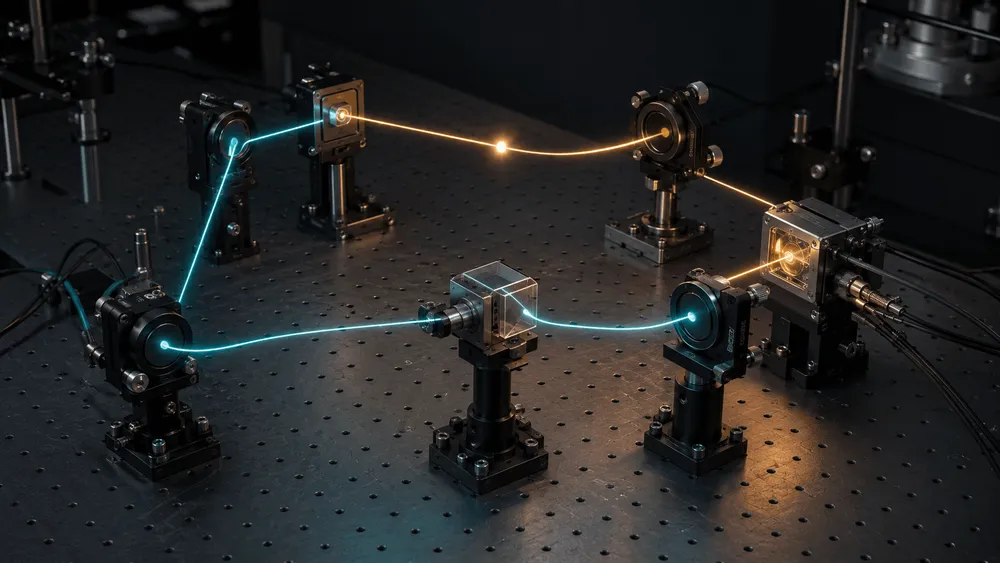
In photonic quantum information processing, the photons you need don't always arrive at the same moment. In processes that use multiple photons simultaneously, or in communication linking distant quantum systems, an earlier-arriving photon must be temporarily held so its arrival time can be synchronized with others. Photon Queue's quantum memory routes a photon through an optical switch into a path enclosed by high-reflectivity mirrors, circulating it until the moment it needs to be released.
This mechanism differs from matter-based memories, which transfer a photon's quantum state onto the electronic or spin states of an atomic ensemble. Because no such conversion takes place, the wavelength range and bandwidth the device can handle are easier to design around at the optics level, and the conversion losses and noise that typically arise during storage and retrieval are avoided. This is also why the system can run at room temperature without needing cooling equipment, heating furnaces, or vacuum systems for the storage mechanism itself.
Fixed-length optical fiber can also delay photons, but it's difficult to vary the delay time significantly. The device that formed the foundation of Photon Queue, developed at the University of Illinois Urbana-Champaign, used a polarizing beam splitter and a Pockels cell as switches to toggle between three loops of different lengths. For the 125-nanosecond and 1.25-microsecond paths, the team employed Herriott cells, which bounce light back and forth between two or more mirrors multiple times. In the improved design, the optical path is folded to 340 times the resonator length of the Herriott cell.
This distinction also shows up in what gets called "memory." Matter-based memories transfer and hold a photon's state in a separate medium, whereas in a free-space loop, the photon keeps flying. The holding time is determined by the path length and number of round trips, and in principle the moment a photon will be needed must be decided before it enters the device. This makes it well-suited as a short-duration buffer within a quantum network, but its role differs from that of a memory device meant to store information for extended periods.
The scope of what the announcement describes as "room-temperature" is limited to this storage mechanism. It does not mean that the entire system—including the connected quantum processor, single-photon source, and photon detectors—operates at room temperature. The company's claim that the technology can be applied to photonic, ion-trap, and neutral-atom platforms is a design-level assertion that it can be integrated into the optical connection points of these systems, not that it replaces their QPUs.
The Reality of 12.5 Microseconds and 5% End-to-End Efficiency
The experimental device published in 2023 combined three loops of 12.5 nanoseconds, 125 nanoseconds, and 1.25 microseconds, allowing the holding time to be selected in 12.5-nanosecond increments. The per-round-trip efficiency into single-mode fiber for each loop, from shortest to longest, was 96.5%, 88%, and 72%. While the device could hold light for up to 12.5 microseconds, the overall end-to-end efficiency of the system dropped to just 5% at that point.
Every time a photon circulates, it passes through mirrors and switches. Even small losses accumulate with each pass, meaning holding time and retrieval probability cannot be maximized simultaneously. The research team cited keeping per-mirror loss below 0.05%—lower than the loss from the switches—as a condition for multiplexing to work.
There are also differences in how well quantum states are preserved. The average process fidelity for the section that interconverts polarization and time-bin encoding was 99.12%, while the fidelities for the three individual loops were 99.35%, 99.0%, and 97.8% respectively. Longer loops are more strongly affected by optical loss and the extinction ratio of polarization components. Room-temperature operation eliminates the need for cooling equipment, but it doesn't make handling a long optical path itself any easier.
To suppress beam misalignment caused by temperature fluctuations, the experimental setup included, in addition to its housing, two active stabilization systems using an auxiliary laser, piezo-controlled mirrors, and a quadrant photodetector. In exchange for eliminating the need for a refrigeration unit, precise control of the optics that repeatedly reflect light becomes central to the product.
Bandwidth limitations also exist at the level of individual components. The 2023 device stored 5-picosecond optical pulses, but the overall operating speed of the memory was constrained by the Pockels cell, with the repetition rate unable to exceed 2 megahertz. Even if the mirrors' reflective bandwidth is wide, the switch's transmission loss, extinction ratio, and drive speed set the upper limit for the entire device. The value of the free-space approach isn't that these constraints disappear—it's that it becomes easier to identify which optical component to improve in order to boost performance.
Turning 100 Lab-Bench Adjustment Knobs Into a Product
In 2024, UIUC described the experimental system at the time as having "roughly 100" adjustment knobs, to the point that if someone turned two of them, tracing the cause became difficult. The co-founders explained that they needed to incorporate a beam-alignment laser and control systems capable of sustained long-term operation, and then test reliability. The progression from the initial 2024 design to the deployment of commercial units is the change confirmed by this announcement.
The design targets for the current version, as listed on the company's website, are as follows. The company notes that these figures are for general planning purposes, and actual device performance may vary depending on customer specifications.
| Item | Published Design Target |
|---|---|
| Holding time | 10 to 10,000 nanoseconds |
| Memory bandwidth | Over 1 terahertz |
| Center wavelength | 350–2000 nanometers, customer-specified |
| Repetition rate | 1 MHz average, up to 5 MHz burst |
| Noise/fidelity | Under 10⁻⁴ per pulse, over 0.99 |
These figures were not values verified upon acceptance at Sandia National Laboratories or the University of Maryland. The product name, price, and physical dimensions have not been disclosed. Power consumption, continuous operating time, and end-to-end efficiency measured at customer sites also remain unknown. The commercial deployment represents progress beyond a research device, but manufacturability and operational track record will need to be judged based on future figures.
How Far Has the Concept of Generating 8 Photons at 1 Kilohertz Progressed?
A preprint published in March 2026 by researchers from Sandia and Photon Queue demonstrates a concrete use case for the quantum memory. The concept involves taking probabilistically generated single photons of different frequencies and temporally overlapping them using a free-space variable-delay loop combined with fixed fiber Bragg gratings, creating a multi-photon state at the same moment in time.
The paper factored in losses deemed achievable with commercially available components and estimated that an 8-photon frequency-bin state could be generated at an average rate of 1 kilohertz. Under the conditions described in the paper, this represents roughly a 2,000-fold improvement over the non-multiplexed case. However, this is a proposal based on a loss model, not the result of an actual generation experiment using the device. Whether the deployed memory will actually lead to multi-photon generation matching these calculations remains something that must be verified through measurement.
Also in July, Photon Queue received a combined $500,000 in support from the State of New Mexico and Roadrunner Venture Studios. The state's Quantum Technologies Award provides $200,000, with conditions requiring the company to establish an in-state presence and hire at least one employee, maintained for two years after receiving the funds. The company plans to conduct assembly, testing, and verification in Albuquerque.
The challenge that the $4 million must solve isn't adding more mirrors. It's whether end-to-end efficiency, fidelity, and optical-axis stability can be reproduced at customer sites across different wavelengths and holding times—and how many units of consistent quality can be manufactured. Once those numbers are in place, room-temperature quantum memory will move closer to becoming a procurable component for building distributed quantum systems, rather than remaining an experimental delay line.