

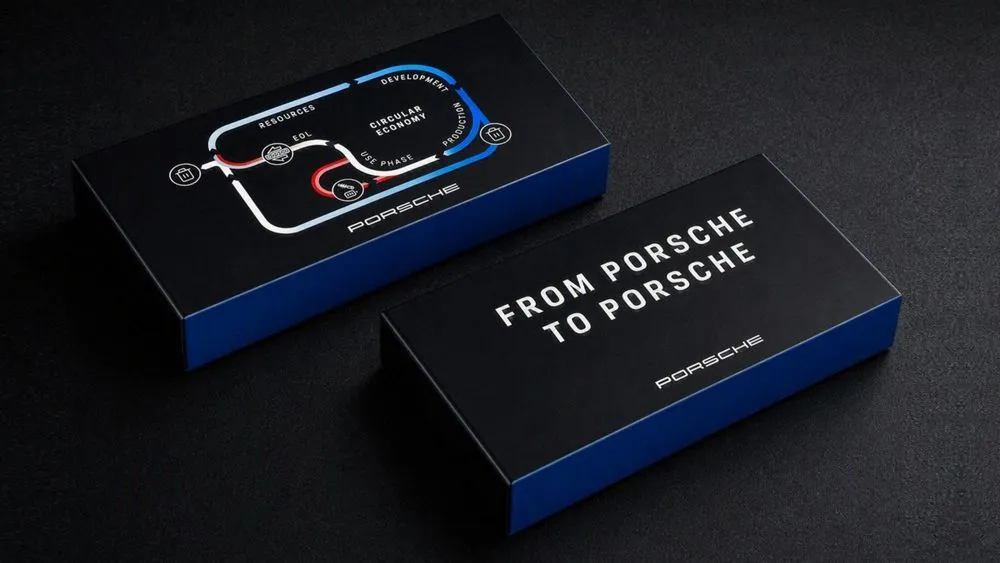
German automaker Porsche has built new battery cells using cathode active material made entirely from lithium, nickel, cobalt, and manganese recovered from its own used high-voltage batteries. As part of a demonstration project with German battery recycling company cylib and others, the prototype cells are now undergoing testing under real-world usage conditions.
However, the "100%" figure in the announcement does not refer to the proportion of recycled material in the entire cell. It applies specifically to the raw materials used in the cathode active material—the component responsible for the reaction that stores electricity. This is not a claim that the rest of the cell's components, such as the anode or electrolyte, were made entirely from recycled materials, and adoption in mass-produced vehicles has not been decided.
Still, this represents significant process progress. The work has advanced from the stage of shredding used batteries to obtain metal-containing powder, to reformulating the four recovered elements into cathode active material and testing it as cells intended for automotive use. The challenge has shifted from "can the metals be extracted?" to "can they be turned back into cells that meet the same requirements as virgin materials?"
"100%" applies only to the cathode active material
Cathode active material is the primary material in the cathode that releases and absorbs lithium ions during charging and discharging. In Porsche's prototype, the four elements used for this material were fully replaced with raw materials recovered from the company's own high-voltage batteries. This means that newly mined and refined virgin raw materials were not used in this specific scope.
The process begins with discharging and disassembling used batteries, then mechanically shredding them. The shredded material is processed into an intermediate product called black mass, from which the necessary raw materials are separated and refined. What's notable about this achievement isn't simply obtaining the recovered materials—it's resynthesizing them into cathode active material and rebuilding them into cells.
Simply having the elements present isn't enough to turn them back into cathode material for automotive use. They must be refined to a purity and composition usable in battery reactions, particle characteristics must be controlled, and cell quality must be verified. Porsche's testing of prototype cells under real-world usage conditions is aimed at determining performance after connecting the output of the recovery process to the input of cell manufacturing.
That said, what Porsche has publicly disclosed is limited to the milestone reached and the testing status. The company has not revealed the cell's chemical composition, format, manufacturer, or quantity. There are no figures for capacity, output, or fast-charging performance, and lifespan, safety, and cell-to-cell variation remain unknown. While Porsche states that initial testing has demonstrated technical feasibility, it has not announced that performance equivalent to existing materials has been achieved.
From "a certain percentage" to 100% cathode raw materials in a year and a half
Porsche's demonstration has progressed from a March 2025 plan involving approximately 65 tons of black mass and cells using "a certain percentage of recycled material," to the September 2026 milestone of 100% cathode active material replacement and testing under real-world conditions. Supply of recovered raw materials for battery cell production is planned to begin in 2028, and mass-production adoption has not yet been decided.
The period from March 2025 to September 2026 spans approximately one and a half years.
| Timing | Announced Stage | Status |
|---|---|---|
| March 2025 | Produced approximately 65 tons of black mass | Achieved |
| March 2025 | Prototyped cells using a certain percentage of recycled material in Phase 3 | Planned |
| September 2026 | Made cathode active material raw materials 100% recycled-sourced and formed into cells | Achieved |
| September 2026 | Evaluated prototype cells under real-world usage conditions | In testing |
| From 2028 | Supply recovered raw materials for cell production by Porsche and certain partner companies | Planned |
Sources: Porsche announcements from 2025 and 2026. The approximately 65 tons refers to the quantity of black mass, not the amount of individually recovered elements or completed cells.
What this timeline shows is that the initial "certain percentage" has progressed to 100% for cathode active material raw materials. However, 2028 is not the start date for installation in mass-produced vehicles. Porsche explains that it plans to track recovered raw materials using a dedicated material ledger and make them available for cell production starting that year. The supply volume, target factories, and vehicle models involved have not yet been disclosed.
The recovery network has already begun expanding beyond the prototype stage. Since May 2026, Porsche and cylib have been processing used high-voltage batteries collected at Porsche centers in Germany. However, the explanation remains limited to describing it as "a water-based processing method," with no disclosure of chemicals used, temperatures, energy input, or recovery rates for individual elements. There isn't enough information available to assess environmental impact or economic viability.
Ahead of EU regulations, but 100% isn't proof of compliance
Part of the reason Porsche is racing to connect this to mass production is that European regulations requiring the use of recycled raw materials are becoming concrete. The EU Battery Regulation sets minimum percentages, by element, for waste-derived materials contained in active materials used in EV batteries.
| Target Element | From August 18, 2031 | From August 18, 2036 |
|---|---|---|
| Cobalt | 16% | 26% |
| Lithium | 6% | 12% |
| Nickel | 6% | 15% |
Source: Article 8 of the EU Battery Regulation. Minimum percentages must be demonstrated through technical documentation for each battery model, by year and by manufacturing plant. Manganese is not currently covered under this article.
The EU Battery Regulation's minimum recycled content requirements for 2031 are 16% cobalt, 6% lithium, and 6% nickel, rising to 26%, 12%, and 15% respectively by 2036. In contrast, Porsche's 100% figure is a claim about a prototype in which cathode active material raw materials were replaced with recycled sources—it does not prove compliance with the regulation's model-specific, year-specific, and plant-specific calculations, nor does it demonstrate mass-production cell performance.
The EU regulation calculates three elements individually and requires proof specific to model, plant, and manufacturing year. Porsche's announcement describes the cathode active material raw materials collectively as 100% recycled-sourced, but has not provided element-specific calculated values or technical documentation aligned with the regulatory framework. Therefore, the prototype-stage 100% figure cannot simply be converted into a multiple of the legal minimum values.
Recycled content rate and material recovery rate also need to be distinguished. The former indicates how much recycled raw material was incorporated into a new battery. The latter is a metric showing how much of the target element contained in a used battery could be extracted during processing.
On September 11, 2026, the European Commission announced it would maintain the current material recovery rate targets. The minimum values through the end of 2027 are 90% for cobalt, copper, lead, and nickel, and 50% for lithium. By the end of 2031, these rise to 95% for the first four elements and 80% for lithium. Since Porsche's announcement does not include element-specific recovery rates for its own demonstration, the efficiency of the recovery process cannot be back-calculated from the 100% cathode raw material figure.
Mass production hinges on performance, volume, and cost
What Porsche has closed is the technical pathway from used batteries, through cathode active material, back to prototype cells. What must be closed next is the economics of mass production.
First, testing under real-world usage conditions needs to demonstrate that capacity and output can be maintained compared to existing cathode materials. Degradation from repeated fast charging, safety, and long-term cycle life are also essential. Furthermore, succeeding with a small number of prototype cells is a different challenge from manufacturing at high yield while controlling quality variation.
Numbers are also needed on the raw materials side. How many tons of each element could be recovered from the approximately 65 tons of black mass, and how much of that could be restored to battery-grade quality? How much can be secured annually from Germany's recovery network, and how much can the price gap with virgin materials be narrowed? Whether the material ledger physically separates and tracks raw materials, or manages quantity attribution on a bookkeeping basis, also cannot be confirmed from the published materials.
If yield is low, even producing small quantities of high-purity cathode material won't easily bring down mass-production costs. Even if recovery rates are high, if the proportion that can be restored to cell-grade quality is low, the supply volume for the closed loop won't increase. Conversely, even with equivalent performance, if raw materials can't be reliably collected from the recovery network, factories won't be able to replace virgin raw materials. The figures for technology, logistics, and manufacturing all need to be integrated into a single mass-production plan.
2028 will mark a milestone where Porsche must answer these questions. It needs to verify performance and lifespan, and demonstrate safety. Furthermore, if the company can disclose the relationship between recovery rate and supply volume, and between yield and cost, these cells will transition from a regulation-anticipating demonstration to a mass-production candidate. Conversely, if those figures don't materialize, the 100% figure will remain merely a technical milestone. What determines the success or failure of closed-loop batteries is not just the purity of recycled materials, but whether that same quality can be reliably supplied, repeatedly, at the necessary volume and price.