

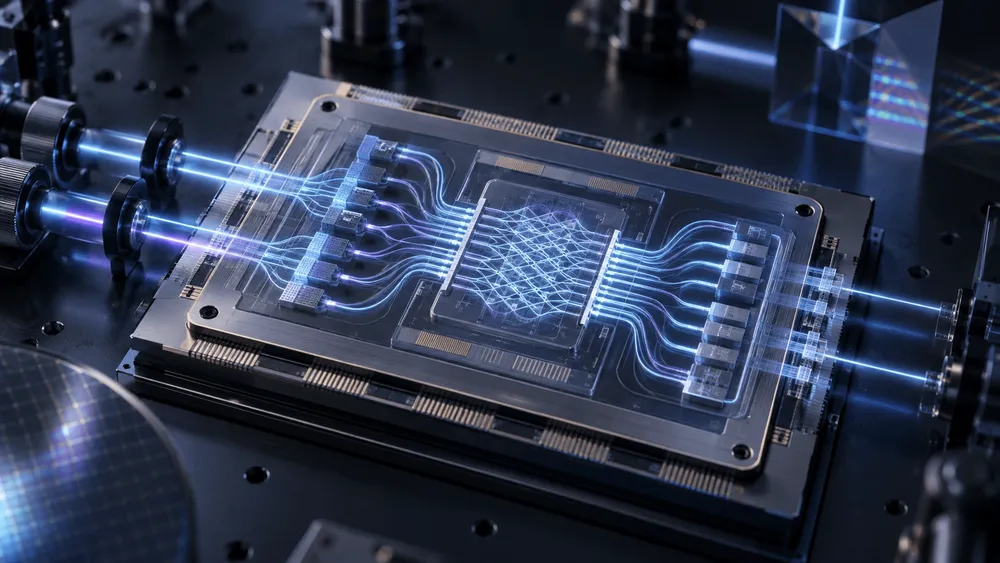
On September 30, 2026, Q/C Technologies announced a research collaboration with the Center for Integrated Nanotechnologies (CINT) at Sandia National Laboratories in the United States.
The work targets an optical processing unit (OPU) for inference, the stage at which a trained AI model processes new inputs. The company's concept uses optical interference for computation, and the collaboration will study nanophotonic components and how they might be combined into a processor.
However, what was announced is a research plan. No measurement results demonstrating processing speed or power efficiency superior to GPUs were presented.
The focus of the collaboration is how to turn the principle of optical computing into a device that can actually handle AI inference.
A research plan, not proof of outperforming GPUs
On March 18, 2026, Q/C announced an initiative to design and prototype its own OPU.
At that time, the company described early-stage development efforts such as recruiting specialist engineers, filing patents, and verifying basic computational functions.
In the new collaboration, Q/C and CINT will select candidate optical computing and device technologies and consider development priorities and future direction. A specific research partner has now been added to the study of the components and systems needed to realize the OPU. The March announcement of the initiative
In its September 30 announcement, Q/C Technologies lists nonlinear operations, memory, computational precision, optical loss, and integration with electronic circuits as research challenges.
On the other hand, it does not disclose the AI models used for evaluation, inference speed, power consumption, or results of comparisons with GPUs under identical conditions.
The table below sets the research topics named in the announcement against the information needed to assess actual performance.
| Research topics named in the announcement | Evaluation information not provided in the announcement |
|---|---|
| Nonlinear operations and memory | The specific method adopted, the AI models run, evaluation data |
| Computational precision | The number of bits used in computation, inference error or accuracy |
| Optical loss | Measurement conditions of prototype devices, specific loss figures |
| Integration with electronic circuits | Inference speed including input/output, power consumption of the whole device, the GPU used for comparison |
This table organizes what was disclosed in the September 30 announcement alongside the information needed for a performance comparison.
The absence of this information from the announcement does not mean we can conclude that no internal testing has been done.
However, without results from running the same AI model under the same conditions, it is not possible to assess how much of an advantage the OPU has over existing GPUs.
What has been released is a company press release. No peer-reviewed paper or preprint reporting the results of this collaboration has been presented.
No results from physical experiments or simulations have been published, and the number of prototype devices built and the scale of the AI models to be evaluated are unknown.
There has also been no independent replication, so at this point it is not possible to quantitatively assess how much faster or more power-efficient optical computing could be than GPUs.
Computing with light does not by itself make an AI inference device
Q/C is aiming to use interference, the effect that occurs when light waves overlap, for computation.
It exploits the way light waves reinforce or cancel one another to process, optically, the matrix operations used extensively in AI.
Matrix operations can be thought of as repeating a huge number of steps in which input values are multiplied by weights and the results are summed.
In its March announcement, Q/C described a concept in which the propagation of light itself carries out part of this computation.
However, the time it takes for an operation to finish inside an optical circuit is not the same as the time it takes for an AI system to receive an input and return a final answer.
If electronic data is converted into optical signals, processed in an optical circuit, and then read out again as electrical signals, the time required for that conversion and data transfer must also be included in the evaluation.
A useful guide to these issues is the perspective paper "Is Computing with Light All You Need?" by Prasad P. Iyer and colleagues at Sandia.
It was published in the peer-reviewed journal Advanced Intelligent Systems, with the online version released on August 8, 2025. The DOI is 10.1002/aisy.202500371.
The paper mainly deals with approaches in which light propagates through free space, and it is not a study evaluating Q/C's OPU itself. The paper by Iyer et al.
The authors argue that materials, optical elements, device architecture, and algorithms must be optimized together as a whole.
This is because it is not necessarily possible to simply replace each operation of a neural network running on electronic circuits with optical components.
For example, neural networks require "nonlinear processing" between layers.
However, with weak light the nonlinear effects generated in a material can be small, and simply stacking optical layers may not reproduce the same processing as a neural network built from electronic circuits.
The characteristics of the components that detect light and convert it to electrical signals also affect computational results and performance.
Q/C's decision to include not only nonlinear operations but also memory and integration with electronic circuits among its research topics appears to reflect an aim of going beyond individual optical operations to develop a practical inference device.
However, the specific materials and circuit approaches it will adopt have not been announced.
It therefore cannot be assumed that Q/C will adopt the configurations described in the paper by Iyer and colleagues as they are.
Chief Technology Officer Yossef Ehrlichman also describes the collaboration as an effort toward future development rather than a finished product.
"Through our work with CINT, we believe we can define a path from fundamental optical functions to an integrated OPU architecture."
This states the outcome Q/C hopes for from the collaboration; it does not mean the OPU has already been completed.
What can the collaboration with CINT achieve?
CINT is a U.S. Department of Energy (DOE) nanotechnology research facility jointly operated by Sandia National Laboratories and Los Alamos National Laboratory.
According to DOE's description of CINT, it conducts research on integrating nanoscale materials and structures into larger devices and systems.
Its strengths include research on controlling light at the nanoscale, along with the ability to combine materials fabrication and characterization, theoretical calculation, and simulation.
Even if the principle of optical computing holds, a processor design cannot be settled without confirming that the necessary components can actually be manufactured and connected to other optical components and electronic circuits.
The nanophotonic component research Q/C has announced overlaps with these CINT research areas.
What matters is not the Sandia National Laboratories name itself, but under what conditions the components needed for the OPU can be prototyped and evaluated, and whether they can be integrated into a complete device.
CINT's user program also has conditions that apply to it as a research facility.
According to CINT's official guidance, for research whose results will be published, there is a mechanism that allows free use of facilities and equipment on the condition that the results are made public.
For proprietary research whose results are kept confidential, users bear the cost of using the facility.
Even for published research, CINT does not cover the labor costs, travel expenses, and other costs needed for users' own research.
However, Q/C's announcement does not explain which user program applies, or what kind of agreement was reached regarding fees or publication of results.
CINT's general terms of use cannot simply be applied as they are to Q/C's collaboration.
Having access to a research facility, being able to build prototype devices, and demonstrating high performance in a finished processor are separate stages.
Next: AI inference comparisons with GPUs under matched conditions
For Q/C to move from component research to practical use, what will matter are concrete measurement results: which AI model was run, at what computational precision, and at what speed and power consumption.
For example, even if an "inference speed" is published, its meaning changes greatly depending on whether the value measures only the optical computation or includes conversion from electronic to optical signals, data transfer, and readout of results.
For power consumption as well, a fair comparison with existing electronic processors such as GPUs is impossible unless the same scope is measured.
Beyond speed and power consumption, the accuracy of the results the AI produces must also be considered.
In optical computing, even if lowering computational precision enables higher speed or lower power, a large drop in AI model accuracy as a result would reduce the benefit for some uses.
If the same AI model and evaluation data are used, compared with GPUs and others under the same conditions, and processing speed, power consumption, and inference accuracy are shown, and if measurement conditions that third parties can reproduce are published, it will become possible to judge more concretely which parts of AI inference optical computing can speed up or make more power-efficient, and by how much.