

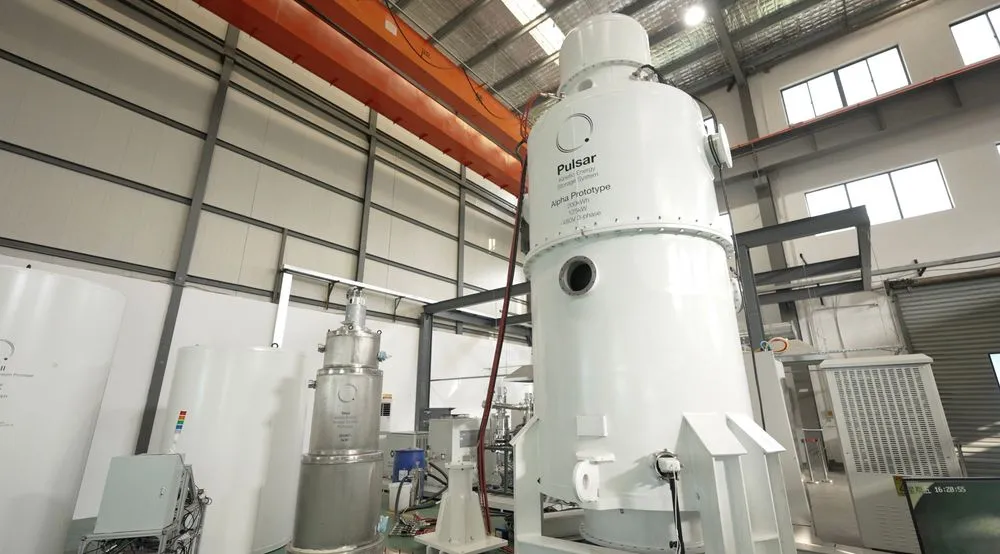
US-based Qnetic announced on September 21, 2026, that it has begun low-speed integrated testing of its flywheel energy storage prototype, Pulsar, designed with a storage capacity of 200kWh. The company has moved into a phase where it operates the assembled prototype to verify that the control system, safety equipment, and power conversion equipment all work together properly.
However, this announcement does not mean the system has actually charged and discharged 200kWh of electricity. The 100-cycle charge-discharge test the company disclosed and a separate motor performance test it conducted are confirmations of different aspects of Pulsar's path toward practical deployment.
What the 200kWh figure alone doesn't tell us
According to Qnetic, Pulsar completed 100 consecutive charge-discharge cycles at low speed without any failures or observed capacity degradation. The significance lies in the progression from verifying individual components to operating multiple systems together.
This matters because the mechanism supporting the rotating mass, the equipment that moves power in and out, and the control system that monitors for abnormalities may each function fine on their own, yet vibration, heat generation, or control delays can emerge once they are combined.
That said, the company has not disclosed how many kWh were charged and discharged in each of the 100 cycles, how long each cycle took, or at what power level the test was conducted. The finding of "no capacity degradation" is merely an early observation under this particular test's conditions. It cannot be treated as equivalent to a test that fully exercised the 200kWh design capacity, nor as a durability test representing years of operation.
The other performance figure comes from a separately tested motor. Qnetic reported an output of 130kW, motor efficiency of 97.3%, and a maximum rotational speed of 11,010 rpm.
This reflects the performance of the motor alone in converting electrical energy into rotational energy. The 97.3% efficiency figure does not include losses that occur elsewhere in the overall storage system.
The "round-trip efficiency"—which indicates what percentage of the electricity put in during charging can be recovered during discharging, accounting for the power converter, bearings, and standby power consumption—has not yet been disclosed. Likewise, the 130kW figure is a result from testing the motor in isolation; it does not demonstrate that Pulsar can sustain a continuous discharge of 130kW.
Qnetic outlined its test plan using a temporary steel rotor on September 12, disclosed the motor-only test results on September 15, and announced the low-speed integrated test on September 21. What these results confirm so far is limited to assembly and basic operation at low speeds. Actual discharge of 200kWh, the round-trip efficiency of the full system, standby losses, and safety at high rotational speeds all remain to be verified in future testing.
Why a temporary steel rotor is being used
There is another important condition in the test plan Qnetic described on September 12. The company is proceeding with assembly and initial low-speed testing using a temporary steel rotor matched in dimensions and mass properties to the carbon-fiber rotor intended for the final product. At the time, the carbon-fiber rotor was still being manufactured.
While the September 21 announcement refers to Pulsar as the "first full-scale prototype," this does not mean it has been run up to rated conditions using the final rotor specification.
By matching the dimensions and mass properties of the temporary rotor to those of the final unit, the mechanism supporting the rotating mass, the housing, and the control system can be tested under conditions close to those of the finished product. However, steel and carbon fiber differ in the stress they can withstand at high rotational speeds and in how they behave if damaged—these are not equivalent between the two materials.
In other words, this round of testing can reduce uncertainty around assembly and system integration at low speeds, but it does not yet confirm the performance and safety of high-speed operation using the final material composition.
Using a temporary rotor allows engineers to study early on how the rotating mass behaves inside the device. It enables checks on assembly precision, rotational balance deviations, and the responsiveness of bearings and control systems, so that any issues can be corrected before speed is increased. This is why Qnetic is raising operating conditions incrementally, starting from low speed.
The energy stored in a flywheel is proportional to the moment of inertia of the rotating mass and the square of its rotational speed. For the same rotating mass, energy storage increases sharply as rotational speed rises.
At the same time, the load on the material also increases, and in the event of failure, a greater amount of rotational energy would need to be safely contained. Low-speed testing with a temporary steel rotor can serve as evidence for confirming control and overall system integration, but it does not prove the strength or safety of high-speed operation using the carbon-fiber rotor.
How the device behaves while actually storing energy close to the 200kWh level will be confirmed in future testing.
What sets this apart from existing flywheels
The idea of using flywheels as grid-scale energy storage equipment is not new in itself.
In a facility from Beacon Power introduced by the US Department of Energy, the Gen4 flywheel is designed for 25kWh and 100kW output per unit, with a configuration combining 200 units to operate as a 20MW frequency regulation facility.
Frequency regulation refers to the application of rapidly charging and discharging power in response to small mismatches between electricity supply and demand.
According to the Department of Energy's materials, Beacon's equipment is designed to withstand more than 150,000 full charge-discharge cycles and to allow the mechanical components to be used for more than 20 years.
Of course, this figure does not indicate Pulsar's lifespan. Still, it shows that when evaluating the practicality of an energy storage technology, simply asking "did capacity hold up over the first 100 cycles" is not enough. It is necessary to determine how deep the charge-discharge cycles are, how many times they can be repeated, and whether the system, including maintenance, can be used stably over a long period.
Pulsar's designed capacity of 200kWh is eight times greater than Beacon Gen4's 25kWh per unit. However, this is merely a comparison between design values, and it does not mean Pulsar has actually demonstrated the ability to charge and discharge 200kWh.
In Beacon's case, relatively small-capacity flywheels are combined in large numbers to achieve high output. Pulsar, on the other hand, is attempting to increase the storage capacity per unit up to 200kWh.
Whether this difference translates into a longer duration of power supply can only be determined once the usable storage capacity and continuous output are actually measured in a prototype.
Here, "capacity" and "output" need to be considered separately. kWh represents the amount of electrical energy that can be stored or drawn out, while kW represents how much power can be delivered at a given moment.
How long power can be supplied is determined by both the usable capacity and the output that can be sustained continuously. Simply dividing Pulsar's designed capacity of 200kWh by the 130kW motor output obtained in a separate test cannot yield the actual continuous discharge time of the finished system.
This, along with how the extractable energy and output change as rotational speed decreases, needs to be measured on the completed system as a whole.
What independent evaluation will scrutinize: usable power and losses
Qnetic states that it is participating in the Electric Power Research Institute (EPRI)'s "deRISKED" program, and is proceeding with evaluation with support from the Sacramento Municipal Utility District (SMUD).
The plan is to provide prototype test data to EPRI starting in fall 2026, followed by sharing field test data as well. According to EPRI's materials, deRISKED is an initiative that evaluates the performance, safety, and reliability of pre-commercial energy storage technologies based on laboratory and field test data.
However, the announcement of program participation is separate from EPRI having already certified Pulsar's performance.
SMUD's support for the evaluation also establishes a framework in which an actual utility is involved in testing and assessment. However, this does not mean that deployment at SMUD or commercial operation has been decided. It also remains unclear at this point to what extent the data and evaluation results provided to EPRI will be made public.
For a utility to actually decide on adoption, it would need to confirm how many kWh can actually be extracted when the final carbon-fiber rotor specification is spun up to rated speed. How long the rated output can be sustained is also important.
Furthermore, in addition to the round-trip efficiency from charging to discharging, the power consumed during standby and the energy lost over a given period of time need to be measured separately.
This is because the performance metrics that matter most differ between applications involving frequent, short charge-discharge cycles and applications that hold and supply energy over several hours.
A flywheel stores the electrical energy it receives as rotational energy rather than through a chemical reaction. However, losses accumulate the longer it sits idle.
Evaluation must also account for the power required by the equipment supporting the rotating mass, the systems maintaining a vacuum, and the control systems. While a flywheel may excel at instantaneous charging and discharging, the suitable application depends on how much energy it can retain hours later.
Safety and cost are also important evaluation criteria. If something goes wrong with a rotor carrying large amounts of rotational energy, how do the protective devices and outer casing respond? Taking into account maintenance costs for bearings and vacuum systems over the long term, which applications can actually compete with existing energy storage technologies?
This round of 100-cycle low-speed testing marks a first step toward rigorously verifying these kinds of performance characteristics. If testing with the final rotor specification reveals the actual storage capacity and losses, and if similar performance is subsequently confirmed through EPRI's evaluation and field operation, it will become possible to make a concrete determination as to whether Pulsar can be used not only for high-frequency charge-discharge applications like frequency regulation, but also for longer-duration energy storage applications.